

Douglas Tavares: How Do We Get More People To Donate?
Douglas Tavares, Adjunct Professor of Business at Florida Southern College, shared a post on LinkedIn:
“We’ve been asking the same question every time a blood shortage makes the headlines: ‘How do we get more people to donate?’
It’s an important question—but perhaps it’s no longer the most important one.
After the second National Blood Supply Crisis in less than five years, it’s time to ask a different question:
What if the real solution isn’t only increasing supply, but also reducing unnecessary demand?
In this article, I explore why our current approach has failed to solve the problem and why Patient Blood Management, Bloodless programs, modern pharmaceuticals, and blood-preservation technologies may be the paradigm shift healthcare needs.
I would love to hear your thoughts—especially from clinicians, hospital leaders, and healthcare policymakers.
Beyond the Red Crisis: American Red Cross Declares Second-Ever National Blood Supply Crisis in less than Five Years!
When news broke that the American Red Cross declared a National Blood Supply Crisis—the second in less than five years—the immediate reaction for most people was straightforward: What can we do to stop this?
It is a valid question. The fact that a full-blown national crisis alternated with multiple Emergency Blood Shortage alerts in such a short window proves one thing: the current strategy, by itself, isn’t enough.
Despite continuous awareness campaigns and urgent calls to action, blood donations rose by a modest 3%—a rate far too low to stabilize a fragile system.
Understanding the Hierarchy of Shortages
To grasp the severity of the problem, it helps to understand how the American Red Cross classifies these events:
- Emergency Blood Shortage Alert: Issued when local or national inventory drops below a 1–2 day supply.
- National Blood Supply Crisis: The most critical, severe alert level, where supplies are so depleted that hospital blood distributions are actively rationed or restricted.
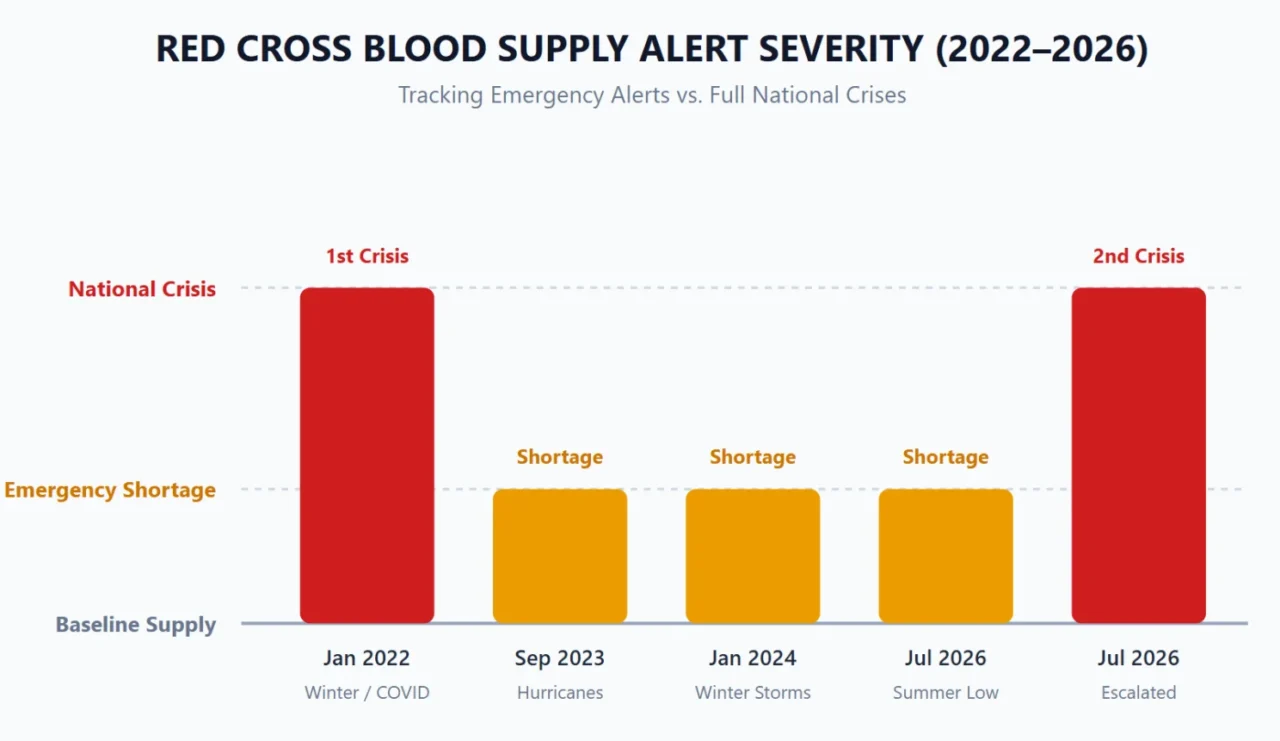
Looking ahead, optimism is hard to justify if we rely solely on traditional methods. While increasing life expectancy is a triumph of modern medicine, an aging population also narrows the eligible donor pool due to age-related criteria.
Concurrently, climate change—manifesting as extreme heat waves, brutal winter storms, and severe hurricanes—frequently shuts down mobile donation drives and restricts mobility for both blood banks and donors.
The writing is on the wall: efforts focused solely on increasing supply are failing to meet the demand.
Shift the Paradigm: The Clinical Solution
If we cannot continuously increase the supply, what can be done from the clinical side to reduce demand? How do we minimize unnecessary blood transfusions and reduce our reliance on donor blood products?
The answer lies in a strategy backed by over 30 years of scientific research. A comprehensive clinical ecosystem already exists—spanning pharmaceutical interventions, advanced medical devices, and specialized surgical techniques designed to preserve a patient’s own blood.
This approach creates a win-win scenario across the board:
- For Patients: Improved surgical outcomes, fewer complications, and faster recoveries.
- For Healthcare Systems: Significant reductions in medical waste, shorter hospital stays, and lower operational costs.
- For Public Health: Reduced strain on fragile blood banks and long-term cost savings for public health programs.
The Three Pillars of Blood Avoidance and Preservation
Minimizing transfusions isn’t wishful thinking; it is a structured discipline built on three key pillars:
1. Clinical and Medical Programs
Two primary methodologies lead the way: Patient Blood Management (PBM) and Bloodless Medicine and Surgery (BMS). Both rely on evidence-based protocols to optimize a patient’s own blood volume and minimize loss, treating blood transfusion as a last resort rather than a default.
Professional societies around the globe are advocating for these standards, including SABM (USA), AABB (USA), BMSS (Africa), NATA (Europe), IFPBM, ISBT, SIAPBM (LATAM), and ABHH (Brazil).
Recognizing its global importance, the World Health Organization (WHO) urged nations to implement PBM as a global standard of care in its landmark 2021 Policy Brief, following up with explicit implementation guidance in 2024.
2. Advanced Pharmaceuticals
Pharmaceutical research has provided clinicians with effective tools to manage blood volume proactively:
- Topical Hemostatics: Agents that accelerate local clot formation during surgery.
- Erythropoiesis-Stimulating Agents (ESAs): Medications that prompt the body to produce its own red blood cells naturally.
- Antifibrinolytics and Coagulation Factors: Targeted drugs that halt active bleeding and optimize the body’s natural clotting cascade.
3. Innovative Medical Devices and Technology
Modern operating rooms are equipped with technologies designed to conserve every drop of blood:
- Cell Salvage Equipment: Autotransfusion devices that collect, wash, and return a patient’s lost blood back into their system during surgery in real time.
- Advanced Electrocautery and Minimally Invasive Tools: Technologies that shrink surgical incisions and seal blood vessels instantly, preventing major blood loss from occurring.
- Point-of-Care (POC) Testing: Diagnostic tools that allow surgical teams to identify coagulation issues immediately and treat them targeted.
The Hidden Cost of Transfusions: Beneath the Iceberg
The public sees the national headline—a blood shortage. However, beneath the surface lies a massive financial and physiological burden on healthcare systems.
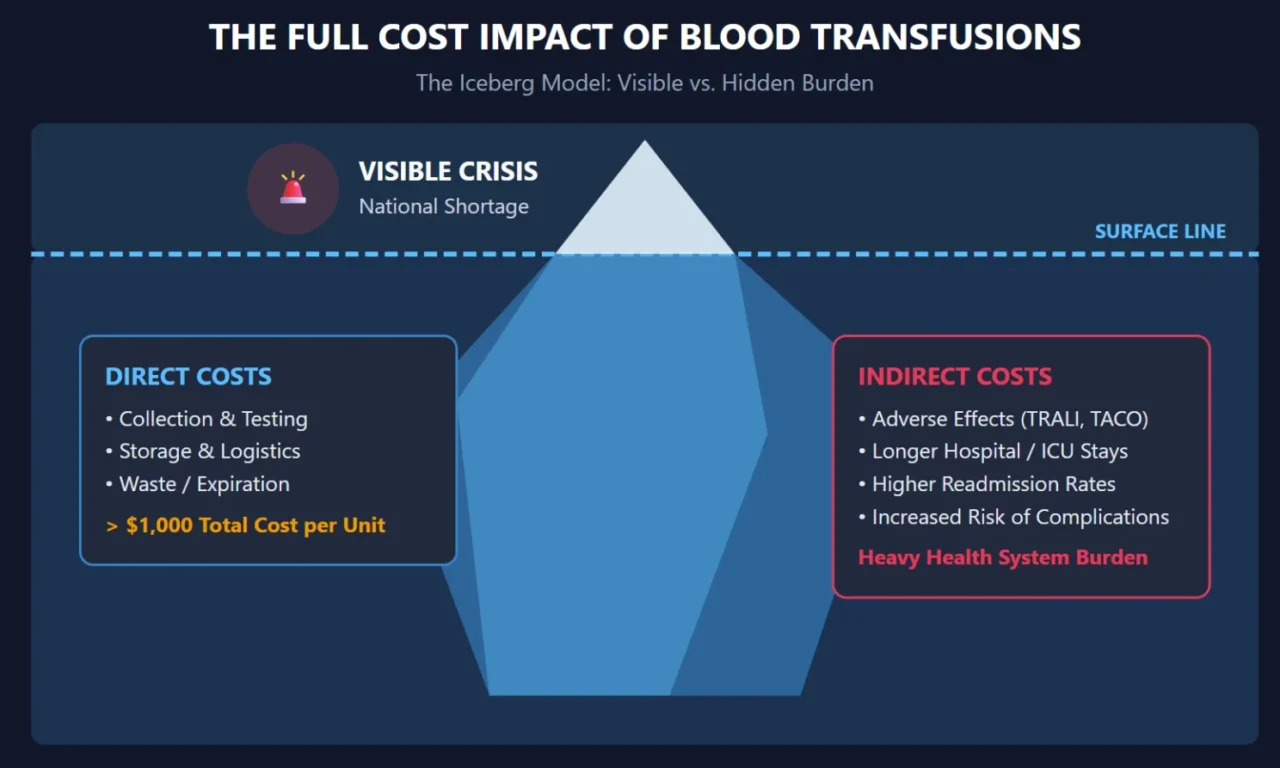
- Direct Costs: Collecting, testing, processing, storing, and transporting donor blood involves immense logistical overhead. Combined with product loss due to short shelf lives, studies estimate the true cost of managing a single unit of blood can exceed $1,000 USD.
- Indirect Costs: Transfusions carry inherent clinical risks, such as Transfusion-Related Acute Lung Injury (TRALI), Transfusion-Associated Circulatory Overload (TACO), elevated infection risks, longer ICU stays, higher readmission rates, and worse long-term outcomes.
A Call for a Mindset Pivot
Albert Einstein famously defined insanity as doing the same thing over and over again and expecting different results.
Relying solely on altruistic blood donors to solve a structural systemic issue will leave us trapped in a perpetual cycle of shortages. We cannot simply ask the public to donate more while clinical settings continue to treat donor blood as a primary resource rather than a precious, high-risk intervention.
This is more than an operational issue—it is an ethical imperative. Patients deserve the safest, most effective, evidence-based care available. Shifting to Patient Blood Management isn’t just about surviving the next national shortage; it’s about providing superior healthcare.
It is time to view the blood crisis through a new lens.
By deploying the medical tools, pharmaceuticals, and protocols already at our disposal, we can protect our healthcare system from future shortages, save billions in unnecessary expenditures, and most importantly, deliver better outcomes for patients worldwide.”
Stay updated with Hemostasis Today.
-
Sep 19, 2026, 00:48Mahmoud Mehawed: Heparin vs Warfarin vs DOACs Understanding the Key Differences
-
Sep 18, 2026, 17:48Ronak H. Mistry: Updated ASH Guidelines Bring New Focus to Iron Deficiency
-
Sep 18, 2026, 17:32Hassan Kawtharany: New Ferritin Cutoffs for the Diagnosis of Iron Deficiency With or Without Anemia
-
Sep 18, 2026, 17:20Abhishek G P: GAVE as an Important Cause of Chronic Gastrointestinal Blood Loss
-
Sep 18, 2026, 17:08Irem Karaman Sebin: ASH 2026 Changes a Key Concept in Iron Deficiency
-
Sep 18, 2026, 16:51Adarsh Krishnan Sundara Rajan: Is VTE the Most Underdiagnosed Critical Threat in Modern Healthcare?
-
Sep 18, 2026, 16:19CRISPR and Hemophilia: The Next Frontier of In Vivo Gene Editing
-
Sep 18, 2026, 16:13Christian Irsara: PF4 Immunothrombosis Following Natural Adenovirus Infection
-
Sep 18, 2026, 16:10Leo Nicolai։ The Spleen Emerges as a Key Regulator of Thromboinflammation