


Saleh Shamse Basha: Severe Neonatal Anemia – When the Analyzer Tells a Story Before the Slide Does
Saleh Shamse Basha, Senior Hematology Technologist (Reference Lab, HQ) at PureLab, shared a post on LinkedIn:
“Case Discussion: Severe Neonatal Anemia – When the Analyzer Tells a Story Before the Slide Does
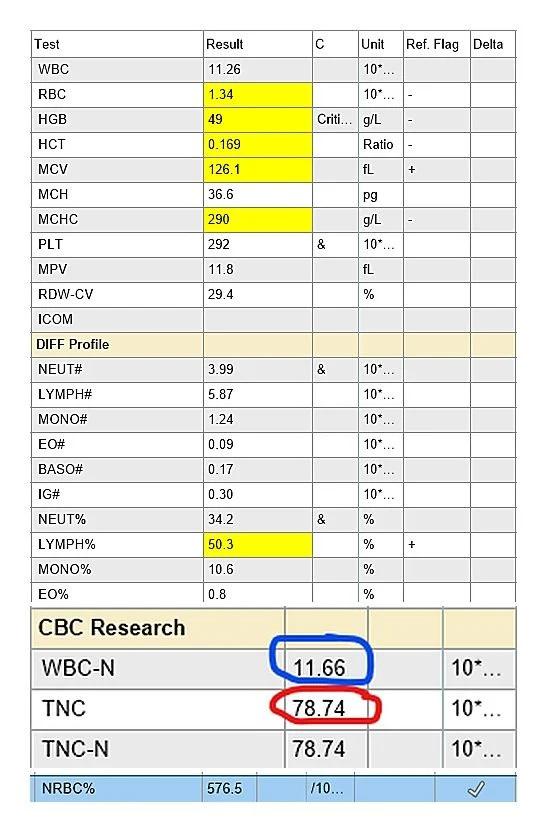
A newborn presented with Hb: 49 g/L, a critical value that immediately raises the question: hemolysis or hemorrhage?
Analyzer Findings (Sysmex XR-9000)
By looking at the WDF and WNR scattergrams, I felt something unusual – more striking than the critically low hemoglobin itself.
- TNC (Total Nucleated Cell): 78.74
- WBC: 11.26
- NRBC : 576/100 WBC
- Reticulocytes: 14%
The WNR channel is where the story begins.
It uses a lysing reagent that strips RBC and reticulocyte membranes but leaves NRBC nuclei intact, so both WBCs and NRBCs are counted together as the Total Nucleated Cell (TNC) count.
A related but separate issue appears on the WDF scattergram: immature NRBCs have larger nuclei that fall close to the WBC populations, sometimes overlapping the lymphocyte region and triggering a “WBC Abnormal Scattergram” flag.
When this happens, manual slide review and a true differential are essential in cases with marked NRBCs. The manual differential was very close to the analyzer count.
Blood Film
Marked anisopoikilocytosis with an elevated MCV, consistent with reticulocytosis.
Occasional target cells and schistocytes were also noted.
DAT: Negative, ruling out alloimmune hemolytic disease of the newborn.
Clinical History
Documented feto-maternal hemorrhage (FMH).
Interpretation
Putting it all together: severe anemia accompanied by reticulocytosis, marked NRBCs, a negative DAT, and a clinical history of feto-maternal hemorrhage is most consistent with acute or chronic blood loss anemia in the neonate secondary to massive FMH, rather than immune hemolysis.
The marrow response, evidenced by reticulocytosis together with marked NRBCs, is compensatory rather than causative.”
Stay updated with Hemostasis Today.
-
Sep 20, 2026, 09:51Ceasovschih Alexandr: A Closer Look at Lipid Disorders in CKM Syndrome
-
Sep 20, 2026, 09:05World Stroke Academy: Can Adjunct IAT Improve Tissue Reperfusion?
-
Sep 20, 2026, 06:46Neeraj Songara: From Donated Blood to Engineered Therapeutics
-
Sep 20, 2026, 06:24Louise St. Germain Bannon: Improving Awareness and Care for Women Across the Lifespan
-
Sep 20, 2026, 05:17Maxime Dely: When ABO Compatibility Isn’t Enough for Safe Transfusion
-
Sep 20, 2026, 04:54William Aird: What Does a Complete History and Physical Really Mean?
-
Sep 20, 2026, 04:34Hons Saurabh Kaushik: Why Uncontrolled LDL Can Be Harmful
-
Sep 20, 2026, 03:58Salih Ehsan: The Complexities of HbF and HbA2
-
Sep 20, 2026, 03:22The Voices of People Living With Bleeding Disorders – EHC