


Filippo Cademartiri: Treating Atherosclerosis Rather Than Its Probability
Filippo Cademartiri, Consultant Advanced Cardiovascular Imaging at UPMC Salvator Mundi International Hospital, shared a post on X about a recent article by Eugenia Gianos et al, published in Journal of Clinical Lipidology, adding:
“We’ve Spent Decades Predicting Risk. Maybe It’s Time to Start Seeing Disease.
For years, preventive cardiology has debated two competing philosophies:
Treat based on risk factors.
Or…
Treat based on imaging.
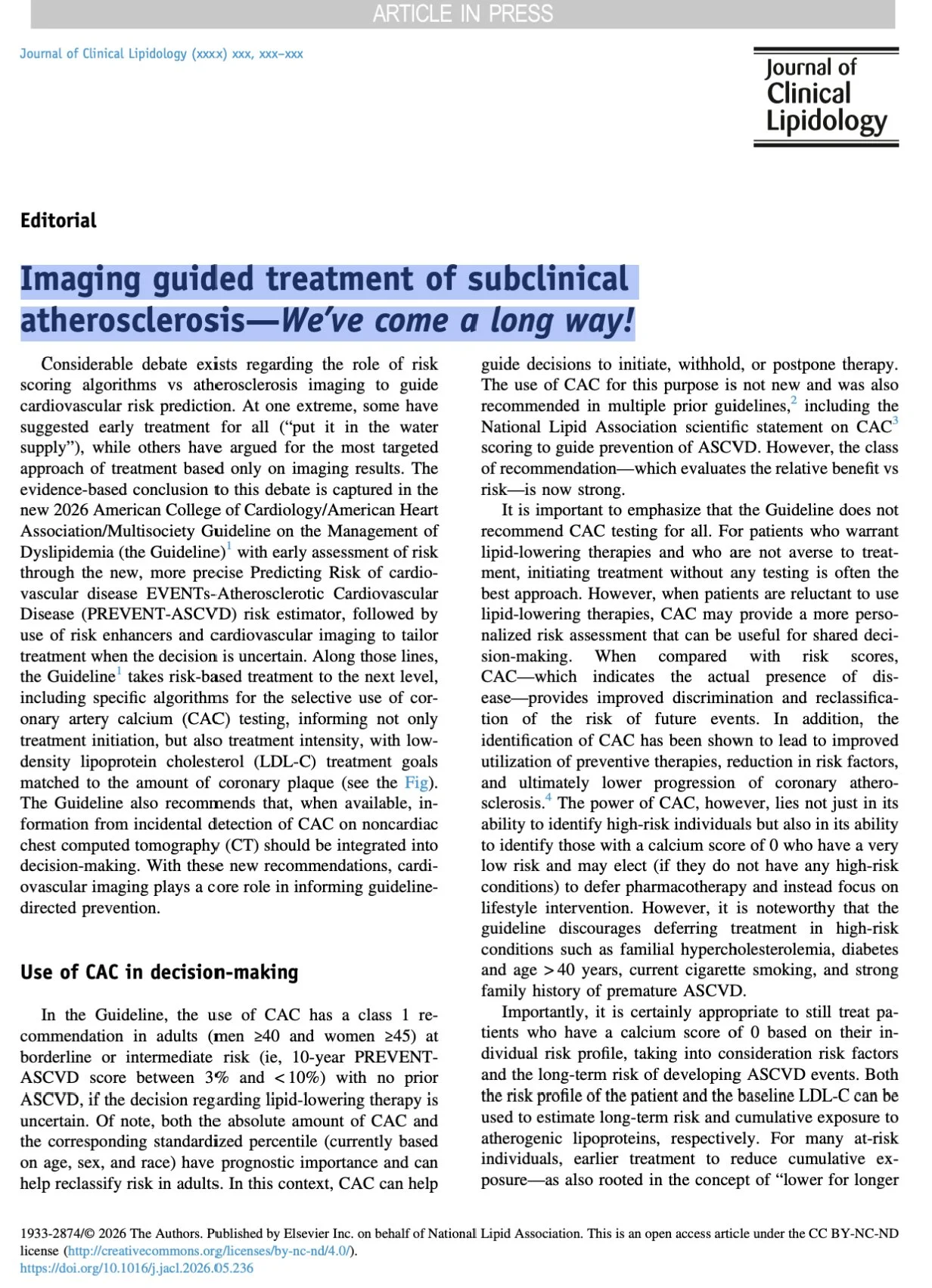
This editorial argues that the new 2026 ACC/AHA Dyslipidemia Guideline may finally bring the two together. Imaging guided treatment of subclinical atherosclerosis—We’ve come a long way!.pdf
The proposed strategy is simple:
Estimate risk with PREVENT-ASCVD.
Refine uncertainty using risk enhancers.
Then, when needed, look directly for subclinical atherosclerosis with coronary imaging. Imaging guided treatment of subclinical atherosclerosis—We’ve come a long way!.pdf
The Critical Point
The most important message isn’t that CAC has become more prominent.
It’s why.
CAC is no longer viewed simply as another risk marker.
It is a marker of actual disease.
The guideline goes even further, recommending treatment intensity according to plaque burden, incorporating incidental CAC from routine chest CT, and introducing a selective role for CCTA in patients likely to harbor substantial non-calcified plaque.
The figure in the editorial illustrates this shift beautifully: LDL-C targets are no longer driven solely by estimated risk, but increasingly by the amount of coronary atherosclerosis already present. Imaging guided treatment of subclinical atherosclerosis—We’ve come a long way!.pdf
My Take
This is exactly the evolution many of us have been waiting for.
For decades we’ve treated the probability of disease.
We’re now beginning to treat the disease itself.
That doesn’t mean abandoning risk scores.
It means recognizing that wide areas of UNCERTAINTY exists, biology should trump probability.
Where PCCT Fits
Today’s guideline uses CAC as the gateway to imaging-guided prevention.
Tomorrow, I believe that gateway will become plaque-guided prevention.
Photon-Counting CT has the potential to move beyond calcium alone by providing a more complete assessment of plaque burden, composition, and biology.
Perhaps the next revolution in prevention won’t come from a better risk equation.
It will come from seeing atherosclerosis earlier, more completely, and more biologically.
Treat the plaque. Not just the predicted risk.”
Title: Imaging guided treatment of subclinical atherosclerosis—We’ve come a long way!
Authors: Eugenia Gianos, Ron Blankstein

Stay updated on all scientific advances with Hemostasis Today.
-
Sep 22, 2026, 08:06Tim Brümmendorf: Exciting Sessions Ahead at ESHBMFS2026
-
Sep 22, 2026, 08:05Samin Mohsenian: Can Factor VII Activity Predict Bleeding Severity?
-
Sep 22, 2026, 07:59Cesar de Almeida Neto: Jehovah’s Witnesses Update Their Position on Blood Components
-
Sep 22, 2026, 07:39Better Trials and Better Treatments Through Greater Inclusion – American Society of Hematology
-
Sep 22, 2026, 07:18X. Long Zheng: From ADAMTS13 to New TTP Treatment
-
Sep 22, 2026, 07:11Platelet Dependent Protection Against Bacterial Pneumonia – JTH
-
Sep 22, 2026, 07:10Sumita Pandey: Apheresis Beyond Automation
-
Sep 22, 2026, 07:04Wafik El-Deiry: Type 1 interferon Alters Clonal Competition in Human Blood Development
-
Sep 22, 2026, 06:53Tania L.: Women in Hematology Take the Stage in Austin