


Denis Oduor: Patient Blood Management and Systemic Transfusion Reform
Denis Oduor, Nairobi County Blood Services Coordinator at Nairobi City County, shared a post on LinkedIn:
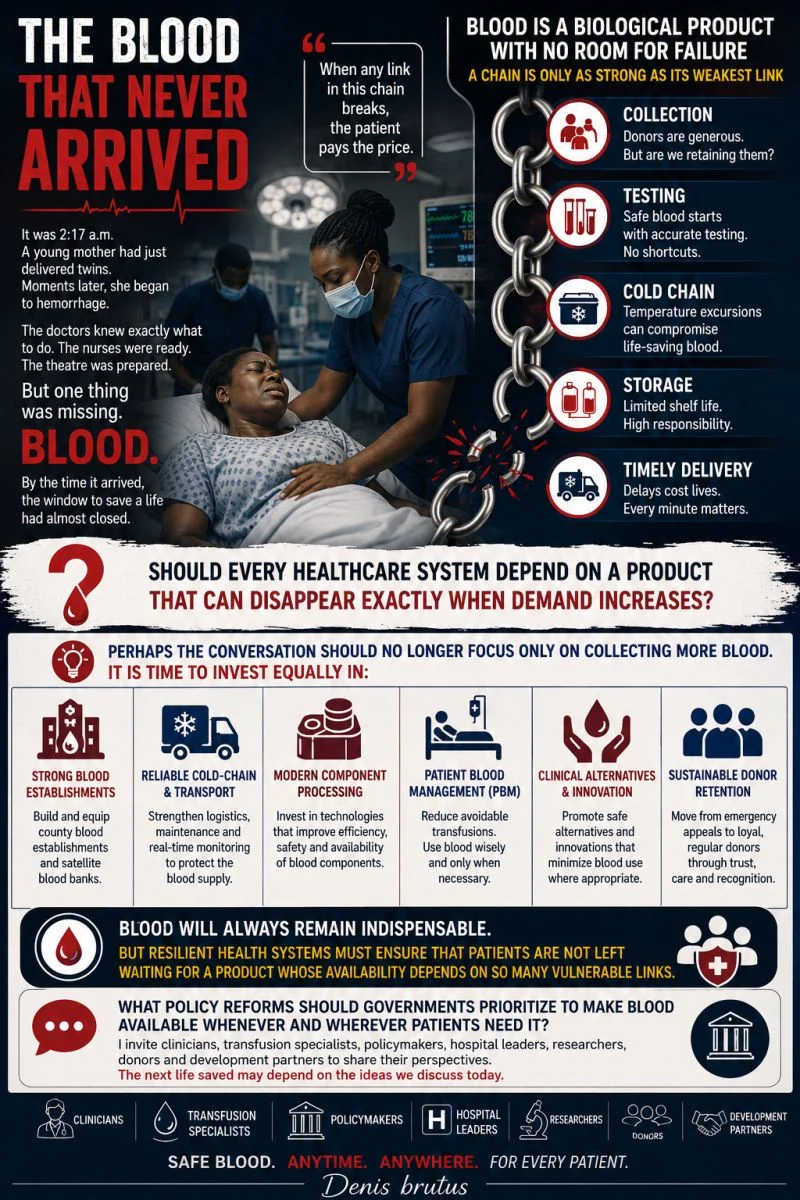
“The Blood That Never Arrived
It was 2:17 a.m.
A young mother had just delivered twins. Moments later, she began to hemorrhage.
The doctors knew exactly what to do. The nurses were ready. The operating theatre was prepared.
But one thing was missing.
Blood.
Not because no one wanted to donate.
Not because the clinicians delayed.
Not because the science failed.
The nearest blood unit was hours away.
The cold chain had been interrupted. Testing had to be completed elsewhere. Transport was delayed. By the time compatible blood arrived, the opportunity to save a life had narrowed dramatically.
Blood is unlike any other medical product.
It cannot be manufactured in a factory.
It cannot be ordered overnight.
It depends on generous donors, sophisticated testing, uninterrupted cold-chain systems, skilled personnel, reliable transport, and functioning blood establishments.
When any link in this chain breaks, the patient pays the price.
This raises an uncomfortable but necessary question:
Should every healthcare system continue depending on a biological product that can become unavailable precisely when emergencies increase?
Perhaps the conversation should no longer focus only on collecting more blood.
Perhaps it is time to invest equally in:
- Strong county blood establishments and satellite blood banks.
- Reliable cold-chain and transport logistics.
- Modern component processing technologies.
- Patient Blood Management (PBM) to reduce avoidable transfusions.
- Alternatives that minimize blood use where clinically appropriate.
- Sustainable donor retention rather than emergency donor appeals.
Blood will always remain indispensable. But resilient health systems should ensure that patients are not left waiting for a product whose availability depends on so many vulnerable links.
What policy reforms should governments prioritize to make blood available whenever and wherever patients need it?
I invite clinicians, transfusion specialists, policymakers, hospital leaders, researchers, donors, and development partners to share their perspectives. The next life saved may depend on the ideas we discuss today.”
Stay updated with Hemostasis Today.
-
Sep 20, 2026, 09:51Ceasovschih Alexandr: A Closer Look at Lipid Disorders in CKM Syndrome
-
Sep 20, 2026, 09:05World Stroke Academy: Can Adjunct IAT Improve Tissue Reperfusion?
-
Sep 20, 2026, 06:46Neeraj Songara: From Donated Blood to Engineered Therapeutics
-
Sep 20, 2026, 06:24Louise St. Germain Bannon: Improving Awareness and Care for Women Across the Lifespan
-
Sep 20, 2026, 05:17Maxime Dely: When ABO Compatibility Isn’t Enough for Safe Transfusion
-
Sep 20, 2026, 04:54William Aird: What Does a Complete History and Physical Really Mean?
-
Sep 20, 2026, 04:34Hons Saurabh Kaushik: Why Uncontrolled LDL Can Be Harmful
-
Sep 20, 2026, 03:58Salih Ehsan: The Complexities of HbF and HbA2
-
Sep 20, 2026, 03:22The Voices of People Living With Bleeding Disorders – EHC