


William Wallace: Is Your Cholesterol Test Missing Your Biggest Inherited Risk?
William Wallace, Co-Founder and CSO of Supplement Success Solutions, shared a post on LinkedIn:
”Your cholesterol test is missing a particle that may matter more than the one it measures.
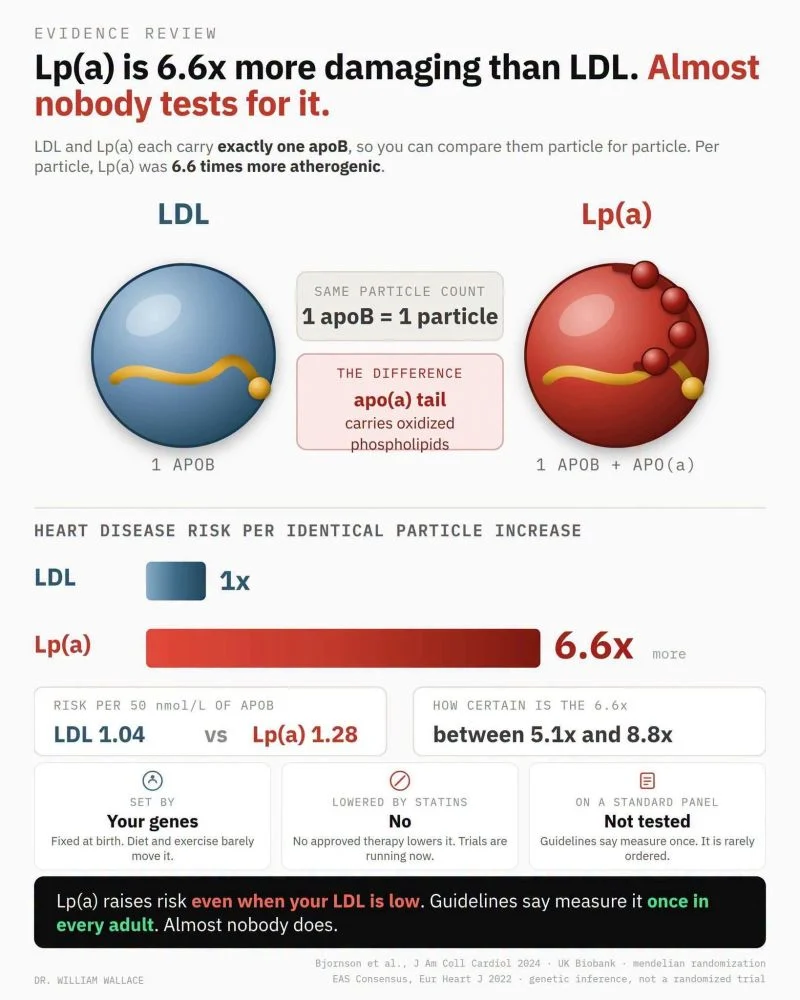
LDL and Lp(a) each carry exactly one copy of a protein called apoB.
One apoB, one particle.
That’s what makes it possible to line them up and ask a fair question: if you add the same number of each, which one does more damage to an artery?
Researchers answered that using genetic data from more than 300,000 people in the UK.
They compared people who inherited more of one particle against people who didn’t, which sidesteps the usual problem of diet and lifestyle muddying the picture.
Particle for particle, Lp(a) did about 6.6 times more damage than LDL. The range the data supports runs from about 5 to 9 times more.
The reason is physical. An Lp(a) particle is basically an LDL particle with an extra protein wrapped around it, called apo(a). That tail carries oxidized fats that inflame the artery wall. Same cholesterol inside. Extra weapon on the outside.
Three things make this worth knowing:
Your level is set by your genes. It’s essentially fixed at birth. Diet, exercise, and weight loss barely move it.
Statins don’t lower it. No approved drug currently does. Drugs designed specifically to lower Lp(a) are in late-stage trials right now.
It isn’t on a standard cholesterol panel. Guidelines say every adult should have it measured at least once.
In practice, almost nobody does. So a person can get a reassuring cholesterol result and still be carrying serious inherited risk that no one ever looked for.
The honest limit: this comes from genetics, not from a treatment trial.
It’s the same kind of evidence that convinced everyone LDL causes heart disease, and it’s strong.
But nobody has yet lowered Lp(a) in a trial and shown fewer heart attacks.
That trial is running now.
Until it reports, the case rests on inheritance rather than on treating people and watching what happens.
If you’ve never had it checked, it’s a one-time blood test for a number that won’t change for the rest of your life.
Bjornson et al., Journal of the American College of Cardiology, 2024.
European Atherosclerosis Society Consensus, 2022.”
Stay updated with Hemostasis Today.
-
Sep 29, 2026, 12:02Hajra Malik: Bridging Language Gaps in Hematology With AI
-
Sep 29, 2026, 11:57Joan Montaner: Can Blood Test Identify Intracerebral Hemorrhage Within Minutes?
-
Sep 29, 2026, 11:43From Years Without Answers to Life With Hemophilia Care – WFH
-
Sep 29, 2026, 11:32Sara Al Dallal: Transforming Hemophilia Care Across the Gulf
-
Sep 29, 2026, 11:21Richard Davis: Rapid Rescue in Massive Pulmonary Embolism
-
Sep 29, 2026, 11:14Nissan Brown: Every Step Counts for the Hemophilia Community
-
Sep 29, 2026, 11:03Zain Khalpey: SINGLE AF Adds New Evidence to the Anticoagulation Debate
-
Sep 29, 2026, 10:54How Does Haemophilia Affect Motor Development in Infants? – EAHAD
-
Sep 29, 2026, 10:49Alison Davey: The Vital Role of Community Support in Bleeding Disorders