


Rishdha Roshad: What Happens to the Brain During Cardiopulmonary Bypass?
Rishdha Roshad, BS Cardiac Perfusion Technology Student at Dow University of Health Sciences, shared a post on LinkedIn:
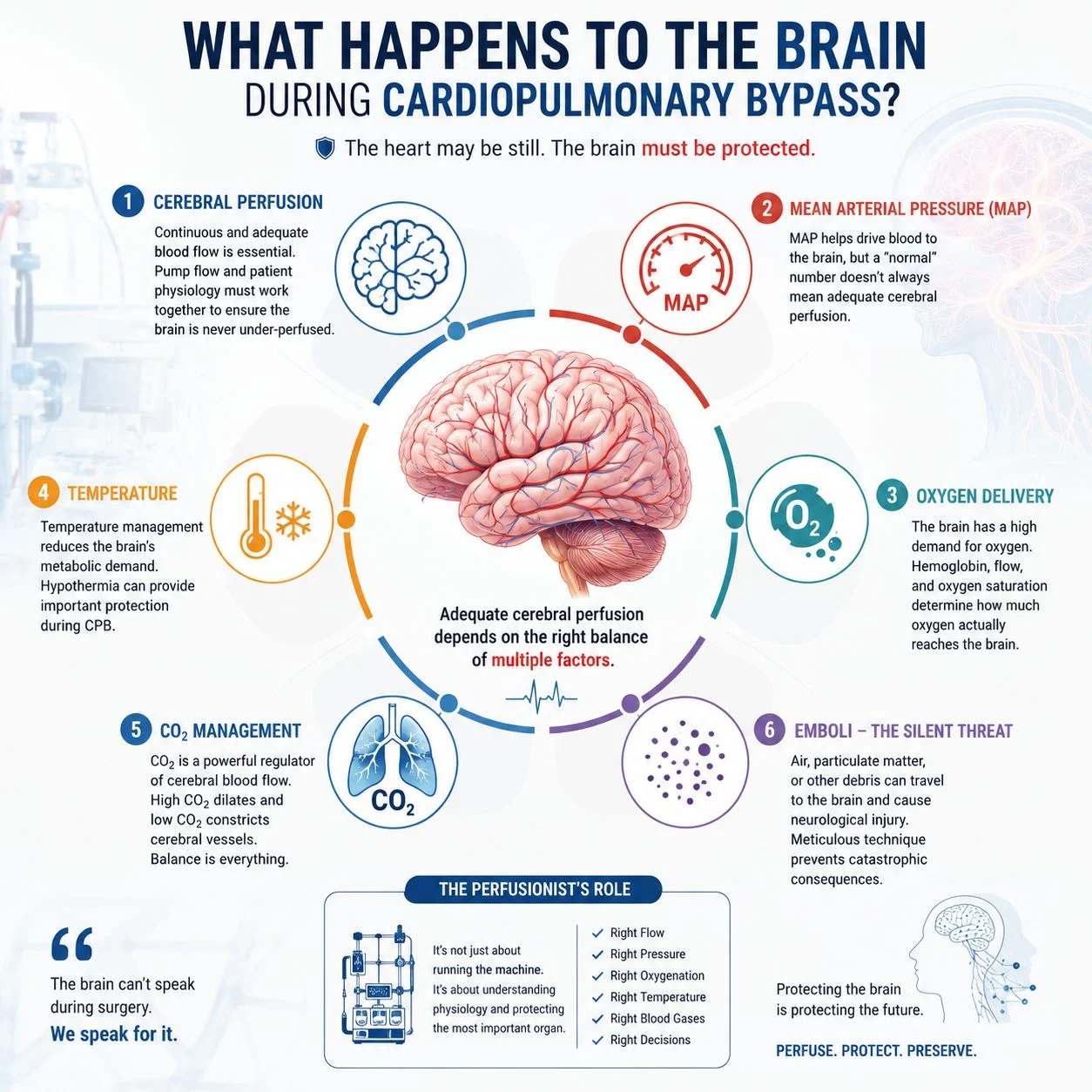
“What Happens to the Brain During Cardiopulmonary Bypass?
During cardiac surgery, the heart may be stopped — but the brain cannot afford to stop.
This is one of the reasons cerebral protection is such an important part of cardiopulmonary bypass.
While the perfusionist manages the CPB circuit, several factors can influence cerebral perfusion:
1. Cerebral Blood Flow
The brain requires continuous and adequate blood flow. Pump flow and arterial pressure must be considered in relation to the patient’s physiology — not simply as isolated numbers.
2. MAP — Pressure Matters, But So Does Perfusion
Maintaining an appropriate mean arterial pressure helps support cerebral perfusion, but a ‘normal-looking’ MAP does not automatically guarantee adequate oxygen delivery to the brain.
3. Oxygen Delivery
The brain is highly dependent on oxygen.
Hemoglobin, arterial oxygen saturation, cardiac output/pump flow and oxygen content all contribute to the oxygen available to cerebral tissue.
4. Temperature
Temperature management during CPB changes metabolic demand. Hypothermia can reduce cerebral metabolic rate and is therefore an important component of cerebral protection in appropriate surgical settings.
5. CO₂ — A Small Change, A Big Effect
CO₂ has a major influence on cerebral vascular tone. Changes in PaCO₂ can alter cerebral blood flow, making blood-gas management an important part of perfusion practice.
6. Emboli — The Silent Threat
Air, particulate matter, or other embolic material can reach the cerebral circulation and contribute to neurological injury. This is why meticulous circuit management, de-airing and blood conservation practices matter.
And this is what makes perfusion fascinating to me:
The perfusionist isn’t simply watching the pump.
They are constantly asking:
- Is the brain receiving enough blood?
- Is oxygen delivery adequate?
- Is metabolic demand being controlled?
- Are pressure, flow and blood gases appropriate for this patient?
The more I learn about CPB, the more I realize that cerebral protection is not one setting or one number.
It is the result of understanding how multiple physiological variables interact — and making thoughtful decisions throughout bypass.
The heart may be temporarily supported by a machine.
The brain still depends on a perfusionist who understands what those numbers mean.
Learning perfusion means learning to protect what cannot be seen.”
Stay updated with Hemostasis Today.
-
Sep 29, 2026, 12:02Hajra Malik: Bridging Language Gaps in Hematology With AI
-
Sep 29, 2026, 11:57Joan Montaner: Can Blood Test Identify Intracerebral Hemorrhage Within Minutes?
-
Sep 29, 2026, 11:43From Years Without Answers to Life With Hemophilia Care – WFH
-
Sep 29, 2026, 11:32Sara Al Dallal: Transforming Hemophilia Care Across the Gulf
-
Sep 29, 2026, 11:21Richard Davis: Rapid Rescue in Massive Pulmonary Embolism
-
Sep 29, 2026, 11:14Nissan Brown: Every Step Counts for the Hemophilia Community
-
Sep 29, 2026, 11:03Zain Khalpey: SINGLE AF Adds New Evidence to the Anticoagulation Debate
-
Sep 29, 2026, 10:54How Does Haemophilia Affect Motor Development in Infants? – EAHAD
-
Sep 29, 2026, 10:49Alison Davey: The Vital Role of Community Support in Bleeding Disorders