


Shehab Mohamed: Philadelphia Negative MPNs in AYA vs Older Adults in Qatar
Shehab Mohamed, Hematologist at Hamad Medical Corporation, shared a post on LinkedIn about a recent article he and his colleagues co-authored, published in Journal of Blood Medicine, adding:
“Here we go!
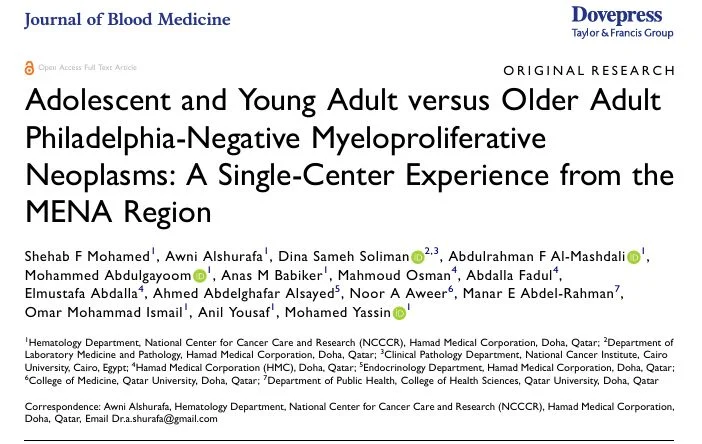
Excited to share our newly published research in the Journal of Blood Medicine: ‘Adolescent and Young Adult versus Older Adult Philadelphia-Negative Myeloproliferative Neoplasms: A Single-Center Experience from the MENA Region.’
Philadelphia-negative myeloproliferative neoplasms (MPNs) are typically associated with older adults, yet their presentation and long-term implications in adolescents and young adults (AYA) remain comparatively understudied—particularly in the Middle East.
In this retrospective study from the National Center for Cancer Care and Research in Doha, Qatar, we evaluated 220 patients with essential thrombocythaemia (ET), polycythaemia vera (PV), or myelofibrosis (MF). Importantly, 76 patients (34.5%) were aged 15–39 years, highlighting the relevance of MPNs in younger populations within our region.
Several findings stood out: younger patients with ET and PV were more frequently classified as low risk, although this is partly influenced by the inclusion of age in established risk models.
In ET, AYA molecular records showed relatively more CALR-positive and fewer JAK2-positive cases.
We also observed a descriptive tendency toward venous thrombosis in younger patients, compared with more arterial/cerebrovascular events among older adults.
Despite these differences, overall survival was not significantly different between AYA and older adults across ET, MF, and PV during the available follow-up.
Perhaps the most important message is that ‘young’ and ‘low risk’ should not mean ‘low impact.’
Younger patients may live with MPNs for decades, making fertility, cumulative treatment toxicity, quality of life, adherence, thrombosis prevention, and long-term disease modification especially important considerations.
We hope this work contributes to the growing evidence on MPNs in younger patients and, importantly, adds data from a region that remains underrepresented in the literature.
Grateful to all our collaborators and colleagues who contributed to this work.”
Title: Adolescent and Young Adult versus Older Adult Philadelphia-Negative Myeloproliferative Neoplasms: A Single-Center Experience from the MENA Region
Authors: Mohamed SF, Alshurafa A, Soliman DS , Al-Mashdali AF , Abdulgayoom M , Babiker AM, Osman M, Fadul A, Abdalla E, Alsayed AA, Aweer NA, Abdel-Rahman ME, Ismail OM, Yousaf A, Yassin M
Stay updated on all scientific advances with Hemostasis Today.
-
Sep 29, 2026, 12:02Hajra Malik: Bridging Language Gaps in Hematology With AI
-
Sep 29, 2026, 11:57Joan Montaner: Can Blood Test Identify Intracerebral Hemorrhage Within Minutes?
-
Sep 29, 2026, 11:43From Years Without Answers to Life With Hemophilia Care – WFH
-
Sep 29, 2026, 11:32Sara Al Dallal: Transforming Hemophilia Care Across the Gulf
-
Sep 29, 2026, 11:21Richard Davis: Rapid Rescue in Massive Pulmonary Embolism
-
Sep 29, 2026, 11:14Nissan Brown: Every Step Counts for the Hemophilia Community
-
Sep 29, 2026, 11:03Zain Khalpey: SINGLE AF Adds New Evidence to the Anticoagulation Debate
-
Sep 29, 2026, 10:54How Does Haemophilia Affect Motor Development in Infants? – EAHAD
-
Sep 29, 2026, 10:49Alison Davey: The Vital Role of Community Support in Bleeding Disorders