


Edward Lee Carter: Why Clinically Relevant Nonmajor Bleeding Demands Anticoagulation Stewardship?
Edward Lee Carter, Clinical Pharmacist Practitioner at U.S. Department of Veterans Affairs, shared a post on LinkedIn about a recent article by Deborah M. Siegal et al., published in Circulation, adding:
“‘Nonmajor’ bleeding does not mean inconsequential bleeding.
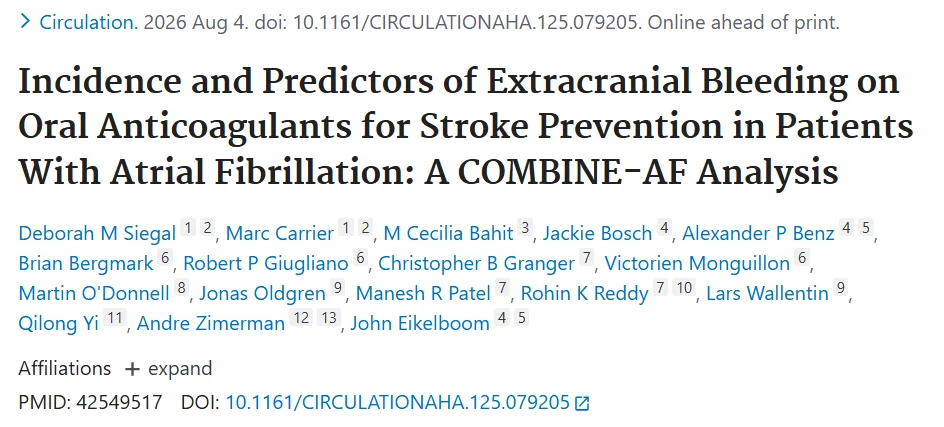
A new COMBINE-AF analysis in Circulation pooled patient-level data from 73,737 anticoagulated patients across five pivotal atrial fibrillation trials.
Over approximately two years, the estimated cumulative incidence of clinically relevant extracranial bleeding was 26%:
- 7% major bleeding
- 19% clinically relevant nonmajor bleeding
The second category matters.
These events may require medical evaluation, treatment, or interruption of anticoagulation-and can affect quality of life, adherence, and whether a patient remains protected from stroke.
The strongest predictors included hemoglobin below 12 g/dL and creatinine clearance below 60 mL/min.
Concomitant antiplatelet therapy and NSAID use were among the other important signals.
Perhaps the most revealing finding was what the analysis could not explain: measured baseline factors accounted for only about two-thirds of the population-level bleeding risk.
That does not mean two-thirds of bleeding is preventable. It suggests that our usual baseline variables do not capture the entire picture.
Dynamic factors-frailty, changing renal function, medication exposure, vascular fragility, or occult disease-may account for part of the remaining risk.
The lesson is not to avoid anticoagulation. For many patients with AF, it remains one of our most effective tools for preventing disabling stroke
The lesson is that anticoagulation stewardship cannot end when the prescription is written.
A clinically relevant bleed should trigger a structured review:
- Is the agent and labeled dose still appropriate?
- Have renal function or hemoglobin changed?
- Does aspirin-or any concomitant antiplatelet-still have a current indication?
- Is the patient using a prescribed or OTC NSAID?
- Does the bleeding site require evaluation for an underlying lesion or disease?
- Can we treat the cause while preserving stroke protection?
The response should not be automatic: neither dismiss the bleed nor reflexively stop or underdose anticoagulation without reassessing the patient
Patients often live in the large middle ground between “no bleeding” and “major hemorrhage.”
How we manage that middle ground may determine whether they can safely remain protected from stroke.
Siegal DM, et al. Circulation. Published online August 4, 2026.”
Title: Incidence and Predictors of Extracranial Bleeding on Oral Anticoagulants for Stroke Prevention in Patients With Atrial Fibrillation: A COMBINE-AF Analysis
Authors: Deborah M. Siegal, Marc Carrier, M. Cecilia Bahit, Jackie Bosch, Alexander P. Benz, Brian Bergmark, Robert P. Giugliano, Christopher B. Granger, Victorien Monguillon, Martin O’Donnell, Jonas Oldgren, Manesh R. Patel, Rohin K. Reddy, Lars Wallentin, Qilong Yi, Andre Zimerman, John Eikelboom
Other posts featuring Edward Lee Carter on Hemostasis Today.
-
Sep 29, 2026, 12:02Hajra Malik: Bridging Language Gaps in Hematology With AI
-
Sep 29, 2026, 11:57Joan Montaner: Can Blood Test Identify Intracerebral Hemorrhage Within Minutes?
-
Sep 29, 2026, 11:43From Years Without Answers to Life With Hemophilia Care – WFH
-
Sep 29, 2026, 11:32Sara Al Dallal: Transforming Hemophilia Care Across the Gulf
-
Sep 29, 2026, 11:21Richard Davis: Rapid Rescue in Massive Pulmonary Embolism
-
Sep 29, 2026, 11:14Nissan Brown: Every Step Counts for the Hemophilia Community
-
Sep 29, 2026, 11:03Zain Khalpey: SINGLE AF Adds New Evidence to the Anticoagulation Debate
-
Sep 29, 2026, 10:54How Does Haemophilia Affect Motor Development in Infants? – EAHAD
-
Sep 29, 2026, 10:49Alison Davey: The Vital Role of Community Support in Bleeding Disorders