


W. Alberto Sifuentes Giraldo: Targeting the JAK-STAT Pathway in Behçet’s Disease
W. Alberto Sifuentes Giraldo, Rheumatologist at Hospital Nuestra Señora de Sonsoles (Sacyl), shared a post on LinkedIn about a recent article by Fadi Hassan et al, published in Seminars in Arthritis and Rheumatism, adding:
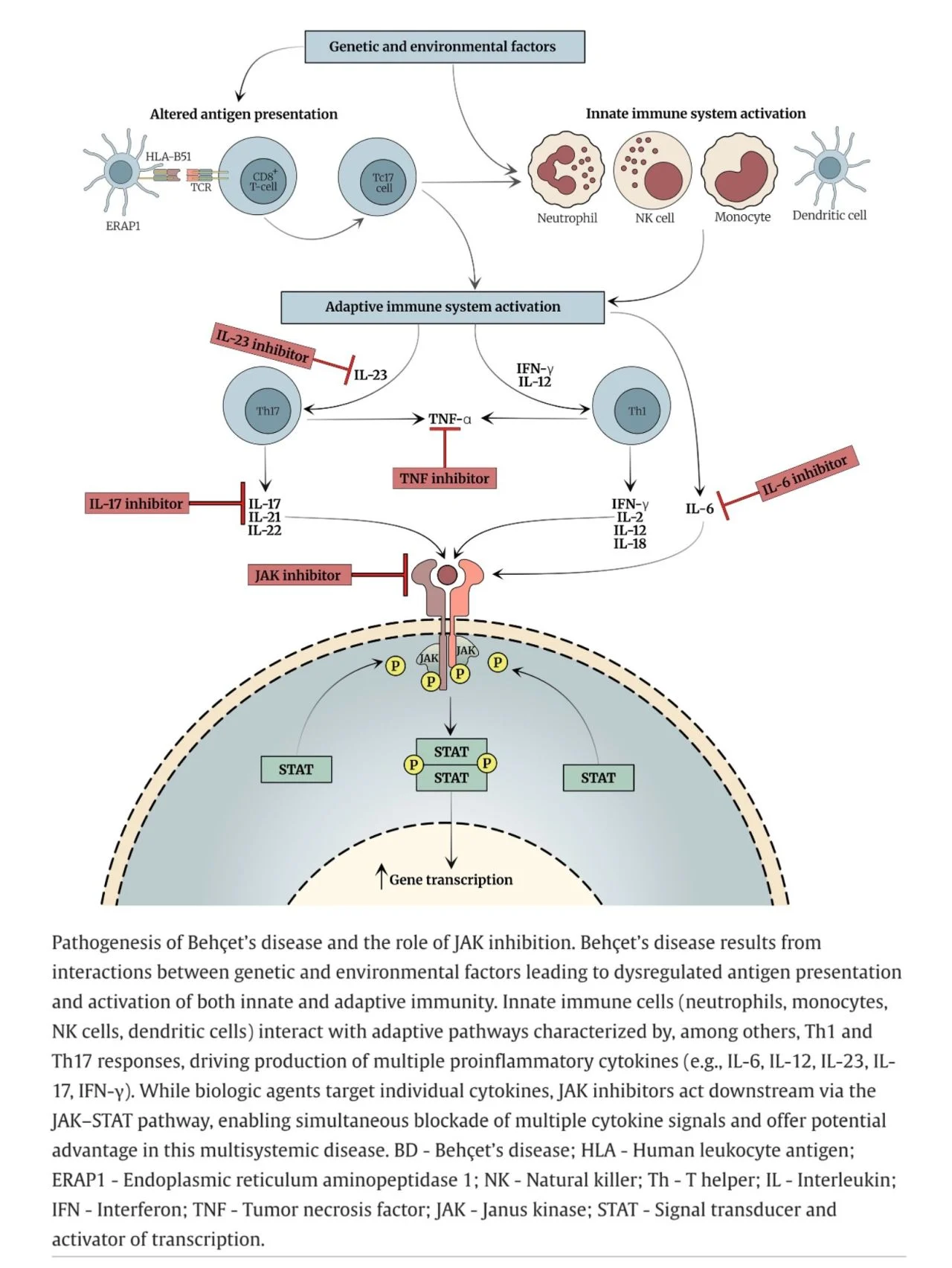
“Behçet’s Disease (BD) pathogenesis involves dysregulated innate and adaptive immunity with elevated proinflammatory cytokines (e.g., IL-6, IL-12, IL-23, interferon-γ), many signaling via the Janus kinase
(JAK)–signal transducer and activator of transcription (STAT) pathway (JAK-STAT pathway).
JAK inhibitors therefore offer a mechanistic advantage by targeting multiple pathways. Additional practical benefits include oral administration, relatively rapid onset, and short half-life, which allow flexible treatment management.
Several JAK inhibitors have been increasingly investigated in BD across a range of clinical manifestations. However, current evidence remains limited and heterogeneous. Due to this, Hassan et al. conducted a systematic review to evaluate their efficacy and safety in BD.
Key Results Seventeen studies (99 patients)—mainly case reports and small observational cohorts of high methodological quality—evaluated only tofacitinib, baricitinib, or upadacitinib. Patients were highly treatment-refractory (prior failure of conventional and biologic therapies).
- Upadacitinib was the most studied agent, showing an overall response rate of 85.2 percent and complete remission in 59.3 percent in a multicenter study.
- Efficacy was seen across domains, with the most consistent responses in intestinal BD (clinical and endoscopic remission) and frequent glucocorticoid-sparing effects.
Safety Findings aligned with known JAK-inhibitor profiles: mainly mild-to-moderate infections and manageable laboratory abnormalities. No clear signal for increased thrombotic events was observed, though follow-up was limited.
Conclusions JAK inhibitors show promising efficacy in refractory and multisystem BD, especially gastrointestinal involvement (data for other domains remain limited). The safety profile appears consistent with existing knowledge, but longer follow-up and high-quality randomized controlled trials are needed to confirm their role.”
Title: Efficacy and Safety of Janus Kinase Inhibitors in Behçet’s Disease: A Systematic Literature Review
Authors: Fadi Hassan a b, Mahmud Omar c d, Helana Jeries a b, Fatma Alibaz e, Mohammad E. Naffaa
Stay updated on all scientific advances with Hemostasis Today.
-
Sep 29, 2026, 12:02Hajra Malik: Bridging Language Gaps in Hematology With AI
-
Sep 29, 2026, 11:57Joan Montaner: Can Blood Test Identify Intracerebral Hemorrhage Within Minutes?
-
Sep 29, 2026, 11:43From Years Without Answers to Life With Hemophilia Care – WFH
-
Sep 29, 2026, 11:32Sara Al Dallal: Transforming Hemophilia Care Across the Gulf
-
Sep 29, 2026, 11:21Richard Davis: Rapid Rescue in Massive Pulmonary Embolism
-
Sep 29, 2026, 11:14Nissan Brown: Every Step Counts for the Hemophilia Community
-
Sep 29, 2026, 11:03Zain Khalpey: SINGLE AF Adds New Evidence to the Anticoagulation Debate
-
Sep 29, 2026, 10:54How Does Haemophilia Affect Motor Development in Infants? – EAHAD
-
Sep 29, 2026, 10:49Alison Davey: The Vital Role of Community Support in Bleeding Disorders