


Breck Gamel: Why Factor V Leiden Matters
Breck Gamel, Heart Hospital Pulmonary Embolism Registry and Program Coordinator and Quality Improvement Consultant at Baylor Scott and White Health, shared National Blood Clot Alliance’s post on LinkedIn, adding:
”My best friend lost her first born in the womb due to a blood clot in the umbilical cord.
It turned out that both she and her baby had Factor V Leiden.
I think of her often in my daily work to improve the care of patients with pulmonary embolism.
I wish even more people appreciated the significance of this not-well-known inherited clotting disorder.”
National Blood Clot Alliance shared a post on LinkedIn:
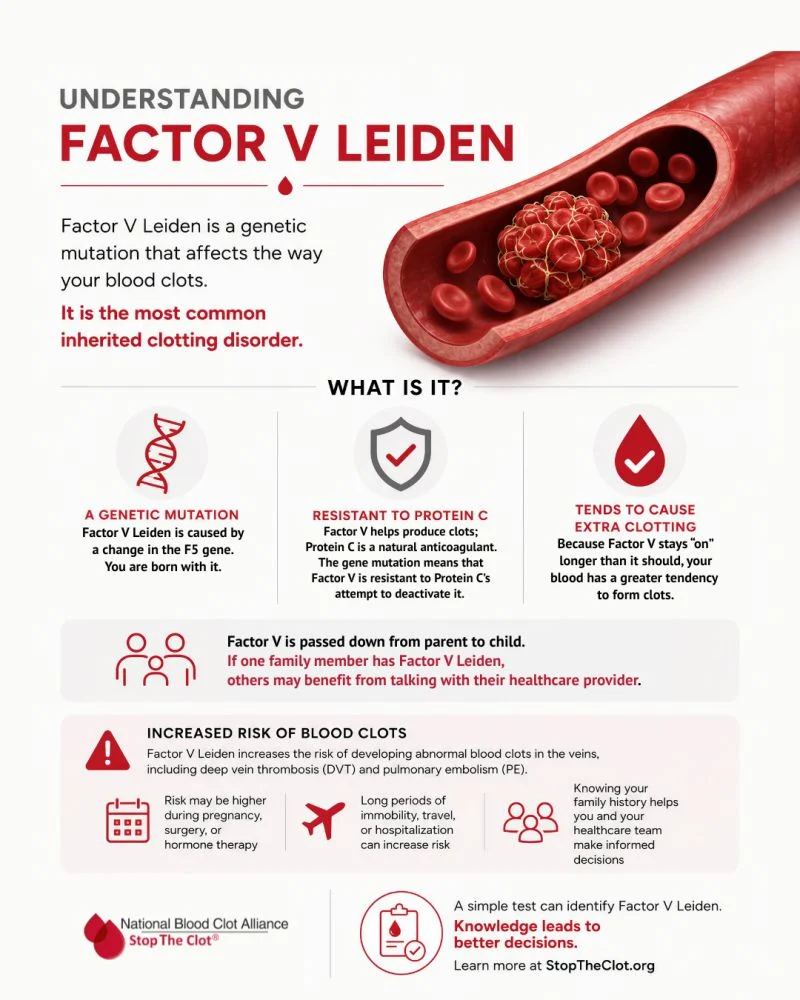
”Factor V Leiden is the most common inherited blood clotting disorder—but many people who have it don’t know they carry it.
Having Factor V Leiden doesn’t mean you’ll definitely develop a blood clot. But it can increase your risk, especially when combined with other factors such as surgery, pregnancy, hormone therapy, long periods of immobility, or certain medical conditions.
If you’ve experienced a blood clot—or if blood clots seem to run in your family—it may be worth having a conversation with your healthcare provider about whether genetic testing is appropriate for you.
Knowledge is one of the most powerful tools we have for preventing blood clots and recognizing them early.
Learn more about Factor V Leiden, blood clot risk factors, and the signs and symptoms of DVT and pulmonary embolism at
Factor V Leiden is the most common inherited blood clotting disorder—but many people who have it don’t know they carry it.
Having Factor V Leiden doesn’t mean you’ll definitely develop a blood clot. But it can increase your risk, especially when combined with other factors such as surgery, pregnancy, hormone therapy, long periods of immobility, or certain medical conditions.
If you’ve experienced a blood clot—or if blood clots seem to run in your family—it may be worth having a conversation with your healthcare provider about whether genetic testing is appropriate for you.
Knowledge is one of the most powerful tools we have for preventing blood clots and recognizing them early.
Learn more about Factor V Leiden, blood clot risk factors, and the signs and symptoms of DVT and pulmonary embolism at StopTheClot.org.”
Stay updated with Hemostasis Today.
-
Sep 29, 2026, 12:02Hajra Malik: Bridging Language Gaps in Hematology With AI
-
Sep 29, 2026, 11:57Joan Montaner: Can Blood Test Identify Intracerebral Hemorrhage Within Minutes?
-
Sep 29, 2026, 11:43From Years Without Answers to Life With Hemophilia Care – WFH
-
Sep 29, 2026, 11:32Sara Al Dallal: Transforming Hemophilia Care Across the Gulf
-
Sep 29, 2026, 11:21Richard Davis: Rapid Rescue in Massive Pulmonary Embolism
-
Sep 29, 2026, 11:14Nissan Brown: Every Step Counts for the Hemophilia Community
-
Sep 29, 2026, 11:03Zain Khalpey: SINGLE AF Adds New Evidence to the Anticoagulation Debate
-
Sep 29, 2026, 10:54How Does Haemophilia Affect Motor Development in Infants? – EAHAD
-
Sep 29, 2026, 10:49Alison Davey: The Vital Role of Community Support in Bleeding Disorders