


William Wallace: ApoB May Reveal the Risk Hidden Behind Normal LDL
William Wallace, Co-Founder and Chief Scientific Officer at Supplement Success Solutions, shared a post on LinkedIn:
“Two people on a statin can show the same normal LDL cholesterol and carry different cardiovascular risk, and the variable that separates them is not the amount of cholesterol in the blood but the number of particles carrying it.
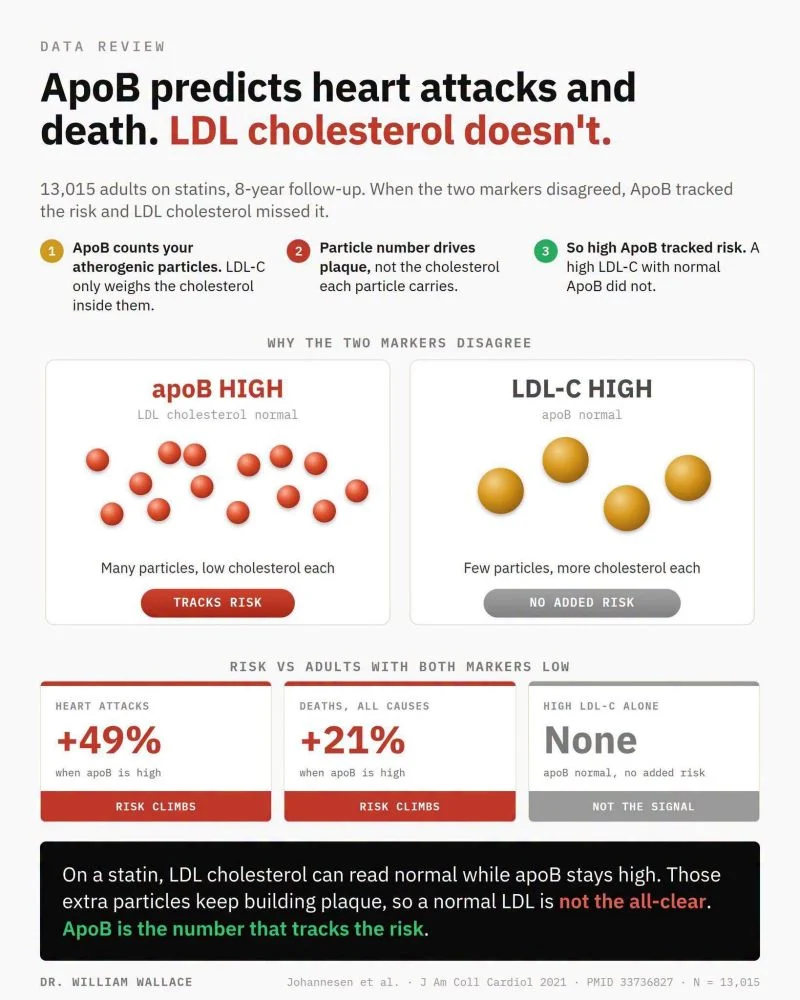
Researchers drew on the Copenhagen General Population Study, took 13,015 adults who were already on statin therapy, measured both their LDL cholesterol and their apolipoprotein B, and followed them for a median of eight years of heart attacks and deaths.
When the two markers disagreed, the people whose apoB ran high while their LDL cholesterol sat in the normal range had a 49% higher rate of myocardial infarction and a 21% higher rate of death from any cause than the people whose two markers were both low.
When LDL cholesterol ran high but apoB stayed normal, the risk did not rise at all, for either heart attack or death.
It was the number of particles, not the amount of cholesterol they carried, that separated the people who had events from the people who did not.
Every atherogenic particle, whether LDL, VLDL, IDL, or lipoprotein(a), carries exactly one apoB molecule, so apoB is a direct count of how many such particles are in circulation, while LDL cholesterol measures only the mass of cholesterol those particles happen to be carrying.
It is the particles themselves, not their cholesterol cargo, that cross the arterial wall and initiate plaque, which is why a marker that counts them tracks disease more faithfully than one that weighs their contents.
Lipid management overwhelmingly targets the cholesterol number, the value printed on every standard panel, while the particle count that this study flags as the marker carrying the residual risk is one most people on a statin have never had measured.
The open question is whether treating patients to an apoB target, rather than an LDL cholesterol target, changes hard cardiovascular outcomes, or whether apoB is simply the more honest readout of a risk that is already there.”
James P. Crowley, Professor of Medicine Emeritus at Brown University, Captain at U.S. Navy Reserve, shared this post on LinkedIn, adding:
“When the two markers disagreed, the people whose apoB ran high while their LDL cholesterol sat in the normal range had a 49% higher rate of myocardial infarction and a 21% higher rate of death from any cause than the people whose two markers were both low.
When LDL cholesterol ran high but apoB stayed normal, the risk did not rise at all, for either heart attack or death.
It was the number of particles, not the amount of cholesterol they carried, that separated the people who had events from the people who did not.”
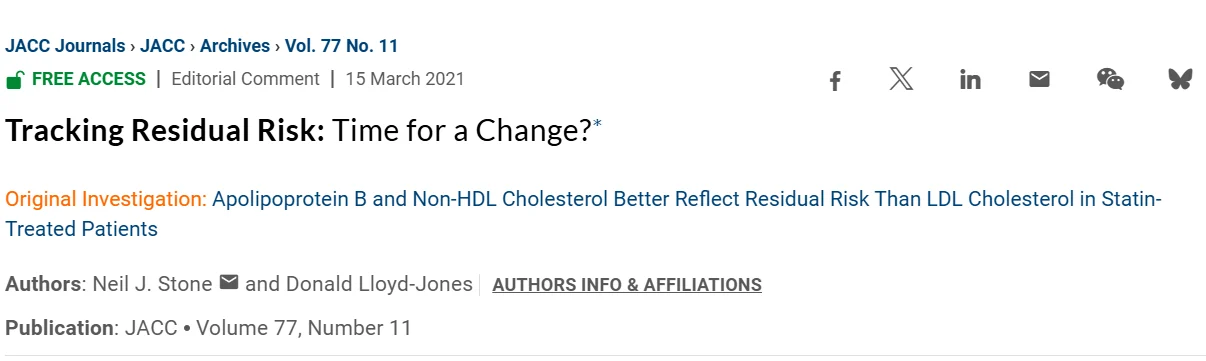
Title: Tracking Residual Risk: Time for a Change?
Authors: Neil J. Stone, Donald Lloyd-Jones
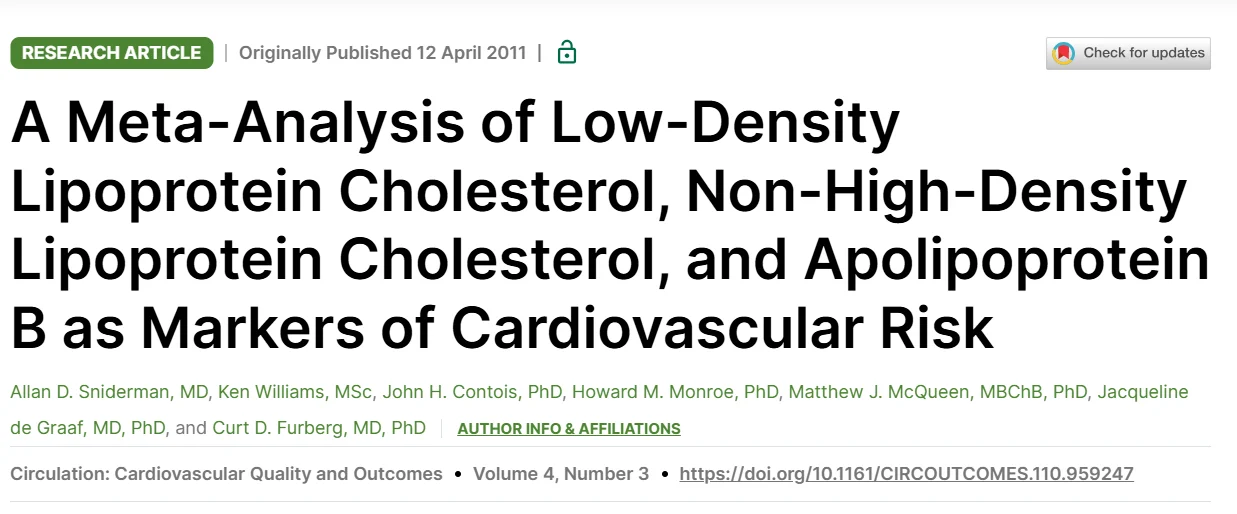
Title: A meta-analysis of low-density lipoprotein cholesterol, non-high-density lipoprotein cholesterol, and apolipoprotein B as markers of cardiovascular risk
Authors: Allan D Sniderman, Ken Williams, John H Contois, Howard M Monroe, Matthew J McQueen, Jacqueline de Graaf, Curt D Furberg
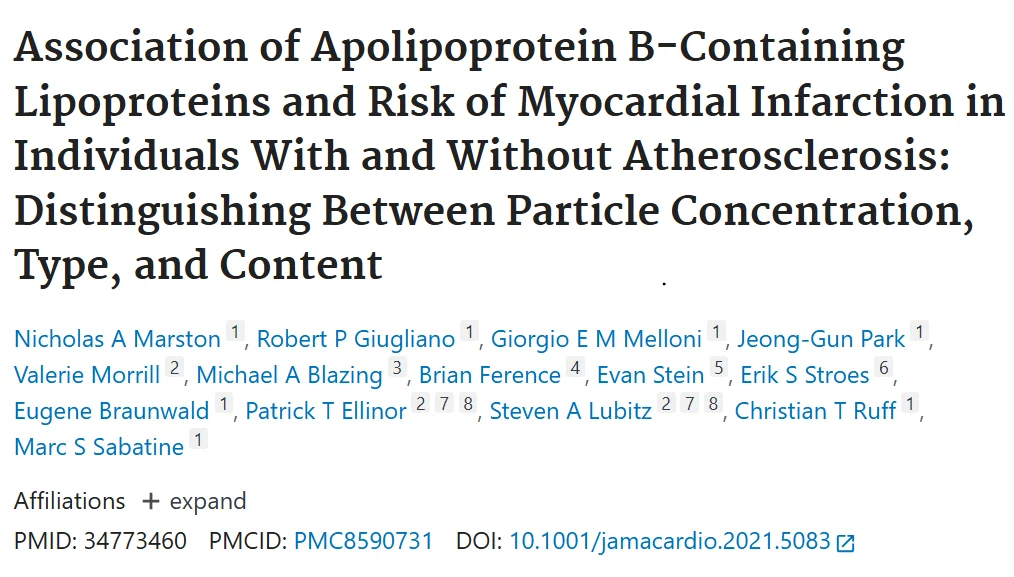
Title: Association of Apolipoprotein B-Containing Lipoproteins and Risk of Myocardial Infarction in Individuals With and Without Atherosclerosis: Distinguishing Between Particle Concentration, Type, and Content
Authors: Nicholas A Marston, Robert P Giugliano, Giorgio E M Melloni, Jeong-Gun Park, Valerie Morrill, Michael A Blazing, Brian Ference, Evan Stein, Erik S Stroes, Eugene Braunwald, Patrick T Ellinor, Steven A Lubitz, Christian T Ruff, Marc S Sabatine
Other posts featuring William Wallace on Hemostasis Today.
-
Sep 29, 2026, 12:02Hajra Malik: Bridging Language Gaps in Hematology With AI
-
Sep 29, 2026, 11:57Joan Montaner: Can Blood Test Identify Intracerebral Hemorrhage Within Minutes?
-
Sep 29, 2026, 11:43From Years Without Answers to Life With Hemophilia Care – WFH
-
Sep 29, 2026, 11:32Sara Al Dallal: Transforming Hemophilia Care Across the Gulf
-
Sep 29, 2026, 11:21Richard Davis: Rapid Rescue in Massive Pulmonary Embolism
-
Sep 29, 2026, 11:14Nissan Brown: Every Step Counts for the Hemophilia Community
-
Sep 29, 2026, 11:03Zain Khalpey: SINGLE AF Adds New Evidence to the Anticoagulation Debate
-
Sep 29, 2026, 10:54How Does Haemophilia Affect Motor Development in Infants? – EAHAD
-
Sep 29, 2026, 10:49Alison Davey: The Vital Role of Community Support in Bleeding Disorders