

How Social Determinants and Clinical Drivers Impact Hospital Outcomes – RPTH Journal
RPTH Journal shared a post on LinkedIn about a recent article by Doris Akolbire et al., adding:
“Who dies from pulmonary embolism in hospital: why does it depend on more than just physiology
Despite advances in diagnosis and management, in-hospital mortality from acute pulmonary embolism (PE) remains substantial.
A new study in RPTH Journal uses nationally representative US data to identify which clinical and socioeconomic factors predict death and the findings go beyond the expected.
Key findings from 723,579 PE hospitalisations (National Inpatient Sample, 2018–2021; 3% in-hospital mortality):
Clinical predictors:
- Lactic acidosis: 7-fold increase in mortality odds (aOR 7.04), the strongest single predictor
- Each 1-point increase in comorbidity burden: 20% increase in mortality odds
- Metastatic cancer, liver disease, arrhythmias, and coagulopathy were also significant predictors
- Obesity and chronic hypertension were associated with lower adjusted mortality
Socioeconomic predictors:
- Female sex and Black and Asian/Pacific Islander patients had higher adjusted mortality than White patients
- Self-pay status was associated with higher mortality than Medicare
- Higher household income was progressively associated with lower mortality
These findings are a stark reminder that PE outcomes are not determined by physiology alone.
Systemic inequities, in access, insurance coverage, and race, independently predict who survives.
A truly multidimensional approach to PE risk assessment must account for social determinants of health, not just clinical parameters.”
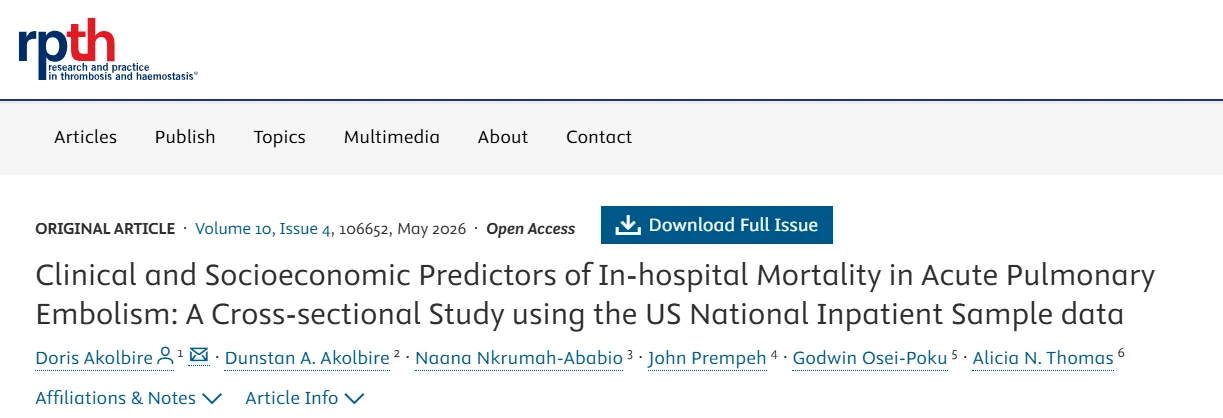
Title: Clinical and Socioeconomic Predictors of In-hospital Mortality in Acute Pulmonary Embolism: A Cross-sectional Study using the US National Inpatient Sample data
Authors: Doris Akolbire, Dunstan A. Akolbire, Naana Nkrumah-Ababio, John Prempeh, Godwin Osei-Poku, Alicia N. Thomas
Other posts featuring RPTH Journal on Hemostasis Today.
-
Oct 2, 2026, 09:20Anticoagulants, Blood Thinners, or Antithrombotic Medications? – World Thrombosis Day
-
Oct 2, 2026, 06:00Susan Wickersham: Gradual Shift towards Autologous Blood Transfusion is a Current Trend
-
Oct 2, 2026, 05:54Shamee Shastry: When Every Cell Reacts – The Hunt for Rare Blood
-
Oct 2, 2026, 05:49David Mclntosh: Expanding Plasma Protein Therapies in Underserved Regions
-
Oct 2, 2026, 05:38Dianne E. van der Wal: C-Terminal Endings Impact PAR1/PAR4 Peptide Potency in In Vitro Platelet Assays
-
Oct 2, 2026, 05:29Mohammed Alo: Your LDL Isn’t a Snapshot – It’s a Smoking Habit Measured in Years
-
Oct 2, 2026, 00:33Marwa Mostafa: Hemoglobinopathies – When Globin Genes Go Wrong
-
Oct 1, 2026, 23:46Behnood Bikdeli: Global Burden of Venous Thromboembolism
-
Oct 1, 2026, 23:46Sthanu Subramanian: Clinical Presentation, Risk Factors, Diagnosis, and Neuroimaging Findings in CVT