

FDA Licenses First Freeze-Dried Plasma Product in the United States
The FDA’s approval of Ezplaz Freeze Dried Plasma marks an important development in transfusion medicine – but its significance is best understood as logistical rather than revolutionary.
Ezplaz is the first freeze-dried plasma product licensed for use in the United States.
It is intended for adults who require plasma when other plasma products are unavailable, including patients with active bleeding, clinically significant coagulation deficiencies during massive transfusion, and selected patients taking warfarin who need urgent reversal.
The Challenge With Conventional Plasma
Fresh frozen plasma (FFP) remains an established component of plasma-based hemostatic resuscitation, but its use depends on a demanding cold chain. It requires frozen storage, controlled transport and thawing before transfusion.
Within a well-equipped hospital, these requirements are usually manageable. In prehospital care, military medicine, rural emergency departments, disaster response and other austere settings, however, they can delay access to plasma when timely hemostatic support is needed.
This creates a critical logistical gap: plasma may be clinically indicated, but conventional plasma may not be immediately available.
Ezplaz is designed to address this challenge. As a lyophilized plasma product, it can be stored at room temperature and rapidly reconstituted when required.
Its self-contained kit includes the freeze-dried plasma, sterile water for injection, a fluid transfer set and a transfusion set, supporting plasma availability closer to the point of care.
For emergency hemostasis, the significance is straightforward: reducing the logistical barriers between plasma and the bleeding patient. 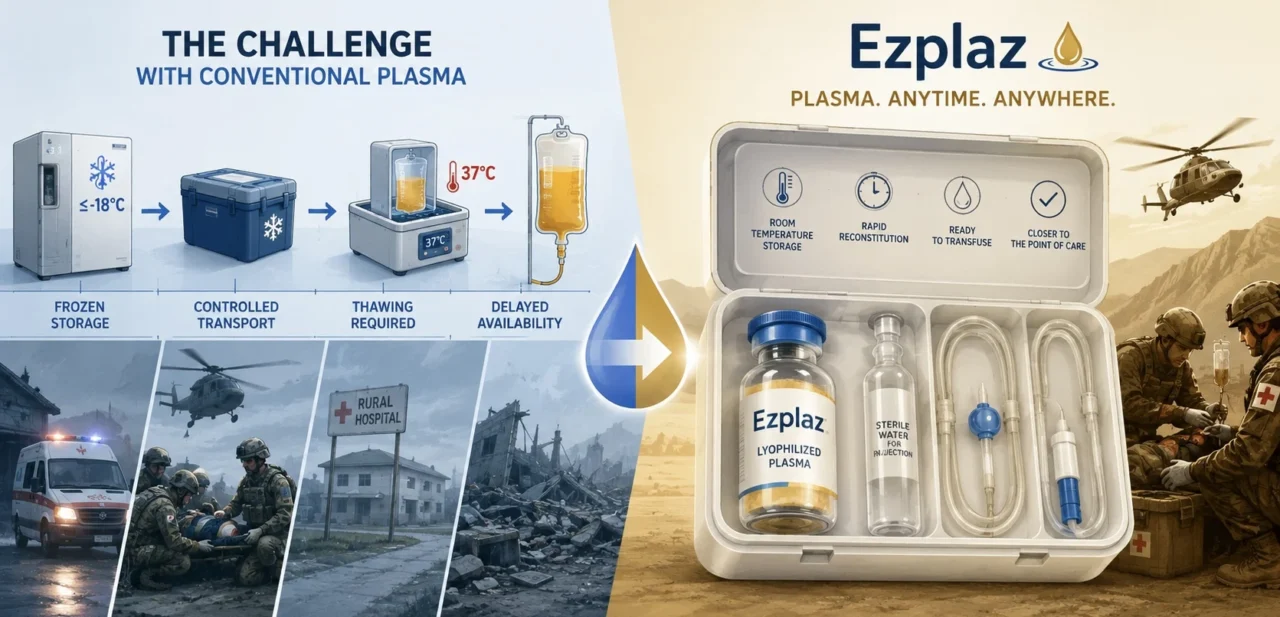
Why This Could Matter
The significance of freeze-dried plasma extends beyond the absence of a freezer.
It could change where plasma is stored, how quickly it can be deployed and how readily it can reach patients with life-threatening bleeding.
A room-temperature plasma product could potentially be positioned closer to the point of care, including:
- Helicopters and ground ambulances
- Military and forward medical units
- Rural and resource-limited hospitals
- Disaster-response and mass-casualty caches
- Remote clinics and expeditionary medical teams
- By reducing dependence on frozen storage and conventional thawing infrastructure, freeze-dried plasma could shorten the logistical pathway from recognition of major hemorrhage to plasma administration.
It may also strengthen the resilience of emergency blood supplies during power outages, transport disruptions, disasters and mass-casualty incidents.
For patients experiencing uncontrolled hemorrhage, particularly when transfer to definitive trauma care is prolonged, having plasma immediately available at the point of care could be an important advantage in early hemostatic resuscitation.
In other words, the innovation is not simply freeze-drying plasma – it is bringing plasma closer to the patient when time, infrastructure and access are limited.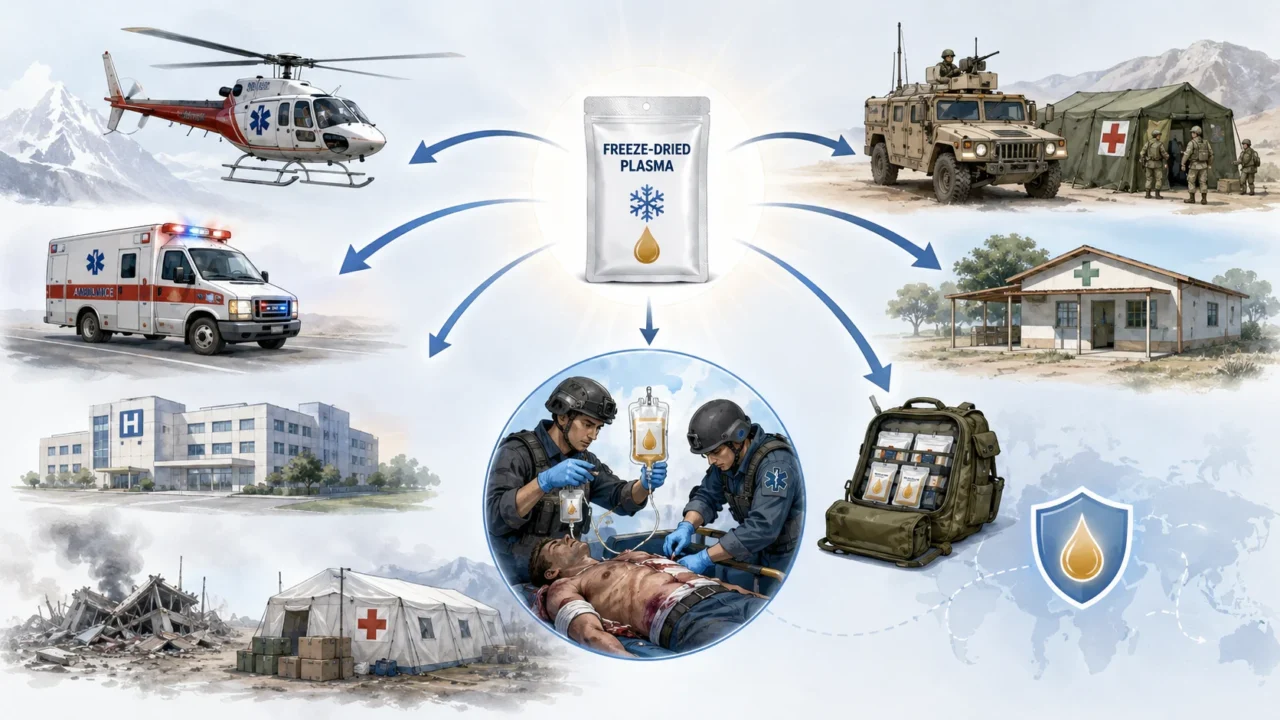
Where Freeze-Dried Plasma Fits in Hemorrhage Management
The FDA licensure establishes Ezplaz as an authorized plasma product for its approved indication. It does not establish clinical superiority over fresh frozen plasma, whole blood, or other established approaches to hemorrhage management.
Its primary contribution is logistical and operational: extending access to plasma when conventional frozen products are unavailable.
This distinction is important because major hemorrhage requires a comprehensive, physiology-driven resuscitation strategy, rather than reliance on a single blood component.
Plasma provides coagulation factors, but it does not replace red blood cells for oxygen-carrying capacity, platelets for primary hemostasis or fibrinogen replacement when clinically indicated.
Management may also require correction of hypocalcemia and hypothermia, appropriate antifibrinolytic therapy such as tranexamic acid and rapid definitive control of the bleeding source.
Ezplaz should therefore be viewed as an additional plasma option within comprehensive hemorrhage management, rather than a replacement for conventional plasma or other components of resuscitation.
Freeze-Dried Plasma: Easier Access, Uncertain Survival Benefit
Early plasma administration is biologically compelling. Severe bleeding can trigger trauma-induced coagulopathy within minutes, so replacing coagulation factors before hospital arrival may help preserve hemostasis.
Yet the clinical evidence remains inconclusive.
A 2025 systematic review found no significant overall reduction in early or late mortality with prehospital plasma; a sensitivity analysis suggested a possible 24-hour benefit, but confidence was limited by heterogeneity, bias, and imprecision.
Trials of lyophilized plasma have been similarly cautious.
PREHO-PLYO found that freeze-dried plasma was feasible and safe, but it did not significantly improve hospital-arrival INR, massive-transfusion requirements, or 30-day survival.
The RePHILL trial also found no clear mortality advantage when lyophilized plasma and red cells were compared with saline resuscitation.
The strongest evidence therefore supports a logistical, not yet definitive therapeutic, advantage.
Freeze-dried plasma can bring plasma to battlefields, ambulances, rural hospitals and disaster zones where conventional FFP may be unavailable.
Whether faster access consistently saves more lives remains an important unanswered question.
Where Ezplaz May Fit
Ezplaz is unlikely to replace conventional plasma or whole blood. Its main value is logistical: it can make plasma available when conventional products are unavailable or difficult to transport.
This may be useful in prehospital care, rural hospitals, military medicine, disaster response and prolonged evacuation, where refrigeration and blood-bank access are limited.
Whole blood remains essential in major hemorrhage because it provides red cells, plasma, and platelets, whereas Ezplaz provides plasma only. The two products should therefore be viewed as complementary.
Bottom Line
Ezplaz does not replace conventional plasma – it addresses the gap between the need for plasma and the ability to deliver it.
By reducing dependence on frozen storage and conventional transfusion infrastructure, freeze-dried plasma could bring plasma-based hemostatic support closer to patients when time, distance, or resources make conventional access difficult.
-
Sep 30, 2026, 22:28Recent Mechanical Risk Factors and Young-Onset Cryptogenic Ischemic Stroke – American Heart Association International
-
Sep 30, 2026, 22:22Expert Consensus on Inferior Vena Cava Thrombosis – Thrombosis and Haemostasis Journal
-
Sep 30, 2026, 22:21Markus Abeln: How Platelets and Complement Shape Placental Blood Flow
-
Sep 30, 2026, 22:19Fatma Al Arbawi: Studying Blood Clot Mechanics to Understand Aspirin Resistance and Thrombosis
-
Sep 30, 2026, 22:17Sudhir Kumar: Stroke is a Medical Emergency – and Every Minute Matters
-
Sep 30, 2026, 22:15Luisa Medeiros Visentini: Our Research on Cognitive Impairment After CVT Cited in the International Journal of Stroke
-
Sep 30, 2026, 21:50Jagat Narula: Connecting Cardiovascular Health and Sickle Cell Disease on World Heart Day 2026
-
Sep 30, 2026, 21:38John Kastelein: Exploring the Biology of Cardiovascular Disease at BioCentury Grand Rounds Europe
-
Sep 30, 2026, 21:36Mark Murphy: Irish Heart Foundation Meets With Senator Teresa Costello on World Heart Day