


Bhaskar M.: Blood Bank – The Lifeline of Modern Healthcare
Bhaskar M., Intern at Soban Singh Jeena Government Institute of Medical Science and Research Almora, shared a post on LinkedIn:
“Blood Bank: The Lifeline of Modern Healthcare
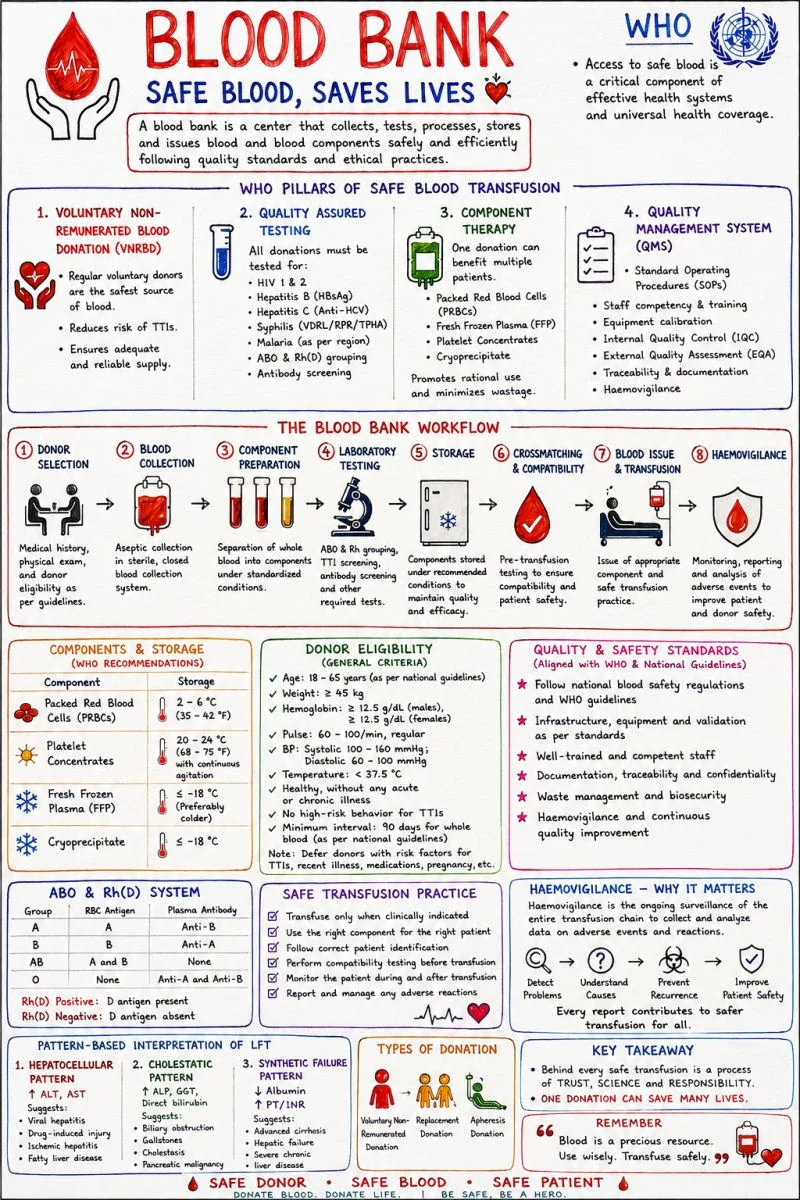
A blood bank is far more than a storage facility — it is a highly regulated system that ensures the right blood component reaches the right patient at the right time, while maintaining the highest standards of quality and safety.
According to WHO, a safe blood transfusion service is built on four key pillars:
Voluntary non-remunerated blood donation (VNRBD) – Regular voluntary donors are the safest source of blood, reducing the risk of transfusion-transmitted infections (TTIs).
Quality-assured testing – Every donated unit should be tested for:
- ABO and Rh(D) grouping
- Transfusion-transmitted infections (HIV, HBV, HCV, Syphilis, and region-specific infections as per national policy)
- Antibody screening and compatibility testing before issue
Component Therapy – One donation can benefit multiple patients by separating whole blood into:
- Packed Red Blood Cells (PRBCs)
- Fresh Frozen Plasma (FFP)
- Platelet Concentrates
- Cryoprecipitate
- This promotes rational blood utilization and minimizes unnecessary transfusions.
Quality management system (QMS) – Safe transfusion depends on:
- Standard Operating Procedures (SOPs)
- Staff competency and continuous training
- Equipment calibration and preventive maintenance
- Internal Quality Control (IQC) and External Quality Assessment (EQA)
- Complete traceability and haemovigilance
The blood bank workflow
Donor Selection – Blood Collection – Component Preparation – Laboratory Testing – Storage – Crossmatching – Blood Issue – Haemovigilance
WHO-recommended storage
- PRBCs: 2–6 degrees Celsius
- Platelets: 20–24 degrees Celsius with continuous agitation
- FFP: less than or equal to –18 degrees Celsius (preferably colder where applicable)
- Cryoprecipitate: less than or equal to –18 degrees Celsius
Every unit of blood represents a donor’s trust, a laboratory’s precision, and a patient’s chance at life.
Safe blood saves lives – but only when every step, from donor selection to transfusion, follows evidence-based standards.”
Stay updated with Hemostasis Today.
-
Oct 2, 2026, 00:33Marwa Mostafa: Hemoglobinopathies – When Globin Genes Go Wrong
-
Oct 1, 2026, 23:46Behnood Bikdeli: Global Burden of Venous Thromboembolism
-
Oct 1, 2026, 23:46Sthanu Subramanian: Clinical Presentation, Risk Factors, Diagnosis, and Neuroimaging Findings in CVT
-
Oct 1, 2026, 23:45Martha Gulati: Oral MHT Is Associated With Increased Thrombotic Risk
-
Oct 1, 2026, 23:44Priya Sriskandarajah: HEMA-MED Trial Exploring Roginolisib Plus JAK Inhibitors in Myelofibrosis
-
Oct 1, 2026, 23:44Inge Vanhomwegen: Join Our Upcoming Webinar on D-dimer Testing
-
Oct 1, 2026, 23:43Bianca Rocca: Beyond API-CAT – Who Should Continue Anticoagulation, And for How Long?
-
Oct 1, 2026, 23:26Sara Gaafar Ibnauf Suliman: The Changing Role of Bariatric Surgery in the GLP-1 Era
-
Oct 1, 2026, 23:16Ahmed Reda: New Ferritin Cutoffs For Iron Deficiency – Ash 2026