


Erhabor Osaro: Critical Issues to Consider During the Clinical Blood Transfusion Process
Erhabor Osaro, Professor of Haematology and Transfusion Science, Author, Leadership Advocate, and Public Commentator, shared a post on X:
“Critical issues to consider during the clinical blood transfusion process
Every unit is precious. Every step is critical. Every check can save a life.
Blood transfusion can be lifesaving, but safe transfusion requires much more than simply connecting a unit of blood to a patient.
It is a carefully controlled chain of clinical, laboratory and bedside processes, and an error at any stage can have serious consequences.
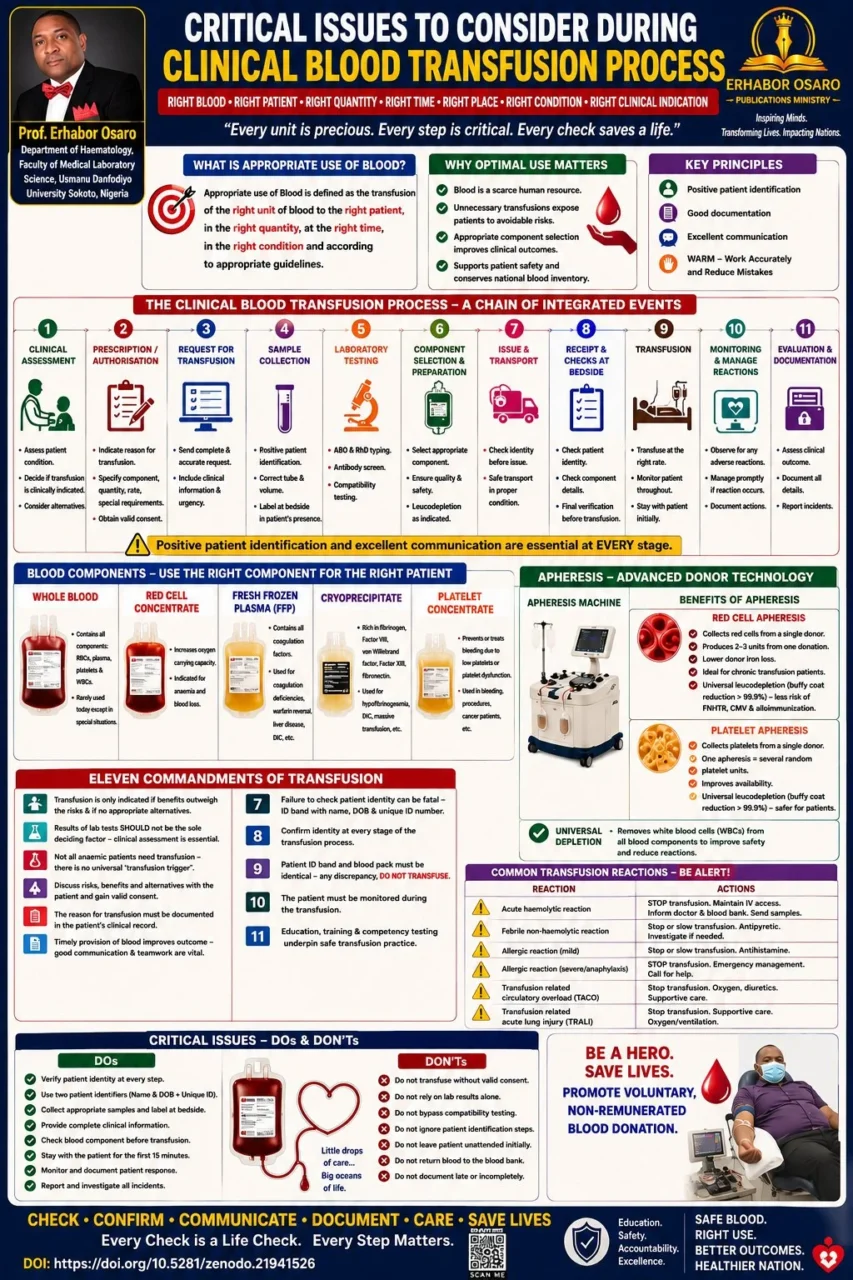
This colourful, annotated blood transfusion teaching poster highlights the critical safety issues that healthcare professionals must consider throughout the clinical transfusion pathway.
What does the poster cover?
The poster follows the complete transfusion journey:
- Clinical assessment – Is transfusion genuinely indicated, and are safer alternatives available?
- Prescription/authorisation and consent – Document the reason, component, quantity, rate and special requirements, while ensuring the patient understands the benefits, risks and alternatives.
- Blood request – Provide complete and accurate patient identifiers, clinical information, urgency and component requirements.
- Sample collection – Positively identify the patient and label the sample correctly at the bedside. Never pre-label blood samples.
- Laboratory testing – ABO and RhD grouping, antibody screening and compatibility testing help ensure that the safest appropriate component is selected.
- Component selection and preparation – Select the correct red cells, platelets, plasma or cryoprecipitate and ensure any required special specifications are met.
- Issue and transportation – Maintain correct identification, traceability and storage conditions from the transfusion laboratory to the clinical area.
- Final bedside check – One of the most important safeguards in the entire process. Patient identity and blood-component details must match exactly. Any discrepancy equals do not transfuse.
- Administration – Give the correct component at the prescribed rate and remain particularly vigilant during the early stages of transfusion.
- Monitoring and management of reactions – Observe the patient closely and recognise signs of acute haemolytic reactions, febrile reactions, allergy/anaphylaxis, TACO, TRALI and other complications.
- Evaluation, documentation and haemovigilance – Record the outcome, complete traceability documentation and investigate and report adverse reactions, incidents and near misses.
The central safety principles
- Positive patient identification
- Excellent communication
- Accurate documentation
- Appropriate component selection
- Valid consent
- Competent and trained staff
- Correct bedside checking
- Careful patient monitoring
- Haemovigilance and learning from incidents
Appropriate use of blood
Appropriate use of blood means transfusing: The right unit of blood To the right patient In the right quantity At the right time In the right condition According to appropriate guidelines.
Blood should only be transfused when the expected clinical benefit outweighs the risks and when appropriate safer alternatives are not suitable.
Remember: Patient identification saves lives
Wrong blood into a patient can have catastrophic consequences.
Positive patient identification must therefore occur at every stage, from blood sampling through collection and final bedside administration.
The bedside identity check represents the final opportunity to prevent an incompatible transfusion.
Know the components
The poster also illustrates:
- Red Cell Concentrates
- Fresh Frozen Plasma
- Cryoprecipitate
- Platelet Concentrates
- Whole Blood
- Apheresis technology and component collection
Support safe and sustainable blood supplies
Safe transfusion begins with safe blood donation.
Be a hero. Save lives. Support voluntary, non-remunerated blood donation.
Blood is a precious human resource.
Every donated unit should be carefully collected, properly tested, appropriately prescribed, safely administered and fully accounted for.
Take-home message
- Check
- Confirm
- Communicate
- Document
- Care
- Save lives
Right Blood. Right Patient. Right Quantity. Right Time. Right Condition. Right Clinical Indication.
Every check is a life check. Every step matters.”
Stay updated with Hemostasis Today.
-
Oct 2, 2026, 09:20Anticoagulants, Blood Thinners, or Antithrombotic Medications? – World Thrombosis Day
-
Oct 2, 2026, 06:00Susan Wickersham: Gradual Shift towards Autologous Blood Transfusion is a Current Trend
-
Oct 2, 2026, 05:54Shamee Shastry: When Every Cell Reacts – The Hunt for Rare Blood
-
Oct 2, 2026, 05:49David Mclntosh: Expanding Plasma Protein Therapies in Underserved Regions
-
Oct 2, 2026, 05:38Dianne E. van der Wal: C-Terminal Endings Impact PAR1/PAR4 Peptide Potency in In Vitro Platelet Assays
-
Oct 2, 2026, 05:29Mohammed Alo: Your LDL Isn’t a Snapshot – It’s a Smoking Habit Measured in Years
-
Oct 2, 2026, 00:33Marwa Mostafa: Hemoglobinopathies – When Globin Genes Go Wrong
-
Oct 1, 2026, 23:46Behnood Bikdeli: Global Burden of Venous Thromboembolism
-
Oct 1, 2026, 23:46Sthanu Subramanian: Clinical Presentation, Risk Factors, Diagnosis, and Neuroimaging Findings in CVT