


Giulia Alagna: Managing Coronary Aneurysmal and Ectatic Disease
Giulia Alagna, Interventional Cardiologist at ASL VCO, shared a post on LinkedIn about a recent article she and her colleagues co-authored, published in The American Journal of Cardiology, adding:
“New publication in The American Journal of Cardiology.
This work focuses on coronary aneurysmal and ectatic disease (CAA/CAE), an increasingly recognized condition in contemporary catheterization laboratory practice that still represents a significant diagnostic and therapeutic challenge.
A sincere thank you to my co-authors Francesca Campanella, Lucio Giuseppe Granata, Pierre F. Sabouret, Alessandro Lupi, Giuseppe Andò for their valuable contributions and for sharing this project with me.
What did we focus on?
We aimed to provide a practical framework for the management of these patients, from pathophysiology to treatment, with particular emphasis on the aspects most relevant to everyday Cath Lab practice.
A central role is played by intravascular imaging (IVUS and OCT). Angiography alone may not adequately characterize vessel dimensions, aneurysm morphology, or intraluminal thrombus.
Intravascular imaging can also help distinguish true aneurysms from pseudoaneurysms and guide procedural planning when PCI is required.
What about antithrombotic therapy?
This remains one of the most controversial aspects of management.
Our systematic appraisal of the available literature shows that current evidence does not support routine oral anticoagulation in unselected patients with coronary aneurysmal disease.
Antiplatelet-based therapy therefore remains the cornerstone of treatment, while oral anticoagulation may be considered, off-label, in selected high-risk scenarios, such as documented intraluminal thrombus, recurrent ischemic events despite adequate antiplatelet therapy, or very large/diffuse aneurysmal disease.
Revascularization also cannot follow a ‘one-size-fits-all’ strategy.
PCI should primarily target flow-limiting or culprit lesions, preferably with intravascular imaging guidance, while giant aneurysms and particularly complex anatomies may require surgical evaluation and multidisciplinary Heart Team discussion.
The key message of our work is therefore straightforward: There is no single treatment strategy that fits every patient.
Clinical presentation, coronary anatomy, thrombus burden, ischemic risk, and bleeding risk should all be integrated into an individualized, phenotype-driven approach.”
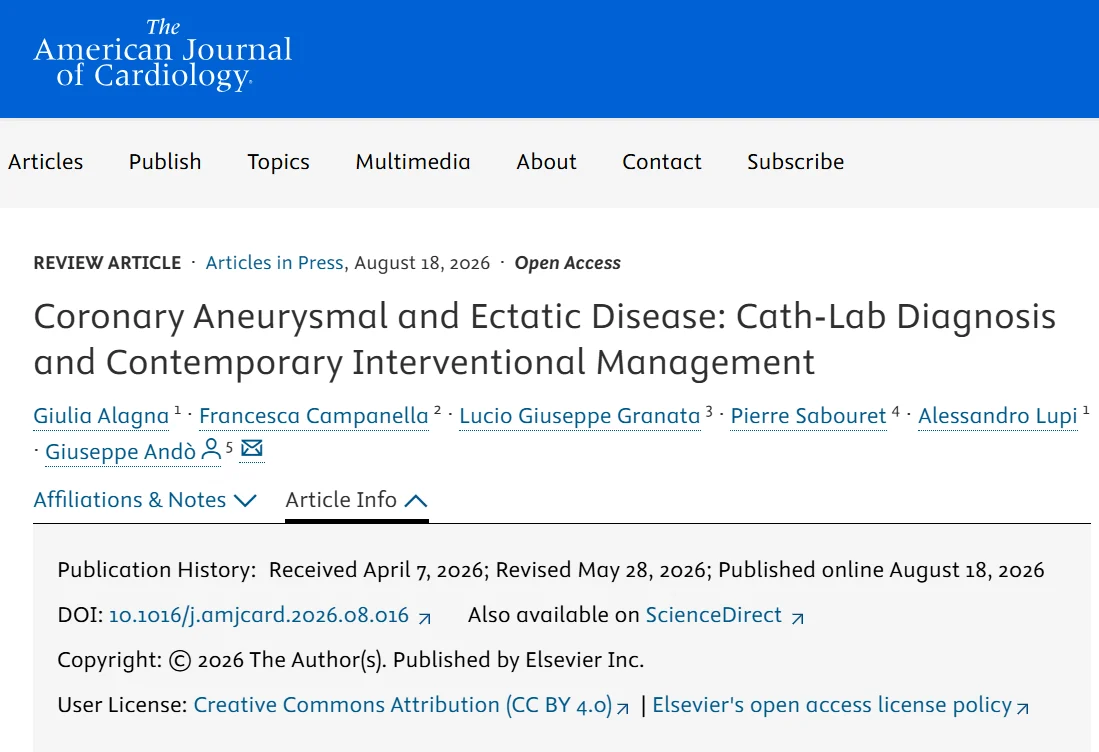
Title: Coronary Aneurysmal and Ectatic Disease: Cath-Lab Diagnosis and Contemporary Interventional Management
Authors: Giulia Alagna, Francesca Campanella, Lucio Giuseppe Granata, Pierre Sabouret, Alessandro Lupi, Giuseppe Andò
Stay updated with Hemostasis Today.
-
Oct 7, 2026, 11:44Megan Curtis: Raising Awareness of Pernicious Anaemia
-
Oct 7, 2026, 10:42Nasir K.: The Global Healthcare Community Comes Together for IPAW 2026
-
Oct 7, 2026, 09:20Maurizio Bertaina: Optimizing Anticoagulation in Temporary Mechanical Circulatory Support
-
Oct 7, 2026, 08:55Ifeanyichukwu Ifechidere: Cancer, Clotting and Bleeding – The Critical Role of Haemostasis in Oncology
-
Oct 7, 2026, 08:39Pediatric Hematology – Careers in Thrombosis and Blood Disorders – ASH Education
-
Oct 7, 2026, 07:57Edward Lee Carter: When Should Apixaban Become the Default for Acute VTE?
-
Oct 7, 2026, 07:40Annette Bowyer: Exploring New Developments in Thrombin Generation
-
Oct 7, 2026, 07:06Omid Seidizadeh: When Acquired von Willebrand Syndrome Takes Different Paths
-
Oct 7, 2026, 06:49Neeraj Songara: Can a Negative Antibody Screen Be Misleading?