


Jan Terje Andersen: Harnessing Placental Biology for Therapeutic Engineering
Jan Terje Andersen, Professor in Biomedical Innovation at University of Oslo, shared a post on LinkedIn, about a recent article he and his colleagues co-authored, published in Science Magazine Immunology, adding:
“From fundamental biology to new opportunities for therapeutic engineering
We are very excited to share our new study, published in Science Magazine Immunology, where we uncover a fundamental feature of placental biology – and show how it can inspire the design of next-generation biologic medicines.
Both IgG antibodies and albumin bind FcRn, which contributes to their remarkably long plasma half-lives.
But at the placenta, something striking happens: IgG is actively transported to the fetus, while albumin is largely excluded.
This led us to ask: Can we exploit this biological selectivity to engineer long-acting biologics with limited fetal exposure?
By fusing therapeutic antibodies or antibody fragments to albumin, we substantially reduced their transport across the placenta while retaining FcRn-mediated long plasma half-life.
With an engineered albumin variant, these properties could be further tuned through rational protein design.
Importantly, the findings were consistent across mouse models and an ex vivo human placental perfusion system.
In a model of fetal and neonatal alloimmune thrombocytopenia (FNAIT), restricting fetal transfer also reduced adverse effects in the offspring.
The work points toward an exciting opportunity: albumin-based engineering strategies for designing long-acting biologics with tailored fetal exposure profiles.
A huge congratulations to first author Jeannette Nilsen and to the fantastic team of national and international collaborators who made this work possible!”
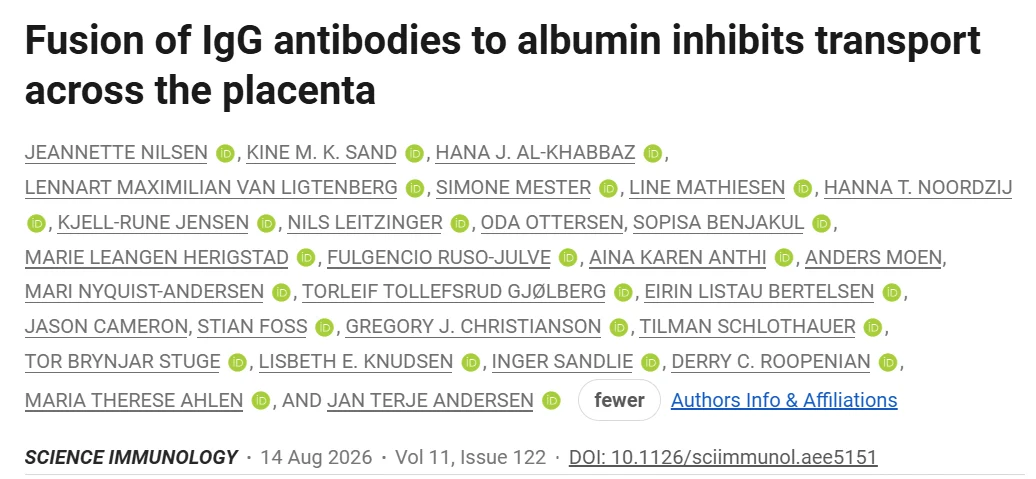
Title: Fusion of IgG antibodies to albumin inhibits transport across the placenta
Authors: Jeannette Nilsen, Kine M. K. Sand, Hana J. Al-Khabbaz, Lennart Maximilian van Ligtenberg, Simone Mester, Line Mathiesen, Hanna T. Noordzij, Kjell-Rune Jensen, Nils Leitzinger, Oda Ottersen, Sopisa Benjakul, M, Jason Cameron, Stian Foss, Gregory J. Christianson, Tilman Schlothauer, Tor Brynjar Stuge, Lisbeth E. Knudsen, Inger Sandlie, Derry C. Roopenian, Maria Therese Ahlen, Jan Terje Andersen
Stay updated on all scientific advances with Hemostasis Today.
-
Nov 21, 2026, 20:00Jeyda Star: The FAST Signs of Stroke and the Reality of Life Afterward
-
Nov 21, 2026, 19:59Daniel Lindholm: Women Showed the Largest Improvement in Stroke Risk Over Time in Heart Failure
-
Nov 21, 2026, 19:56Neil Arrowsmith: Raising Awareness of Pulmonary Embolism in Young People
-
Nov 21, 2026, 19:52Muhammad Zeeshan Jamal: Thrilled to Present Our Research on Intermediate-Risk Acute PE in Abu Dhabi
-
Nov 21, 2026, 19:50Mounisha Devireddy: Proud to Share Our Research on High-Risk PE in Pregnancy
-
Nov 21, 2026, 19:47Melissa Hollo: How Severe Anemia Increases the Odds of Acute HF During Pregnancy and Postpartum
-
Nov 21, 2026, 19:44Ashenafi Tazebew Amare: Building Sustainable Systems to Close the Anti-D Immunoglobulin Access Gap in LMICs
-
Nov 21, 2026, 19:43Sheharyar Raza: Interpreting Clotting Times Through Reptilase Time and Thrombin Time Assays
-
Nov 21, 2026, 19:42Minoo Ahmadinejad: Serving on the ISTH 2027 Scientific Theme Committee for Women’s Health