


Sangeeta Pathak: The Bombay Blood Group as a Very Rare Phenotype
Sangeeta Pathak, Senior Director and Head at Max Healthcare, shared a post on LinkedIn:
“What is a Bombay blood group:
The Bombay blood group (Oh or hh) is a very rare blood-group phenotype first described in Bombay (Mumbai), India.
People with the Bombay phenotype lack the H antigen on their red blood cells.
The H antigen is the precursor needed to form the A or B antigens.
Therefore, even if their genes are for A or B, their red cells do not express A or B antigens, so routine ABO typing can misleadingly appear to show group O.
They also usually have anti-H antibodies in their plasma, in addition to anti-A and anti-B.
Because ordinary group O blood contains H antigen, a person with Bombay phenotype generally cannot safely receive ordinary O blood.
They need compatible blood from another Bombay-phenotype donor.
How common is it in India?
The Bombay phenotype is estimated to occur in approximately 1 in 10,000 people in India, or about 0.01% of the Indian population.
Its frequency is higher in some regions and communities.
For comparison, worldwide it is much rarer – roughly 1 in 1,000,000 people, although estimates vary by population.
In short:
Bombay blood group is equal to hh/Oh phenotype plus absence of H antigen plus anti-H antibody plus approximately 0.01% (1 in 10,000) in India.
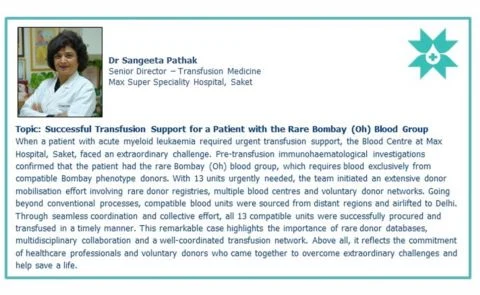
Very happy to be featured in ‘MedInsider’ a monthly news read by Max Hospitals for – Doctors setting benchmarks by managing challenging medical cases extraordinarily.
Do read the story given below related to Bombay blood group .”
Stay updated with Hemostasis Today.
-
Oct 20, 2026, 01:43Oliver Weingärtner: Deprescribing of Lipid Lowering Drug after MI is Associated with Cardiovascular Events
-
Oct 19, 2026, 19:44Where You Live Should not Determine Whether You Receive Care – World Federation of Hemophilia
-
Oct 19, 2026, 19:42Belen Bianco: Prevention, Early Suspicion and an Interdisciplinary Approach Save Lives
-
Oct 19, 2026, 19:40Christina Chrysohoou: Catheter-Based LAAC vs OAC for Stroke Prevention in Atrial Fibrillation
-
Oct 19, 2026, 19:38Matthew Flick: A Two-Day Research Meeting on Fibrinogen, Hemostasis and Thrombosis
-
Oct 19, 2026, 19:37Hayat Saeed: Excited to Share Our Publication on the FGL1–Hepcidin Axis in Iron Homeostasis and Disease
-
Oct 19, 2026, 19:08IPAW 2026 Comes to a Close, but the Work Continues – PPTA
-
Oct 19, 2026, 17:44Paul Riley: Moderating a Webinar on Anticoagulation Monitoring
-
Oct 19, 2026, 16:36Christopher Pittman: Blood Clot Prevention Cannot End at Hospital Discharge