


Rafael Gomes: CoCAP Study Challenges Prolonged DAPT After CABG
Rafael Gomes, Cardiologist, Echocardiographer, Ergometrist at Real Hospital Português, shared a post on LinkedIn:
“ESC Munich 2026 | Does DAPT improve vein graft patency after CABG?
After CABG for acute coronary syndrome, dual antiplatelet therapy is commonly resumed when bleeding risk allows.
But does ticagrelor plus aspirin actually keep saphenous vein grafts more patent than aspirin alone?
The CoCAP study, presented by Associate Professor Jonas Holm at European Society of Cardiology Congress 2026, addressed this question.
CoCAP was a prespecified imaging substudy of the randomized TACSI trial.
- 382 patients
- ACS patients undergoing CABG
- Ticagrelor plus aspirin versus aspirin alone for 12 months
- Coronary CT angiography performed around 20 months after surgery
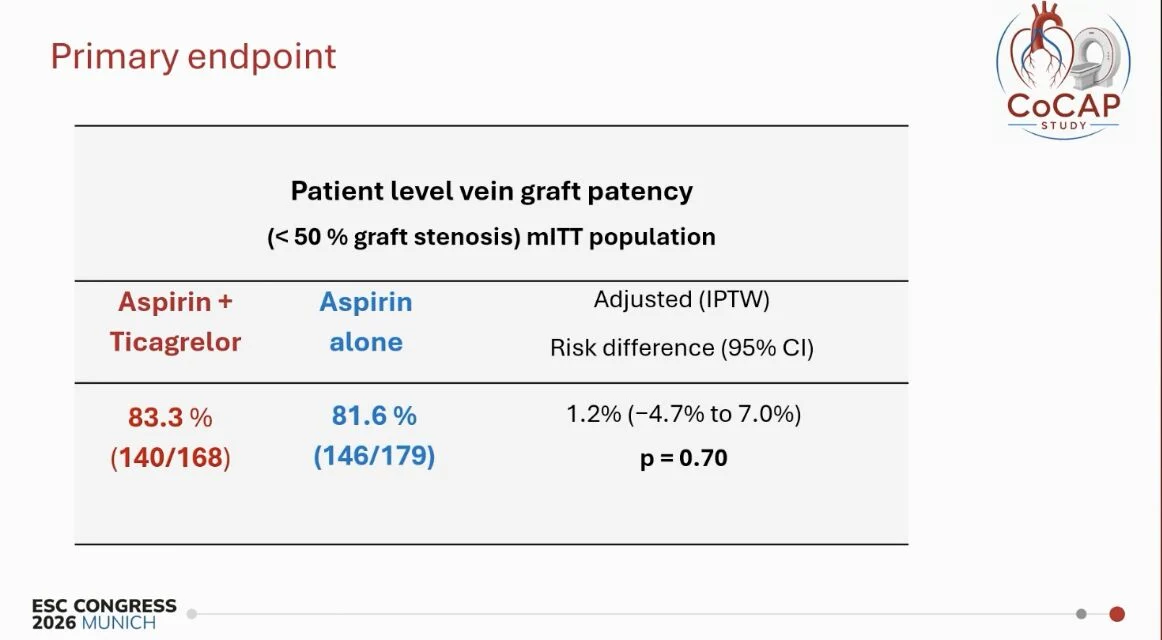
The primary endpoint was vein graft patency with less than 50 percent stenosis.
- Ticagrelor plus aspirin: 83.3 percent
- Aspirin alone: 81.6 percent
- Adjusted risk difference: 1.2 percent
- p=0.70
There was also no significant difference in graft non-occlusion when analyzed per patient, per graft, or per graft segment.
No subgroup showed a clear benefit from DAPT.
What does this mean for clinical practice?
The key message is simple:
Ticagrelor-based DAPT did not improve vein graft patency compared with aspirin alone.
This does not mean that DAPT has no role after CABG for ACS.
In these patients, DAPT may still be indicated because of the acute coronary syndrome itself, aiming to reduce recurrent ischemic events.
What CoCAP challenges is the idea of using prolonged ticagrelor-based DAPT specifically to keep the vein graft open.
Another important finding is that vein graft failure remains frequent even with contemporary therapy, affecting roughly 15–20 percent of patients or grafts in recent studies.
This reinforces that improving long-term CABG outcomes will likely require more than intensified antiplatelet therapy: surgical technique, arterial grafting, lipid lowering and better understanding of vein graft failure remain essential.
Bottom line:
After CABG for ACS, treat the ACS appropriately — but do not assume that more antiplatelet therapy means better vein graft patency.”

Stay updated with Hemostasis Today.
-
Oct 20, 2026, 01:43Oliver Weingärtner: Deprescribing of Lipid Lowering Drug after MI is Associated with Cardiovascular Events
-
Oct 19, 2026, 19:44Where You Live Should not Determine Whether You Receive Care – World Federation of Hemophilia
-
Oct 19, 2026, 19:42Belen Bianco: Prevention, Early Suspicion and an Interdisciplinary Approach Save Lives
-
Oct 19, 2026, 19:40Christina Chrysohoou: Catheter-Based LAAC vs OAC for Stroke Prevention in Atrial Fibrillation
-
Oct 19, 2026, 19:38Matthew Flick: A Two-Day Research Meeting on Fibrinogen, Hemostasis and Thrombosis
-
Oct 19, 2026, 19:37Hayat Saeed: Excited to Share Our Publication on the FGL1–Hepcidin Axis in Iron Homeostasis and Disease
-
Oct 19, 2026, 19:08IPAW 2026 Comes to a Close, but the Work Continues – PPTA
-
Oct 19, 2026, 17:44Paul Riley: Moderating a Webinar on Anticoagulation Monitoring
-
Oct 19, 2026, 16:36Christopher Pittman: Blood Clot Prevention Cannot End at Hospital Discharge