

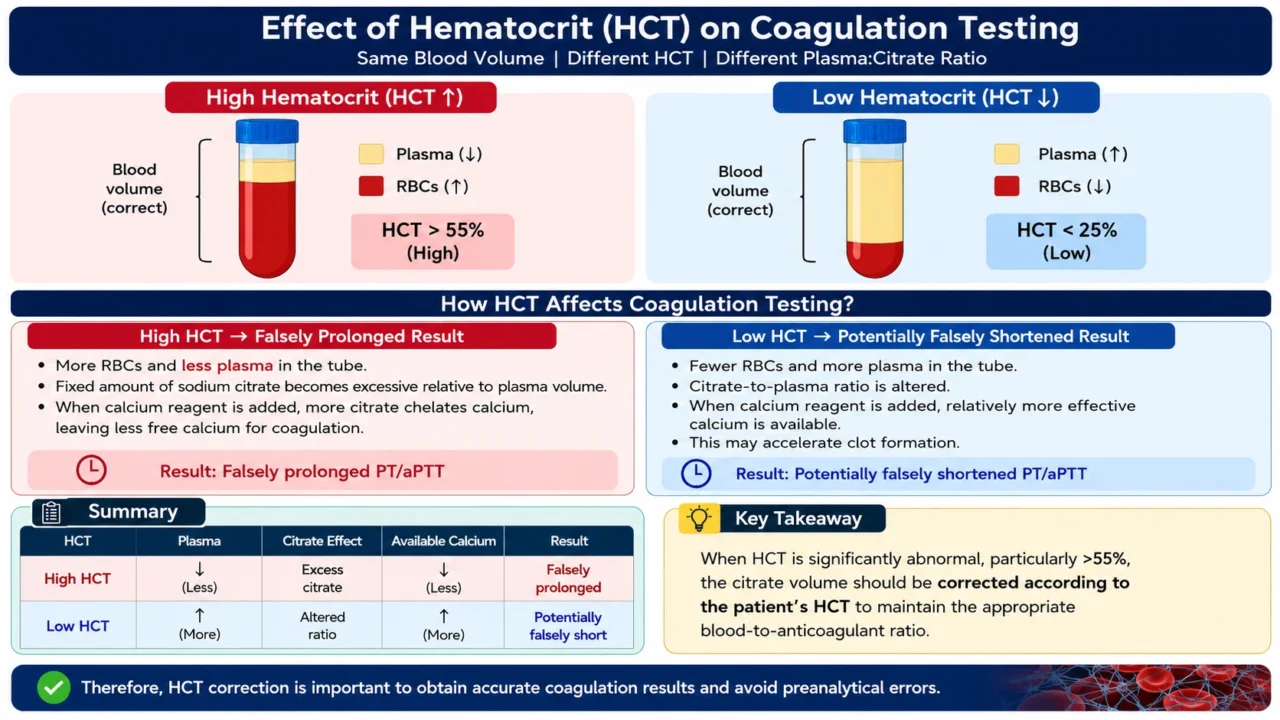
Omnia Ahmed: Effect of Hematocrit (HCT) on Coagulation Testing
Omnia Ahmed, Laboratory Technologist at Faculty of Medical Laboratory Sciences at University of Gezira, shared a post on LinkedIn:
”Effect of Hematocrit (HCT) on Coagulation Testing
What is HCT?
Hematocrit (HCT) is the percentage of whole blood volume occupied by red blood cells (RBCs).
When is HCT increased or decreased?
High HCT: Increased RBC volume
Can be seen in conditions such as dehydration, chronic hypoxia, smoking, or polycythemia.
Low HCT: Decreased RBC volume
Can occur due to blood loss, iron deficiency, nutritional deficiencies, chronic disease, or other causes of anemia.
How does this affect coagulation tests?
Assuming the blood volume was collected correctly, coagulation tubes normally maintain a 9:1 blood-to-sodium citrate ratio.
High HCT (Falsely Prolonged Result):
High HCT means more RBCs and less plasma. Therefore, the fixed amount of citrate becomes excessive relative to the plasma volume.
When calcium reagent is added during the test, the excess citrate can chelate more calcium, leaving less calcium available for coagulation.
Result: Falsely prolonged PT/aPTT.
Low HCT (Potentially Falsely Shortened Result):
Low HCT means fewer RBCs and more plasma. This changes the citrate-to-plasma relationship.
When calcium reagent is added, the altered citrate/plasma ratio can result in greater effective calcium availability, potentially accelerating clot formation.
Result: Potentially falsely shortened PT/aPTT.
Key Point:
The problem is not necessarily incorrect blood collection. The issue is the altered plasma-to-citrate ratio caused by an abnormal HCT.
What should we do?
When HCT is significantly abnormal, particularly greater than 55 percent, the citrate volume should be corrected according to the patient’s HCT to maintain the appropriate blood-to-anticoagulant ratio.
Therefore, HCT correction is important to obtain accurate coagulation results and avoid preanalytical errors.”
Stay updated with Hemostasis Today.
-
Oct 19, 2026, 19:44Where You Live Should not Determine Whether You Receive Care – World Federation of Hemophilia
-
Oct 19, 2026, 19:42Belen Bianco: Prevention, Early Suspicion and an Interdisciplinary Approach Save Lives
-
Oct 19, 2026, 19:40Christina Chrysohoou: Catheter-Based LAAC vs OAC for Stroke Prevention in Atrial Fibrillation
-
Oct 19, 2026, 19:38Matthew Flick: A Two-Day Research Meeting on Fibrinogen, Hemostasis and Thrombosis
-
Oct 19, 2026, 19:37Hayat Saeed: Excited to Share Our Publication on the FGL1–Hepcidin Axis in Iron Homeostasis and Disease
-
Oct 19, 2026, 19:08IPAW 2026 Comes to a Close, but the Work Continues – PPTA
-
Oct 19, 2026, 17:44Paul Riley: Moderating a Webinar on Anticoagulation Monitoring
-
Oct 19, 2026, 16:36Christopher Pittman: Blood Clot Prevention Cannot End at Hospital Discharge
-
Oct 19, 2026, 16:13Javier M. Floren: When Immune Cells Move With Their Environment