

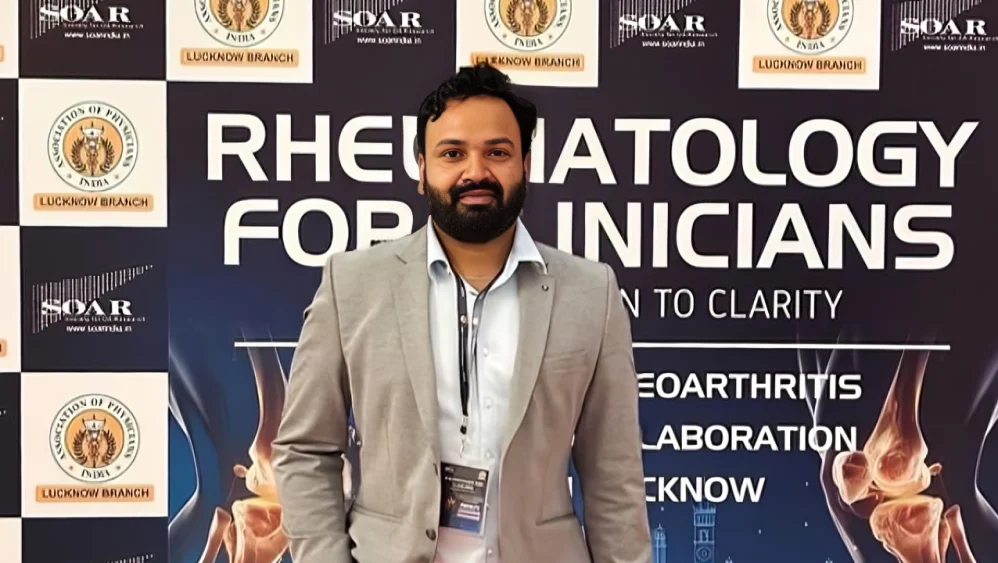
Mukesh Kumar Maurya: Beyond ‘aPL Thrombosis’ – A Modern Approach to APS
Mukesh Kumar Maurya, Assistant Professor of Clinical Immunology and Rheumatology at King George’s Medical University (KGMU), shared a post on X:
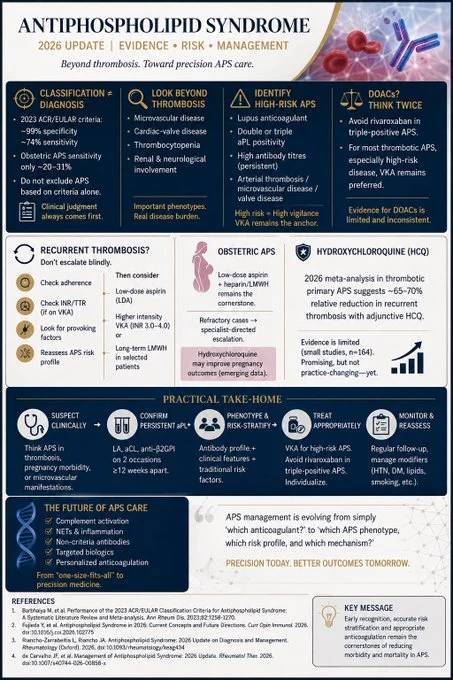
“Antiphospholipid Syndrome | 2026 update APS is no longer simply ‘aPL thrombosis.’
Think phenotype plus antibody profile plus thrombotic risk.
Classification is not diagnosis.
- 2023 ACR/EULAR criteria: approximately 99% specificity, approximately 74% sensitivity.
- Obstetric APS: sensitivity only approximately 20-31%.
Don’t rule out APS by the score alone.
Look beyond thrombosis.
- Microvascular disease,
- valve disease,
- thrombocytopenia,
- renal or neurological involvement are important APS phenotypes.
Identify high-risk APS.
- Lupus anticoagulant.
- Double or triple positivity.
- Arterial or microvascular disease.
VKA remains the anchor.
DOACs? Think twice.
Avoid rivaroxaban in triple-positive APS.
For most thrombotic APS – particularly high-risk disease – VKA remains preferred.
- Recurrent thrombosis?
Before intensifying therapy:
- Adherence – INR/TTR – provoking factors – APS risk profile.
- Then consider LDA / intensified VKA / LMWH in selected patients.
Obstetric APS
- LDA plus heparin or LMWH remains the foundation.
- Refractory disease – specialist-directed escalation; HCQ remains an emerging option.
HCQ: Promising, not practice – changing – yet
- 2026 data suggest fewer recurrent thrombotic events, but evidence remains small and heterogeneous.
Practical take-home
- Suspect clinically – confirm persistent aPL – phenotype or risk-stratify – choose anticoagulation accordingly.
High-risk APS? – VKA. Triple-positive? – Avoid rivaroxaban.
Recurrent event? – Investigate before simply escalating.
Obstetric APS? – LDA plus heparin or LMWH.
The future: precision APS care – not one-size-fits-all anticoagulation.”
Stay updated with Hemostasis Today.
-
Oct 19, 2026, 19:44Where You Live Should not Determine Whether You Receive Care – World Federation of Hemophilia
-
Oct 19, 2026, 19:42Belen Bianco: Prevention, Early Suspicion and an Interdisciplinary Approach Save Lives
-
Oct 19, 2026, 19:40Christina Chrysohoou: Catheter-Based LAAC vs OAC for Stroke Prevention in Atrial Fibrillation
-
Oct 19, 2026, 19:38Matthew Flick: A Two-Day Research Meeting on Fibrinogen, Hemostasis and Thrombosis
-
Oct 19, 2026, 19:37Hayat Saeed: Excited to Share Our Publication on the FGL1–Hepcidin Axis in Iron Homeostasis and Disease
-
Oct 19, 2026, 19:08IPAW 2026 Comes to a Close, but the Work Continues – PPTA
-
Oct 19, 2026, 17:44Paul Riley: Moderating a Webinar on Anticoagulation Monitoring
-
Oct 19, 2026, 16:36Christopher Pittman: Blood Clot Prevention Cannot End at Hospital Discharge
-
Oct 19, 2026, 16:13Javier M. Floren: When Immune Cells Move With Their Environment