


Guillaume Courbon: New Publication on Erythroid-Produced FGF23 and Its Role in Anemia
Guillaume Courbon, Assitant Professor at National Institute of Health and Medical Research (INSERM), shared a post on LinkedIn:
“Accepted earlier this year, our work is featured this month’s issue of Blood:
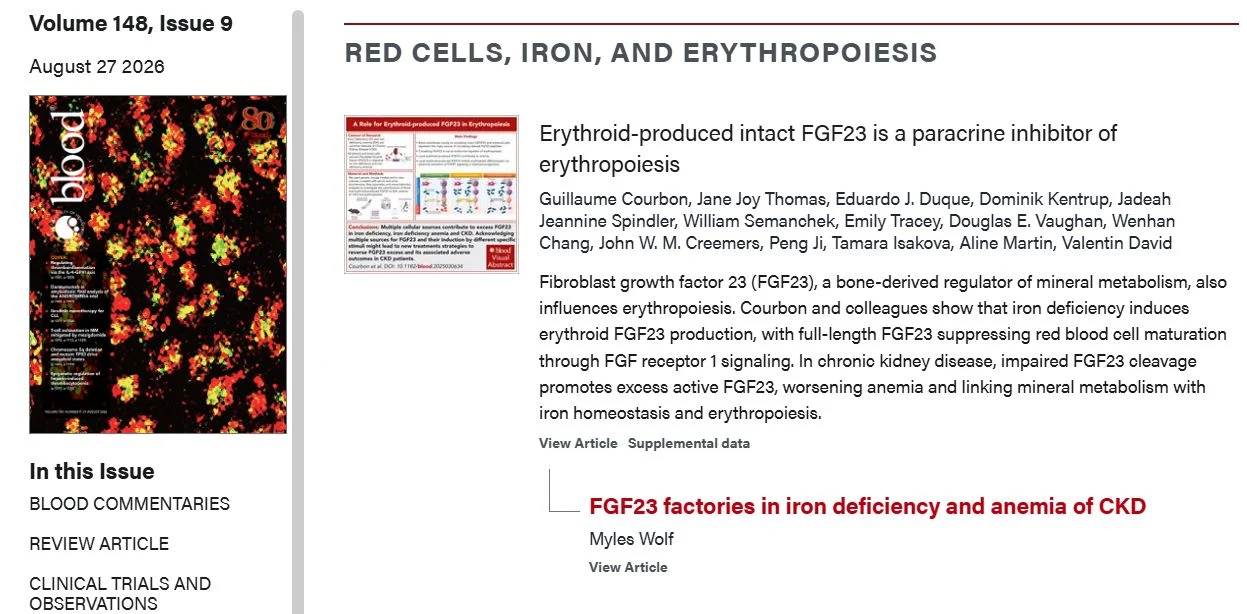
‘Erythroid-produced intact FGF23 is a paracrine inhibitor of erythropoiesis‘
FGF23 is best known as a hormone produced by bone cells to regulate phosphate homeostasis. But our work reveals another, rather unexpected, side of FGF23 biology.
It’s been known for quite a while that intact FGF23 (iFGF23) production and cleavage move alongside iron metabolism, and iron deficiency is a trigger to excess iFGF23 in patients not able to get rid of it.
We show that, under iron deficiency, erythroid cells produce iFGF23, which acts locally in the bone marrow to inhibit erythropoiesis.
Using genetic models, we found that:
- erythroid-derived iFGF23 contributes directly to anemia in iron deficiency
- production of iFGF23 in erythroid cells aggravates anemia
- iFGF23 directly impairs erythroid progenitor differentiation through FGFR1, associated with mitochondrial dysfunction
- and, importantly, targeting deletion of Fgf23 in erythroid alleviates anemia in a model of progressive chronic kidney disease
These findings suggest that FGF23 has functions extending well beyond phosphate regulation, and highlight a potential link between iron metabolism, erythropoiesis, FGF23 and anemia.
This work was led by Dr Valentin David from Northwestern University – The Feinberg School of Medicine and was made possible thanks to all co-authors, including Drs Jane Joy Thomas, Aline Martin, Peng Ji, Tamara Isakova and the entire team involved in this project.
I am happy to see this work ‘officially’ published, excited about the questions it opens for the field, and looking forward to our continued collaboration in my current position.”
Title 1: Erythroid-produced intact FGF23 is a paracrine inhibitor of erythropoiesis
Authors: Guillaume Courbon, Jane Joy Thomas, Eduardo J. Duque, Dominik Kentrup, Jadeah Jeannine Spindler, William Semanchek, Emily Tracey, Douglas E. Vaughan, Wenhan Chang, John W. M. Creemers, Peng Ji, Tamara Isakova, Aline Martin, Valentin David
Read the Full Article on Blood
Title 2: FGF23 factories in iron deficiency and anemia of CKD
Authors: Myles Wolf
Read the Full Article on Blood
Title 3: Role of erythroid fibroblast growth factor 23 in regulating erythropoiesis
Authors: Tilman B. Drüeke, Ziad A. Massy
Read the Full Article on Kidney International

Stay updated on all scientific advances with Hemostasis Today.
-
Oct 19, 2026, 19:44Where You Live Should not Determine Whether You Receive Care – World Federation of Hemophilia
-
Oct 19, 2026, 19:42Belen Bianco: Prevention, Early Suspicion and an Interdisciplinary Approach Save Lives
-
Oct 19, 2026, 19:40Christina Chrysohoou: Catheter-Based LAAC vs OAC for Stroke Prevention in Atrial Fibrillation
-
Oct 19, 2026, 19:38Matthew Flick: A Two-Day Research Meeting on Fibrinogen, Hemostasis and Thrombosis
-
Oct 19, 2026, 19:37Hayat Saeed: Excited to Share Our Publication on the FGL1–Hepcidin Axis in Iron Homeostasis and Disease
-
Oct 19, 2026, 19:08IPAW 2026 Comes to a Close, but the Work Continues – PPTA
-
Oct 19, 2026, 17:44Paul Riley: Moderating a Webinar on Anticoagulation Monitoring
-
Oct 19, 2026, 16:36Christopher Pittman: Blood Clot Prevention Cannot End at Hospital Discharge
-
Oct 19, 2026, 16:13Javier M. Floren: When Immune Cells Move With Their Environment