


Jin-Xiong She: Homocysteine beyond Heart Disease – The Methylation-Mobility Connection
Jin-Xiong She, Founder and CEO at Jinfiniti Precision Medicine, shared a post on LinkedIn:
“Longevity is not merely living longer.
It’s preserving the capacity to move, recover, and stay independent.
Homocysteine gets discussed almost exclusively as a heart disease marker.
That’s only part of what it reflects.
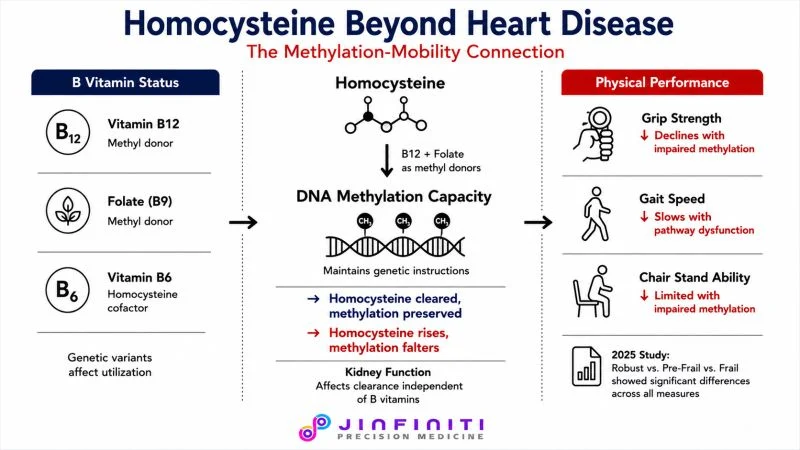
A 2025 study followed 170 older adults, grouped as robust, pre-frail, or frail.
Researchers measured B vitamins, homocysteine, and something less commonly tested: global DNA methylation, a marker of how well the body maintains its own genetic instructions over time.
- Chair stand ability, gait speed, and grip strength differed significantly across the three groups
- Folate and B6 levels varied depending on specific genetic variants tied to methylation
- Homocysteine sits directly in the same metabolic pathway as both
This is association-based research, not proof that lowering homocysteine prevents frailty.
But the biology behind it makes sense.
Homocysteine is cleared through a pathway that depends on B12 and folate acting as methyl donors, the same donors your body needs for DNA methylation more broadly.
When that pathway runs poorly, homocysteine tends to rise, methylation tends to falter, and physical performance may be part of what shows up downstream.
Most people only think to check homocysteine after a cardiovascular concern.
Grip strength and gait speed rarely prompt anyone to check it at all.
Kidney function matters too, since impaired clearance can elevate homocysteine independent of B vitamin status.
The mobility we associate with aging well may be tracking a metabolic pathway more directly than most people realize.”
Stay updated with Hemostasis Today.
-
Oct 19, 2026, 19:44Where You Live Should not Determine Whether You Receive Care – World Federation of Hemophilia
-
Oct 19, 2026, 19:42Belen Bianco: Prevention, Early Suspicion and an Interdisciplinary Approach Save Lives
-
Oct 19, 2026, 19:40Christina Chrysohoou: Catheter-Based LAAC vs OAC for Stroke Prevention in Atrial Fibrillation
-
Oct 19, 2026, 19:38Matthew Flick: A Two-Day Research Meeting on Fibrinogen, Hemostasis and Thrombosis
-
Oct 19, 2026, 19:37Hayat Saeed: Excited to Share Our Publication on the FGL1–Hepcidin Axis in Iron Homeostasis and Disease
-
Oct 19, 2026, 19:08IPAW 2026 Comes to a Close, but the Work Continues – PPTA
-
Oct 19, 2026, 17:44Paul Riley: Moderating a Webinar on Anticoagulation Monitoring
-
Oct 19, 2026, 16:36Christopher Pittman: Blood Clot Prevention Cannot End at Hospital Discharge
-
Oct 19, 2026, 16:13Javier M. Floren: When Immune Cells Move With Their Environment