


Neeraj Songara։ TRAGS – When Alpha-Gal Meets ABO Compatibility
Neeraj Songara, Resident Doctor at Dr S.N. Medical College Jodhpur, shared a post on LinkedIn about a recent article by Richard M. Kaufman et al., published in JAMA Internal Medicine, adding:
“TRAGS: When Alpha-Gal Meets ABO Compatibility
A new transfusion reaction entity is challenging how we think about ‘compatible’ blood components.
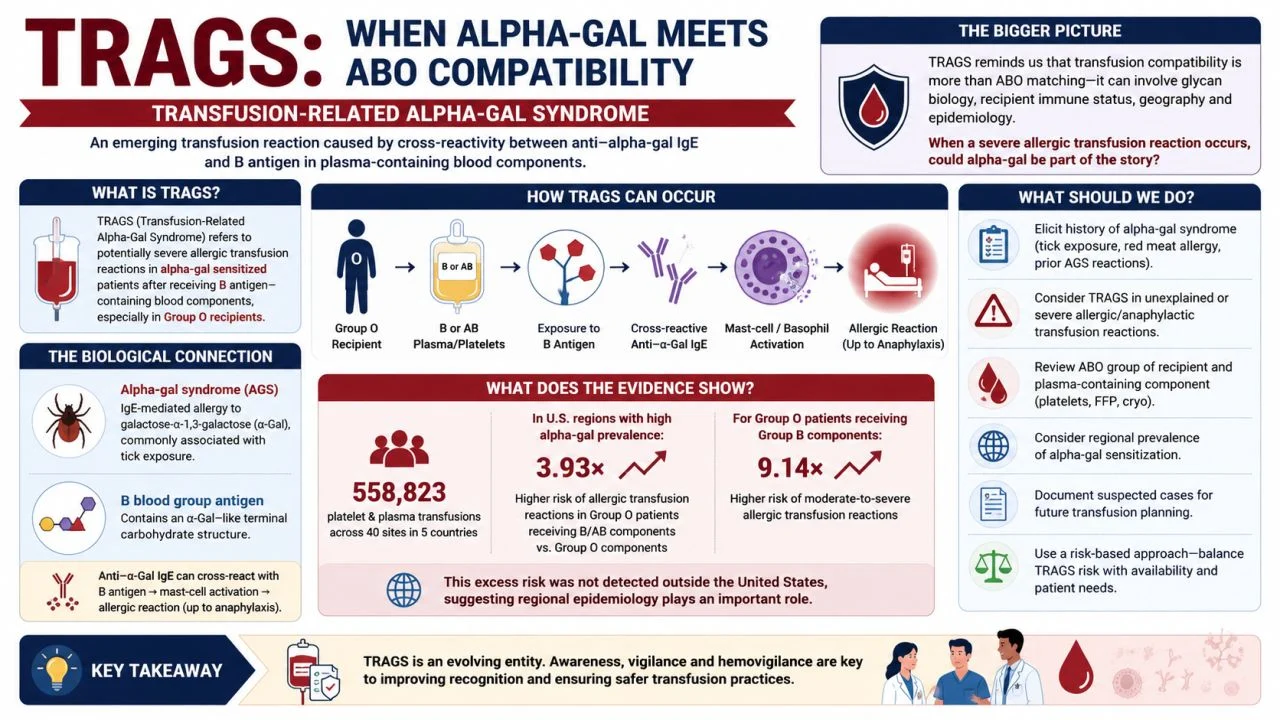
TRAGS – Transfusion-Related Alpha-Gal Syndrome – refers to a potentially severe allergic transfusion reaction associated with alpha-gal sensitization and exposure to Group B antigen, particularly when Group O patients receive Group B or AB plasma-containing components.
Alpha-gal syndrome (AGS) is an IgE-mediated allergy against galactose-α-1,3-galactose (α-Gal), commonly associated with tick exposure.
The intriguing part is that the B blood group antigen contains an α-Gal–like terminal carbohydrate structure.
In a sensitized individual, anti-α-Gal IgE may therefore recognize B-antigen-containing material.
This creates a potential scenario:
- Group O recipient plus α-Gal sensitization leads to
- Group B/AB plasma or platelets results in
- Exposure to B antigen triggers
- Cross-reactive anti-α-Gal IgE causes
- Mast-cell/basophil activation induces
- Allergic reaction which leads to potentially anaphylaxis
Why is this important for transfusion medicine?
ABO compatibility of plasma and platelets is often more complex than simply asking whether the component is ՛compatible.՛
Group O patients may receive Group B or AB plasma-containing components, particularly during emergencies, inventory constraints, or platelet transfusion where ABO-identical products are unavailable.
Recent multicenter epidemiologic data involving 558,823 platelet and plasma transfusions found a significantly higher rate of allergic transfusion reactions among Group O patients receiving B/AB components in US regions with high alpha-gal prevalence.
For Group O recipients receiving B or AB components in these high-prevalence regions, the overall risk ratio for allergic reactions was 3.93 compared with Group O components.
Interestingly, this signal was not detected outside the United States, highlighting how geography and the prevalence of alpha-gal sensitization may influence risk.
What should transfusion services take away?
- Recognizing a history of alpha-gal syndrome
- Considering TRAGS in unexplained or unusually severe allergic/anaphylactic transfusion reactions
- Reviewing the ABO group of the recipient and transfused plasma-containing component
- Considering regional prevalence of alpha-gal sensitization
- Documenting suspected cases carefully for future transfusion planning
- Developing risk-based strategies rather than blanket restrictions
Transfusion compatibility is not always just:
ABO – Rh – antibody screen – crossmatch․
The biology of the recipient, donor plasma, glycan structures, environmental exposures and regional epidemiology can intersect in unexpected ways.”
Title: Epidemiologic Study of Transfusion-Related Alpha-Gal Syndrome
Authors: Richard M. Kaufman, Anne G. Hoen, Jenna Khan, C. Michael Knudson, Ryan A. Metcalf, Andres E. Mindiola Romero, Allison Mo, Richard Schäfer, Minoko Takanashi, Nancy M. Dunbar
Stay updated with Hemostasis Today.
-
Sep 12, 2026, 11:55Susan Shea: Can Coagulation Changes Predict Kidney Injury After Trauma?
-
Sep 12, 2026, 11:08William Wallace: The Neurologic Consequences of Vitamin B12 Deficiency
-
Sep 12, 2026, 10:58Jean Amiral: Reagent-Dependent Factor X Activity in a Novel Calcium-Sensitive Variant
-
Sep 12, 2026, 10:41Alan Nurden: Genetic Complexity Behind Bleeding Severity in Glanzmann Thrombasthenia
-
Sep 12, 2026, 10:31Priyanka Raheja: A Multidisciplinary Approach to Rare Bleeding Disorders in Pregnancy
-
Sep 12, 2026, 10:16Nova Sinclair: The Changing Landscape of Blood Disorders
-
Sep 12, 2026, 10:02Sheharyar Raza: How Machine Learning Could Transform Blood Donation
-
Sep 12, 2026, 09:49Carrie Gillies: Join the D-Dimer Webinar – From Testing to Clinical Decisions
-
Sep 12, 2026, 09:37Kristy Henderson: Iron and Autoimmunity – The Connection We Are Missing?