

Mick Thompson: 2026 AHA/ACC Pulmonary Embolism Guidelines and the Evolving Role of Mechanical Thrombectomy
Mick Thompson, Senior Manager, Global Continuing Education at Stryker, shared a post on LinkedIn:
“Do the new 2026 AHA or ACC Pulmonary Embolism Guidelines mean we should treat fewer patients?
I’ve heard that question a lot lately.
After spending the past several months digging deeply into the new guidelines, teaching them, and discussing them with others working in the PE space, my answer is:
I don’t think that’s what the new guidelines say at all.
The new system gives us a much more granular picture of the patient in front of us. Importantly, it looks beyond blood pressure alone to determine whether a patient is in cardiogenic shock the penultimate turn of the PE Death Spiral.
That same nuance applies to advanced therapies.
For C2 C3 patients, mechanical thrombectomy carries a Class 2b recommendation: ‘the benefit is unclear.’
But ‘benefit is unclear’ does not mean ‘do not treat.’
Those are two very different statements. And here is where I think the distinction is getting lost:
‘The benefit is unclear’ does not mean mechanical thrombectomy is contraindicated, nor does it mean it has been shown to have no benefit.
It means the available evidence has yet to definitively establish that mechanical thrombectomy improves outcomes being evaluated compared with anticoagulation alone.
As patients become sicker, the recommendation becomes even stronger: MT may be considered in D1 D2 and is reasonable in E1.
Clinical guidelines are designed to inform a physician’s clinical judgment, not replace it.
The new guidelines do not suddenly make PE patients who were deemed appropriate for treatment before inappropriate now. A patient who warranted intervention before AHA does not suddenly stop warranting it simply because the framework changed.
If anything, the new AHA guidelines bring mechanical thrombectomy more clearly into the treatment conversation.
Where ESC largely positioned catheter based intervention as a rescue strategy for deteriorating or very high risk patients, AHA explicitly recognizes MT as a treatment option across multiple categories of PE severity.
And by better recognizing patients with normotensive shock, we may end up identifying additional patients who warrant consideration for intervention before further decompensation can occur patients who may have gone unrecognized and untreated before.
So when I look at these new guidelines, I don’t see a door being closed on advanced PE therapy. I see a better map, a more explicit framework within which physicians can apply their clinical judgment.
As randomized clinical evidence continues to emerge, that map will surely continue to change.
That is exactly what good evidence based medicine is supposed to do.
References
- 2026 AHA or ACC or ACCP or ACEP or CHEST or SCAI or SHM or SIR or SVM or SVN Guideline for the Evaluation and Management of Acute Pulmonary Embolism in Adults
- 2019 ESC Guidelines for the Diagnosis and Management of Acute Pulmonary Embolism
Views expressed are my own and are intended for clinical education and discussion.”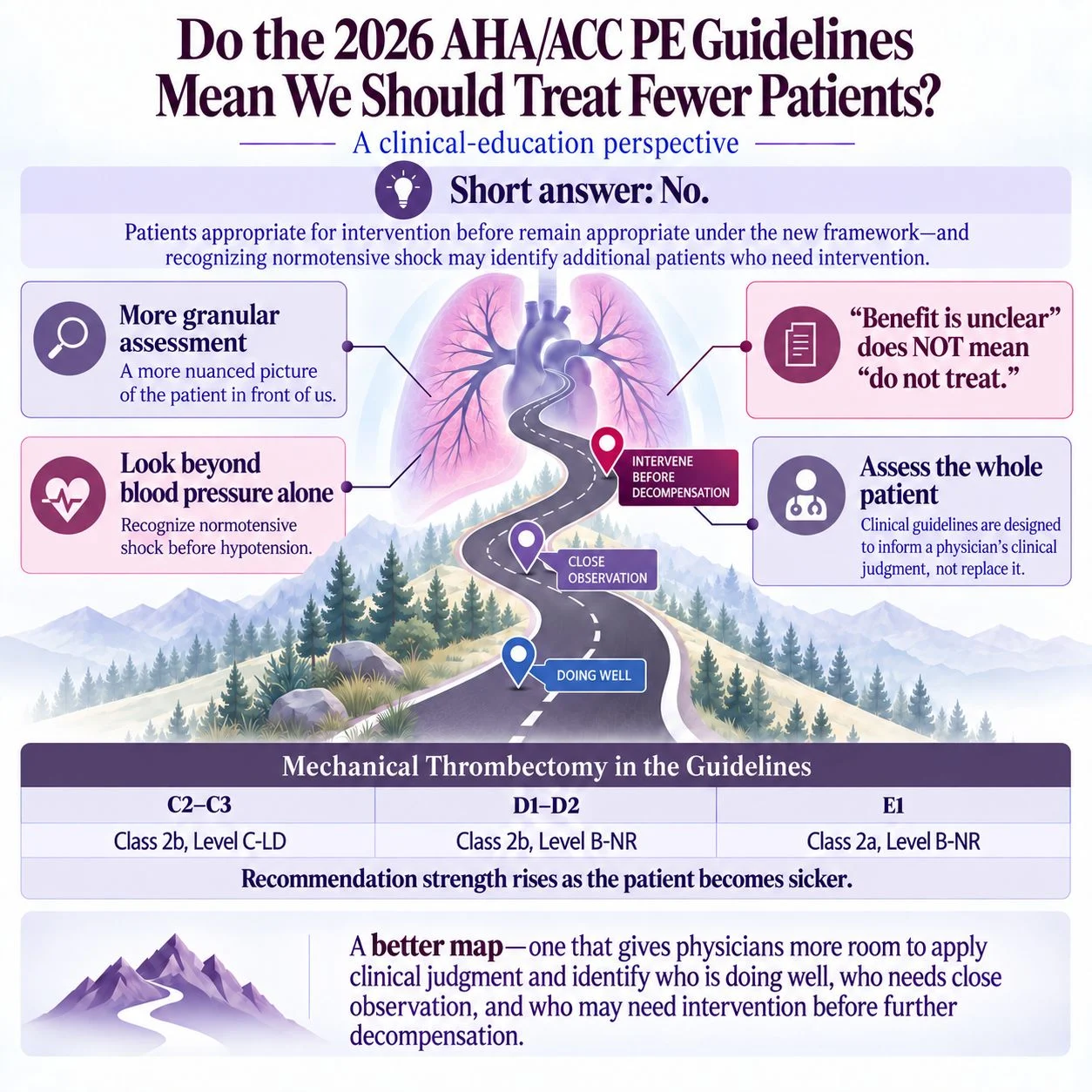
Stay updated with Hemostasis Today.
-
Sep 12, 2026, 14:18Arun V J: A Love Letter to Transfusion Medicine Through Greek Mythology
-
Sep 12, 2026, 14:05Chokri Ben Lamine: Ruxolitinib Safety – Practical Reminders for Hematologists Monitor Blood Counts
-
Sep 12, 2026, 13:53Marta Velia Antonini: Incidence and Outcomes of ECMO Circuit Failure in Children
-
Sep 12, 2026, 13:47Rob Mac Sweeney: How Venoarterial ECMO Can Affect the Gastrointestinal System
-
Sep 12, 2026, 13:46Ishac Nazy: A Newly Uncovered Mechanism Behind a Dangerous Blood-Clotting Disorder
-
Sep 12, 2026, 13:43Latchumanadhas Kalidoss: PETROS vs Infusion Thrombolysis in Mitral Valve Thrombosis
-
Sep 12, 2026, 13:38Claudio Mauro: The Protective Role of Hyodeoxycholic Acid in Liver Cancer
-
Sep 12, 2026, 13:14Jamie Nash: Honoured With the Race and Sanger Award
-
Sep 12, 2026, 13:04James P. Crowley: Blood Thinners After Fracture – Weighing Clot and Bleeding Risks