


Kalyan Roy: TRAGS – An Emerging Transfusion Safety Concern
Kalyan Roy, Transfusion Medicine Specialist at Square Hospitals LTD, shared a post on LinkedIn:
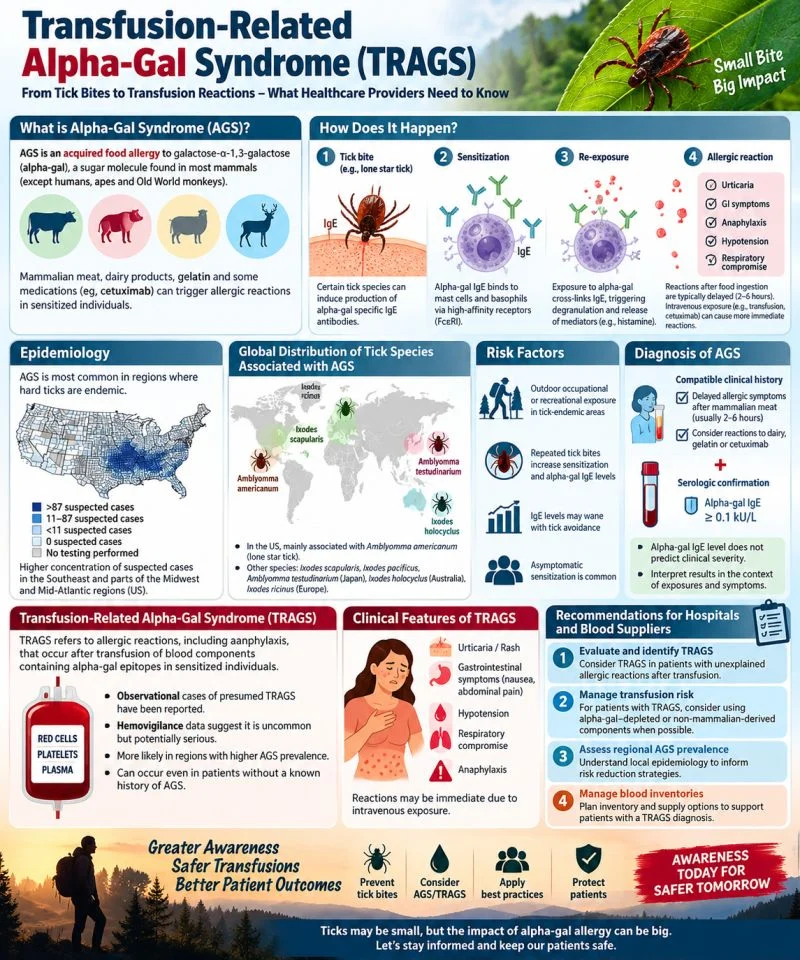
“Transfusion-Related Alpha-Gal Syndrome (TRAGS): An Emerging Transfusion Safety Concern
TRAGS a newly recognized form of severe allergic transfusion reaction, particularly concerning in group O patients receiving group B or AB plasma or platelets.
Key Takeaways
What is Alpha-Gal Syndrome (AGS)?
AGS is an acquired allergy associated with IgE antibodies against galactose-α-1,3-galactose (alpha-gal), often triggered by certain tick bites. Reactions can range from urticaria and GI symptoms to anaphylaxis, hypotension, and respiratory compromise.
Why is TRAGS important?
TRAGS is hypothesized to occur when a patient with pre-existing alpha-gal IgE receives B-antigen–containing platelets or plasma, with possible cross-reactivity between alpha-gal and the ABO B antigen.
Reported cases are concerning:
As of July 5, 2026, 9 presumed TRAGS cases had been reported. All patients were group O, all experienced anaphylaxis after receiving group B or AB platelets or plasma, and one death was reported.
Emerging epidemiological evidence:
In high-AGS-prevalence regions, group O recipients receiving group B or AB plasma or platelets were found to have approximately a 4-fold higher risk of an acute transfusion reaction compared with group O recipients receiving group O components.
Practical Implications for Transfusion Services
- Consider TRAGS in a group O patient with a severe allergic reaction after B or AB platelets or plasma.
- Test serum for alpha-gal IgE; 0.1 kU/L or higher is considered compatible with TRAGS.
- Consider additional investigations such as serum tryptase and IgA when appropriate.
- If TRAGS is diagnosed, avoid B-antigen–containing platelets or plasma in future transfusions and consider allergy or immunology evaluation.
- Transfusion services in medium- to high-prevalence regions should consider targeted risk-reduction strategies, while carefully assessing their impact on blood inventories.
Emergency transfusions should not be withheld because of concerns about TRAGS.
The Bigger Picture
TRAGS remains rare and its overall incidence is currently undefined, but accumulating mechanistic, clinical, and epidemiological evidence supports increased vigilance—particularly in regions where AGS is prevalent. AABB emphasizes that risk-reduction strategies must be balanced against maintaining an adequate blood supply.
My Key Message for Transfusion Medicine Professionals
Think beyond ABO compatibility.
In selected patients, the interaction between Alpha-Gal sensitization and B-antigen exposure may represent an important, underrecognized cause of severe allergic transfusion reactions.
Awareness, followed by recognition, investigation, and prevention
Reference: AABB”
Find more posts featuring Kalyan Roy on Hemostasis Today.
-
Sep 12, 2026, 17:55Dries De Wolf: Honored to Have Wolfgang Miesbach Comment on Our Latest Research
-
Sep 12, 2026, 17:53Usman Waheed: Introducing the Discovery of the 49th ISBT Blood Group System
-
Sep 12, 2026, 17:51Maria Sabater Lleal: Happy to Share Our Latest Work Exploring the Genetic Determinants of PE in VTE
-
Sep 12, 2026, 17:51Jeff Sternlicht: Why LDL-C and ApoB Remain King of the Hill?
-
Sep 12, 2026, 17:48Jason Fung: What Happened to “Statins Save Lives”?
-
Sep 12, 2026, 17:47Eric Topol: Most Supplements and Vitamins Offer Little Proven Benefit
-
Sep 12, 2026, 17:44Manuel Monreal: Clinical Characteristics, Treatment, and Outcomes in Hispanic vs Caucasian Patients With VTE
-
Sep 12, 2026, 17:43Sidi Mohamed El Amine Benlazar: CPX-351 and Ruxolitinib in Advanced-Phase Myeloproliferative Neoplasms
-
Sep 12, 2026, 17:42Elad Asher: Higher IPF Is Associated with Adverse Outcomes in ICCU