


Tiffany Hall: Why Standard Pre-Op Labs Miss High-Risk Patients?
Tiffany Hall, Director of cPBM Clinical Technology at hc1, shared a post on LinkedIn:
“1 in 3 patients walks into elective surgery anemic – and current diagnostic thresholds may be hiding even more.
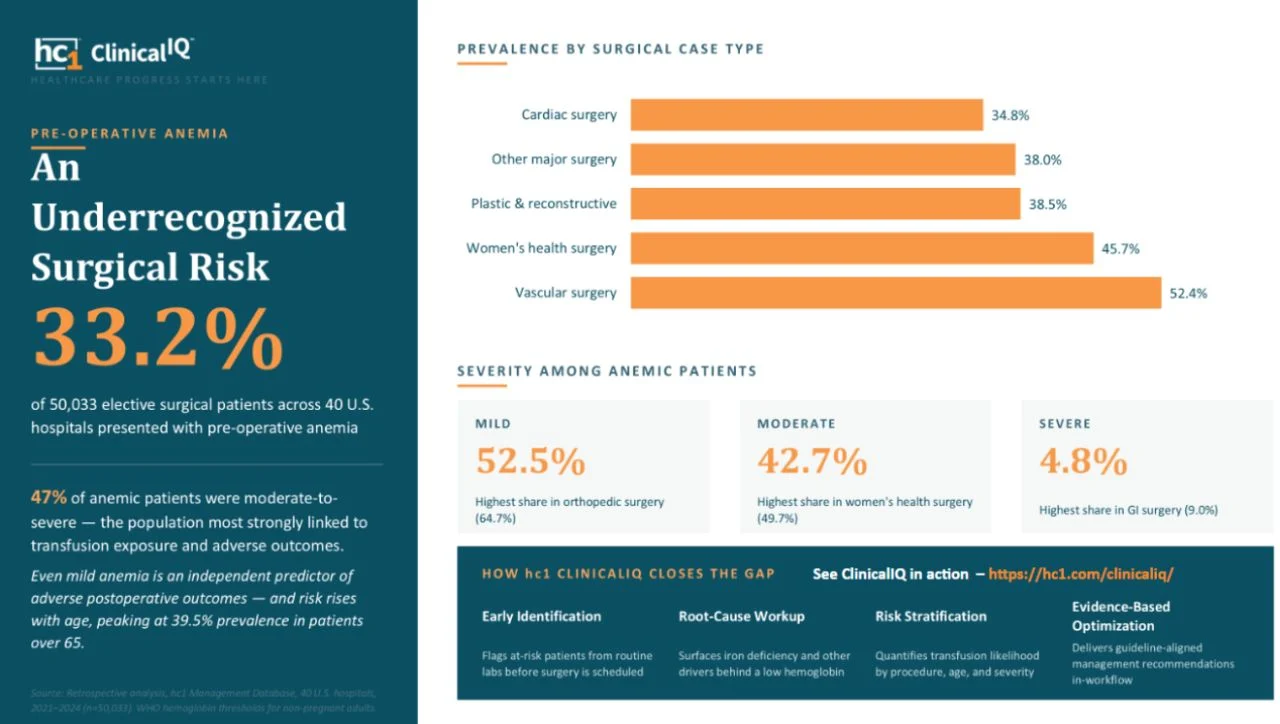
Melissa Hollo and Tiffany Hall analyzed pre-operative hemoglobin data from 50,033 patients across 40 U.S. hospitals (2021–2024) and found pre-operative anemia in 33.2% of them – with vascular surgery (52.4%) and women’s health surgery (45.7%) carrying the heaviest burden.
47% of those anemic patients were moderate-to-severe, the population most strongly linked to transfusion exposure and worse postoperative outcomes.
Even ‘mild’ anemia is an independent predictor of adverse events on its own, with risk climbing steadily with age (39.5% prevalence in patients over 65).
But here’s the missed opportunity underneath these numbers: we still diagnose anemia using sex-specific thresholds (Hb is low than 12 g/dL for women, is low than 13 g/dL for men) that don’t reflect actual physiologic oxygen delivery requirements during surgery.
Emerging evidence and international consensus recommendations now point to a uniform pre-operative threshold of is low than 13 g/dL for all patients, regardless of sex.
Applying the lower, sex-specific cutoff for women likely underestimates true anemia prevalence – meaning a meaningful share of at-risk women are being cleared for surgery who wouldn’t be under a physiologically grounded standard.
That’s the difference between a diagnostic threshold that was never built for the operating room and one that actually predicts surgical risk.
hc1 ClinicalIQ’s anemia management module closes that gap in-workflow – flagging at-risk patients from routine labs, surfacing the root cause, stratifying transfusion risk, and delivering evidence-based optimization recommendations before surgery day.
Analysis by Tiffany Hall and Melissa Hollo, hc1 Management Database (2021–2024, n=50,033, 40 U.S. hospitals).”
Stay updated with Hemostasis Today.
-
Sep 13, 2026, 17:28Jim Hoffman: New Potential Predictive Biomarker for Lupus Nephritis
-
Sep 13, 2026, 17:08W. Alberto Sifuentes Giraldo: Urticarial Vasculitis Clinical Features, Systemic Involvement, and Treatment
-
Sep 13, 2026, 16:58Let’s Debunk Some Myths about Blood in SCD – ASCO
-
Sep 13, 2026, 16:56William Wallace: A Magnesium Ion Decides Whether Your Brain Learns or Not
-
Sep 13, 2026, 16:54Meet NBDF’s 2026 Excellence Fellowship Recipients – National Bleeding Disorders Foundation
-
Sep 13, 2026, 16:52Kaloyan Takov: Native Lp(a) Carries a Distinct Triglyceride Signature Linked to Cardiovascular Disease
-
Sep 13, 2026, 16:51Axay Tomar: How Simulation-Based Education Shapes Safer Transfusion Practices
-
Sep 13, 2026, 16:51Edina Cenko: AZURE-HeFH Highlights the LDL-C Treatment Gap in HeFH
-
Sep 13, 2026, 16:49William Aird: Why Is LDH Elevated In Splenic Infarction?