


Priya Prasad: How Frequent Blood Donors Can Prevent Hidden Iron Deficiency
Priya Prasad, Senior Specialist at Caritas Hospital, shared a post on LinkedIn:
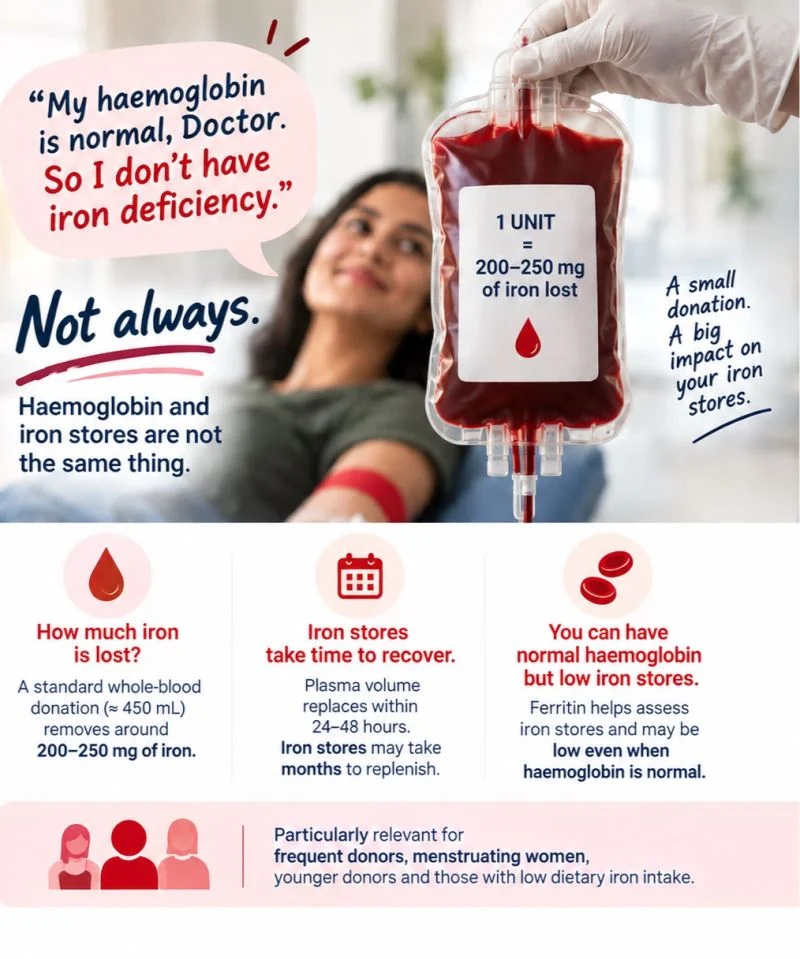
“‘My haemoglobin is normal, Doctor. So I don’t have iron deficiency.’
Not always!
One of the most important things we can teach our blood donors is that haemoglobin and iron stores are not the same thing.
What happens to iron when we donate blood?
A standard whole-blood donation removes approximately 450 mL of blood and around 200–250 mg of iron along with the red blood cells.
The donated plasma volume is replaced relatively quickly.
Red-cell mass and haemoglobin take longer to recover.
But the bigger issue is that iron stores may take considerably longer to replenish.
And repeated donations can progressively reduce those stores.
Therefore, a donor can have:
- Acceptable haemoglobin
- Low ferritin / depleted iron stores
Even before overt iron-deficiency anaemia develops.
This is why relying on haemoglobin alone may not identify every donor who is becoming iron depleted.
Who is particularly vulnerable?
Iron depletion deserves particular attention in:
- Frequent blood donors
- Menstruating women
- Women with heavy menstrual bleeding
- Younger donors
- Donors with low dietary iron intake
- Donors with a previous history of iron deficiency
Does this mean we should discourage blood donation?
Absolutely not!
Voluntary blood donation remains one of the most valuable contributions an individual can make to healthcare.
A message for donors:
If you are a frequent donor – particularly if you are a menstruating woman , talk to your healthcare professional about whether your iron stores may need assessment.
And a message for transfusion professionals:
Our responsibility does not end when the blood bag is labelled and stored.
The donor is also someone whose health we are responsible for protecting.”
Stay updated on all scientific advances with Hemostasis Today.
-
Sep 13, 2026, 17:28Jim Hoffman: New Potential Predictive Biomarker for Lupus Nephritis
-
Sep 13, 2026, 17:08W. Alberto Sifuentes Giraldo: Urticarial Vasculitis Clinical Features, Systemic Involvement, and Treatment
-
Sep 13, 2026, 16:58Let’s Debunk Some Myths about Blood in SCD – ASCO
-
Sep 13, 2026, 16:56William Wallace: A Magnesium Ion Decides Whether Your Brain Learns or Not
-
Sep 13, 2026, 16:54Meet NBDF’s 2026 Excellence Fellowship Recipients – National Bleeding Disorders Foundation
-
Sep 13, 2026, 16:52Kaloyan Takov: Native Lp(a) Carries a Distinct Triglyceride Signature Linked to Cardiovascular Disease
-
Sep 13, 2026, 16:51Axay Tomar: How Simulation-Based Education Shapes Safer Transfusion Practices
-
Sep 13, 2026, 16:51Edina Cenko: AZURE-HeFH Highlights the LDL-C Treatment Gap in HeFH
-
Sep 13, 2026, 16:49William Aird: Why Is LDH Elevated In Splenic Infarction?