


Reza Shojaei: Blood and Plasma Donors Are Not a Production Metric
Reza Shojaei, Chief Operating Officer at Canadian Plasma Resources, shared a post on LinkedIn:
“Rethinking operational excellence in blood and plasma collection
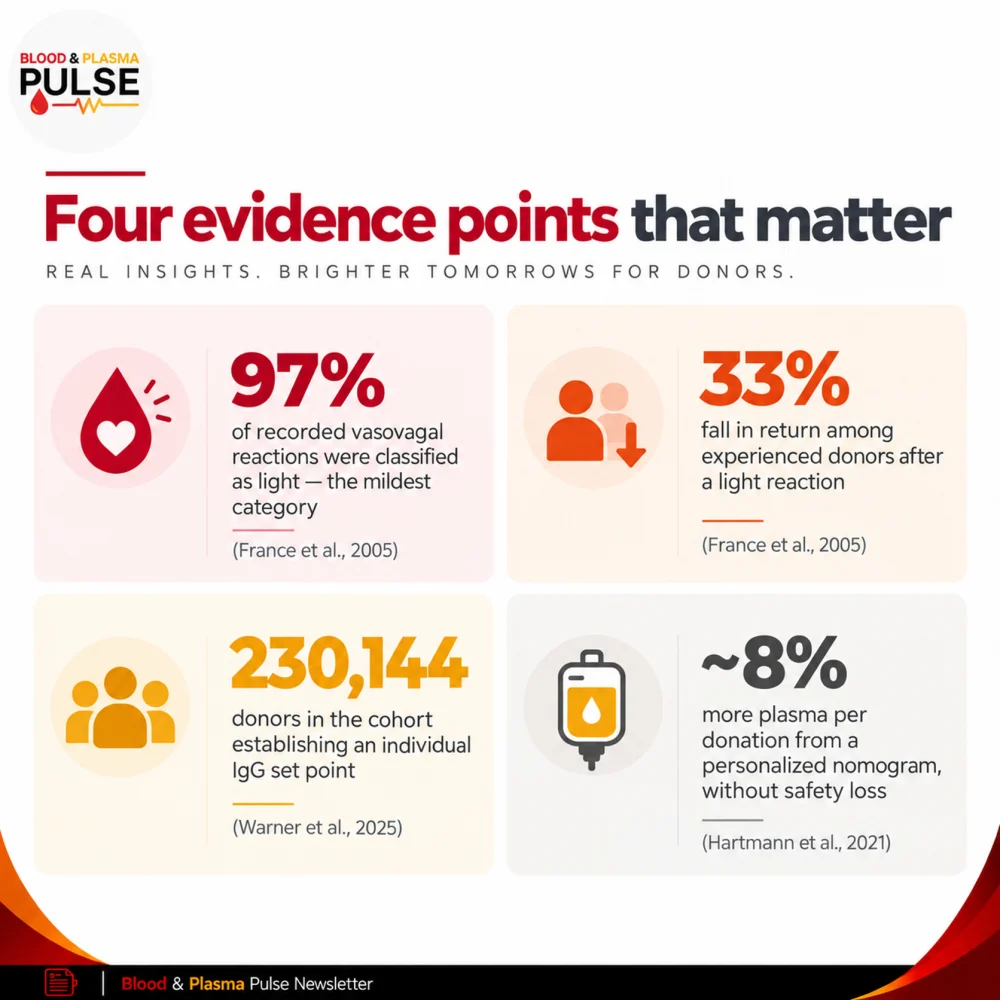
In 2005, researchers followed 89,587 whole blood donors from a single American Red Cross region for a full year after donation. Moderate and severe vasovagal reactions cut the likelihood of a repeat donation by half or more (France et al., 2005). That surprised nobody.
The finding that should still be on every collection executive’s wall is the other one. Light reactions, which accounted for 97% of everything recorded, reduced return rates by 20% among first-time donors and 33% among experienced donors (France et al., 2005).
Ninety-seven percent of our adverse events are the ones we classify as trivial. They are also the ones quietly emptying the chairs.
Every one of those donations was counted as a success. Every one appeared in the day’s collection total, in the productivity report, in the month-end variance. And a meaningful share of them were the last donation that donor would ever make.
That is what this issue is about. Not a bad metric. A metric that is accurate, useful, and blind at exactly the point where it matters most.
Executive Summary
Blood and plasma collection organizations are, by necessity, metric-driven. Donations per hour, litres per centre, chair utilization, cycle time, cost per collection, appointments filled: these numbers keep licensed operations solvent, staffed, and supplied.
Nothing here argues for fewer metrics. It argues against a specific failure mode: optimizing a metric rather than the system it was meant to describe.
The evidence for that failure mode is unusually strong in our sector, because we have something rare in operations: a supply input that remembers how it was treated. A donor can register as one successful collection on today’s dashboard while simultaneously becoming one donor permanently lost from the future supply base. Both events are real. Only one is counted, and it is counted with a plus sign.
The evidence is now specific enough to act on. Adverse reactions, including mild ones, measurably depress return (France et al., 2005; Thijsen and Masser, 2019).
The dominant determinants of plasma donor retention are not motivational but environmental: accessibility, scheduling, and staff support (Etherington et al., 2026).
Return intention among new Canadian plasma donors is driven by what researchers call relational care, meaning attentive staff who have the time to be attentive (Seeley et al., 2025).
And donation frequency, the most direct lever we have on short-term yield, is bounded by donor physiology in ways that randomized and large-cohort studies have only recently quantified (Haugen et al., 2025; Warner et al., 2025).
The central tension is not efficiency versus experience. Framed that way, efficiency wins every quarter, because efficiency reports monthly and donor attrition reports never. The real tension runs between two time horizons that use the same word, performance, to mean opposite things.
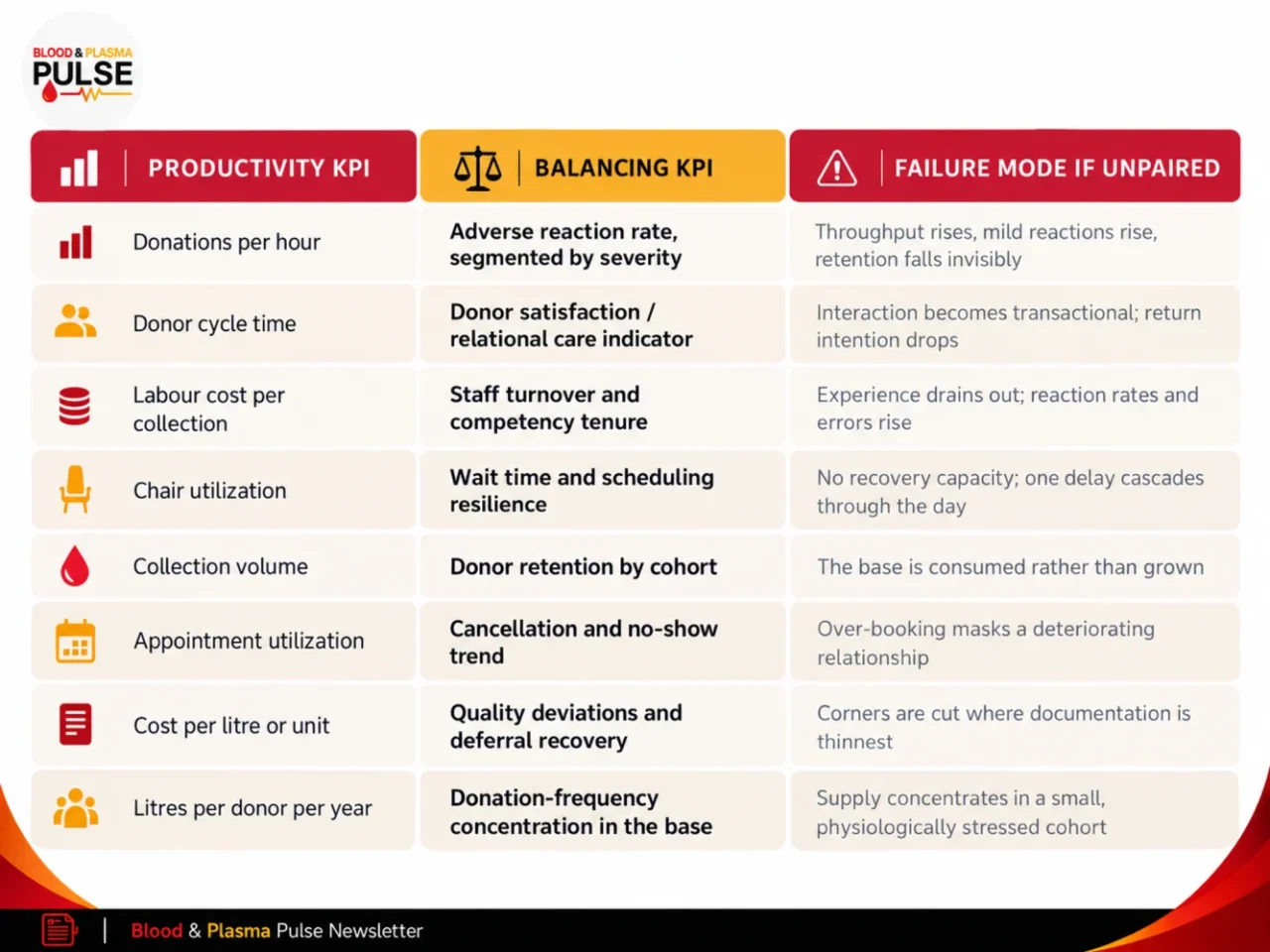
The leadership conclusion is a discipline, not a slogan: every productivity KPI in a collection organization should carry a named balancing KPI, reviewed at the same table, at the same cadence, by the same executive. Unpaired metrics measure how capable operators are of dealing damage while hitting the target.
Why This Matters Now
Three forces have converged to make this a 2026 problem rather than a permanent abstraction.
The growth lever has stopped working
For a decade, collection organizations bought volume by opening buildings. Industry compilations drawing on the Marketing Research Bureau and Jaworski’s Blood Plasma Quarterly report that the United States closed 2025 with roughly 1,247 plasma collection centers, up from 478 in 2014, but with only nine centers added during 2025, under 1% growth against an approximate 11% annual average across the preceding decade (The World Data, 2026).
Whatever the precise figures, no one operating in the market disputes the direction: prime catchments are saturated, and the expansion era is closing.
When you can no longer add chairs, every additional liter must come out of the chairs you have. That is precisely the condition under which single-dimensional productivity targets become dangerous.
Regulators are moving toward system-level obligations
Regulation (EU) 2024/1938 applies from 7 August 2027.
It requires substances-of-human-origin establishments to register with competent authorities, submit to regular inspections, appoint a physician responsible for donor eligibility criteria and investigations of serious adverse reactions, and, drawing directly on pandemic lessons, maintain supply-continuity arrangements for critical substances (European Commission, n.d.; Hogan Lovells, 2024).
Separately, the FDA‘s Center for Biologics Evaluation and Research convenes a roundtable on 29 September 2026 to identify supply chain vulnerabilities across blood and source plasma manufacturing (U.S. Food and Drug Administration, 2026).
The regulatory direction of travel is toward continuity and resilience as measurable obligations. Neither is visible in a throughput metric.
The donor-side evidence base matured this year
A meta-synthesis published in 2026 pooled 20 qualitative studies covering 1,310 participants and mapped 131 belief statements to 13 of the 14 Theoretical Domains Framework domains. The largest single cluster was Environmental Context and Resources, accessibility, scheduling, and staff support (Etherington et al., 2026).
A 2026 United Kingdom study of 488 plasma donors found that donors described same-day deferral as an embarrassing ‘walk of shame,’ a deterrent unique to plasma donors, and that 11.8% reported feeling unwell after donation (Desai et al., 2026).
Read those findings as an operator rather than a researcher. Accessibility is scheduling policy. Staff support is an establishment and training budget.The walk of shame is queue design and screening choreography.
Feeling unwell is hydration protocol, chair time, and post-donation observation.Every dominant driver of donor retention identified in that literature is an operational decision made by someone carrying a productivity target.
The Issue Explained
Collection organizations maintain two ledgers that are never reconciled.
The first is the operating ledger. In blood collection, it holds collections per mobile, appointments filled, units collected, donor throughput, chair utilization, cancellation rate, labour efficiency, and cost per collection.
In plasma collection, it holds donations per hour, litres collected, yield, chair utilization, donor cycle time, labour cost per litre, and centre productivity. This ledger is reported weekly, drives compensation, and is the language the organization uses to speak to its board and parent company.
The second ledger is the donor base itself, the population of eligible, willing, physiologically capable, and psychologically committed people who will present again. This is the actual production asset. It appears in no operating report, because it has no closing balance. It is inferred later from a retention curve that turns down for reasons nobody logged at the time.
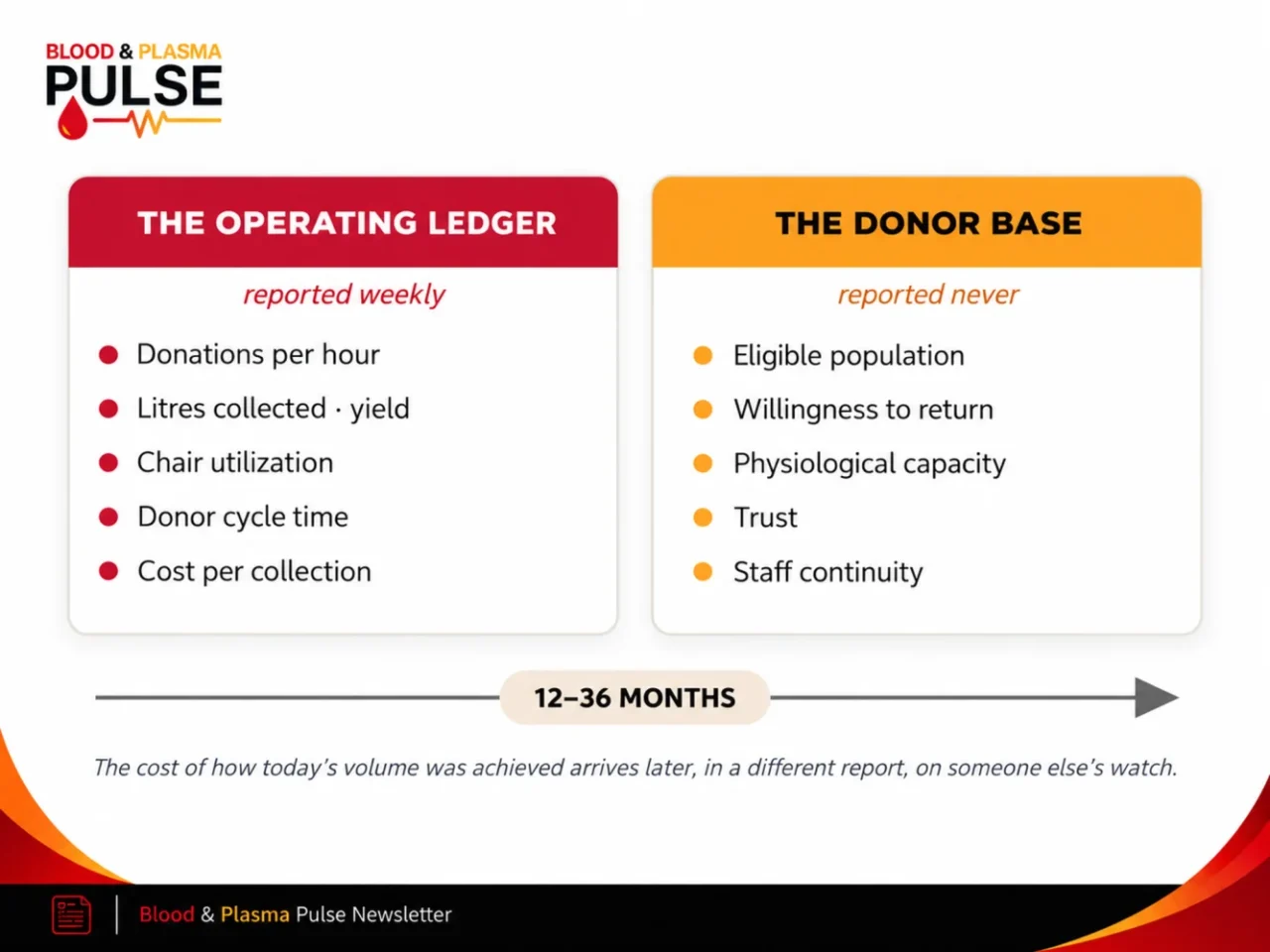
The gap between the ledgers is not a measurement failure. It is a timing mismatch, and by the time the second ledger reports, the manager who moved the first has usually been promoted, transferred, or replaced.
One mechanism specifically worsens the mismatch in our sector.
Adverse events are the primary driver of retention loss, and the mildest ones do most of the damage by volume. Vasovagal reactions have the strongest negative effect on donor return among all adverse event types (Thijsen and Masser, 2019).
In Australia, return fell by 27% among whole blood donors and 22% among plasma donors following a vasovagal reaction (Thijsen and Masser, 2019).
Because mild events dominate the count, an organization can hold a nominally excellent adverse event rate while steadily grinding down its own base.
A donor can appear as one successful collection in a dashboard while simultaneously becoming one future donor lost to the system.
The Evidence
Efficiency gains that reverse themselves
The pattern is well established outside our sector and directly transferable. Goodhart’s law — as commonly rendered, that a measure ceases to be a good measure once it becomes a target (Strathern, 1997) — has been documented repeatedly in health systems.
Evidence reviews of NHS performance targets found that targets did drive improvement in the measured domain while also producing gaming, misinterpretation, and prioritization by target rather than clinical need (The Health Foundation, 2015).
Analysis of New Zealand‘s emergency department target found gaming behaviour that varied by organization and over time, with consequences including erosion of trust in the performance system itself (Tenbensel et al., 2020).
Health systems did not abandon measurement in response. They moved from single-headline targets to bundled indicator sets. That is the correct lesson for collection operations, and it is available to us without repeating the intervening decade of harm.
Mild reactions, major attrition
The effect was first identified in small and restricted donor samples (France et al., 2004), then confirmed at scale in a full-year follow-up of an entire regional donor population. What the larger study added was the distribution, and it matters operationally because it locates attrition within the category most collection organizations treat as noise.
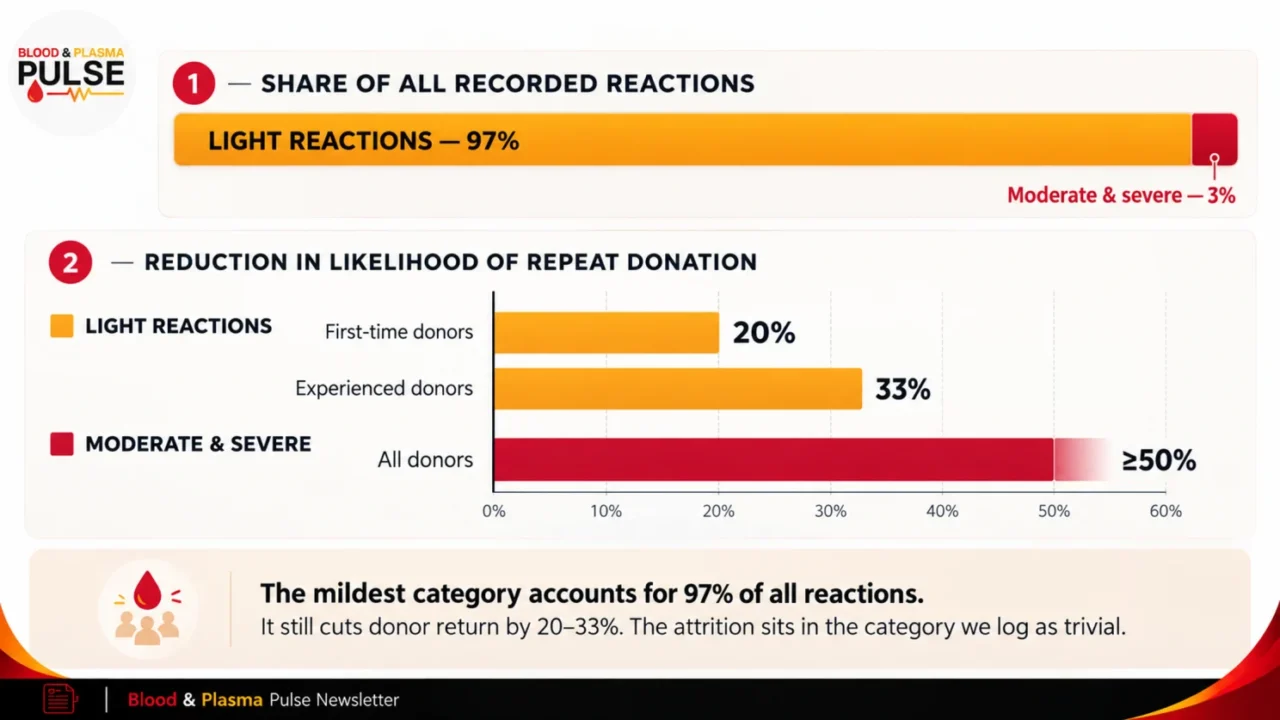
Note: Data are from a whole blood donor cohort in a single American Red Cross region and should not be presented as plasma-specific.
The donor experience is manufactured by operations
Etherington et al. (2026) is the most useful recent paper for executives in this sector, and it is not usually read as an operations paper. Twenty studies, 1,310 participants, 131 belief statements across 13 of 14 domains.
Barriers concentrated in logistical constraints, limited understanding, and negative emotional responses. Enablers included trust in institutions, supportive staff, donor identity, and pride. The single largest domain was Environmental Context and Resources.
Seeley et al. (2025) interviewed 48 new Canadian plasma donors and found that interest in returning was facilitated by relational care — donors cared for by attentive staff, who in turn felt able to care for others by donating.
Holloway’s (2023) ethnography of nurses and phlebotomists at one of Canadian Blood Services‘ first source plasma centres frames the same phenomenon from the staff’s perspective, describing it explicitly as emotional labour and noting evidence that positive interactions with centre staff motivate donors to return.
Put those together and a specific operating conclusion follows. Relational care requires uncommitted staff time. Uncommitted staff time is the first thing eliminated when donations per labour hour becomes the governing target. The retention mechanism and the productivity mechanism draw on the same finite resource, and only one of them has an associated number.
Frequency, yield, and the limits of the chair
When expansion stops, pressure shifts to yield per donor. The frequency evidence sets a boundary on how far that can go.
A systematic review of plasmapheresis frequency concluded that very high-frequency donation, twice weekly, as permitted in the United States, may produce clinically relevant decreases in ferritin and bring IgG below the EDQM threshold of 6 g/L, while noting that the underlying evidence is of low to very low certainty (D’aes et al., 2024).
The authors’ recommendation deserves a second read by anyone building a collection strategy: a sustainable and stable plasma supply may be better served by a large number of donors donating at a lower frequency than by a small number donating at a higher frequency (D’aes et al., 2024).
That is a supply chain design principle stated in a donor safety paper. Concentration risk applies to donors in exactly the same way it applies to suppliers.
The other yield lever is volume per donation, and it is not ours to set.
The FDA source plasma nomogram, issued as a memorandum in November 1992 and still governing collection today, defines three weight brackets: 625 mL for donors between 110 and 149 lbs, 750 mL from 150 to 174 lbs, and 800 mL at 175 lbs and above (U.S. Food and Drug Administration, 1992).
Height, body mass index and haematocrit were deliberately excluded to reduce the risk of human error during what was then a manual, labour-intensive process (Hartmann et al., 2020).
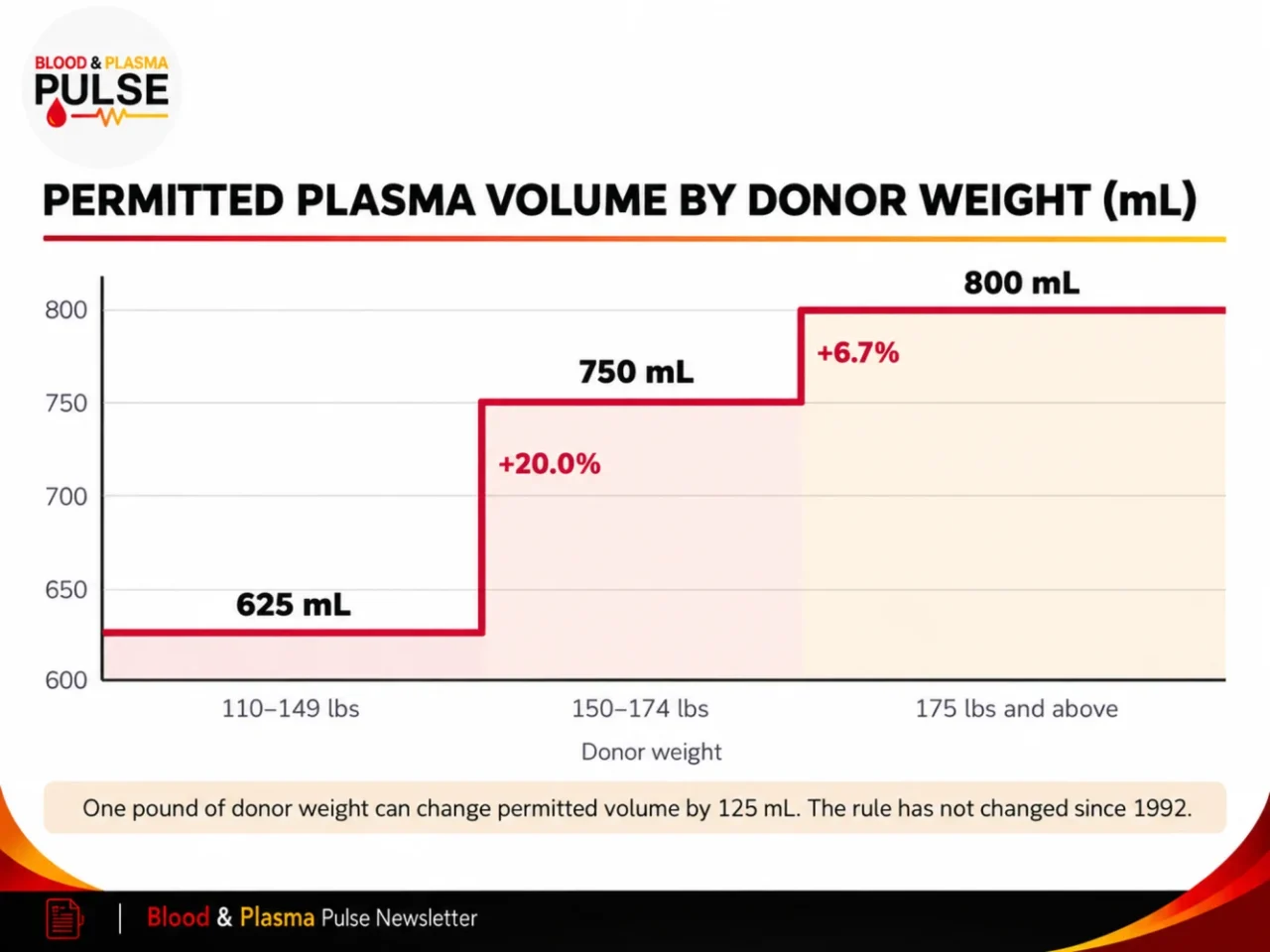
As a result, the proportion of a donor’s total plasma volume actually collected varies widely between individuals, forming three discrete bands that correspond to weight brackets rather than individual physiology (Hartmann et al., 2020).
And here the argument turns, because the alternative has been tested. In a multicentre randomized controlled trial, a technology-enabled personalized nomogram allowed roughly 8% more plasma to be collected per donation without impairing donor safety (Hartmann et al., 2021).
That result deserves careful reading by anyone who assumes the yield conversation is a donor-experience trade-off. The available yield gain came from measuring the individual donor more precisely, not from moving them through faster. Better measurement produced more plasma and preserved safety. The trade-off we habitually accept was never the only option.
So the yield equation has one term fixed by a 34-year-old regulatory simplification, one term bounded by donor physiology, and one term: how the donor is treated while in the building, entirely under operational control and almost entirely unmeasured. It is not difficult to predict which one absorbs the pressure.
Stakeholder Perspectives
- Donors: experience the system as a sequence of small frictions and small kindnesses. The research is consistent: they weigh convenience, predictability, respect, and physical comfort, and a single bad experience carries disproportionate weight (Desai et al., 2026; Etherington et al., 2026; Seeley et al., 2025). Compensated donors are not exempt. Payment changes the motivational mix; it does not make a bruised arm, a two-hour wait, or a humiliating deferral neutral.
- Patients are the ultimate stakeholder in donor sustainability, and their interest is unambiguously long-term. A patient on lifelong immunoglobulin therapy needs a supply base that still exists in 2035. Nothing about short-horizon yield maximization serves that interest if it degrades the base.
- Collectors and operators are not villains here. They work under real cost pressure, real supply commitments and real capital discipline, and the metrics they are held to are largely inherited rather than chosen. The argument is that the metric set is incomplete, not that the people running to it are indifferent.
- Fractionators and manufacturers contract on litres and specifications. Very little in a standard supply agreement creates any incentive for donor base health at the collection end. That is a gap in commercial design worth naming.
- Regulators are moving toward exactly this territory. Donor protection provisions, serious adverse reaction reporting and supply continuity obligations under the SoHO Regulation are, functionally, mandated balancing metrics (European Commission, n.d.).
- Frontline staff carry the entire relational load and appear in the operating ledger only as a cost line. Blood centres have documented persistent turnover among entry-level phlebotomists (ADRP, 2025), and the wider laboratory and diagnostics workforce reports serious retention problems (Medical Economics, 2026). Staff continuity is a donor retention variable currently managed as a payroll variable.
- Critics of compensated collection will read an argument about donor sustainability as vindication. It is not, and it should not be offered as one. The relevant distinction is not paid versus unpaid; it is well-governed versus poorly governed. A voluntary system that runs donors through a badly designed queue with insufficient staff produces the same attrition as a compensated one. Compensation raises specific obligations around vulnerability and informed participation, and those obligations are real and non-negotiable. But donor sustainability is a governance question that applies to every model, and it is worth noting that the retention evidence cited throughout this issue comes overwhelmingly from non-remunerated settings.
Leadership Lens
Table 1. Reframing the operational question
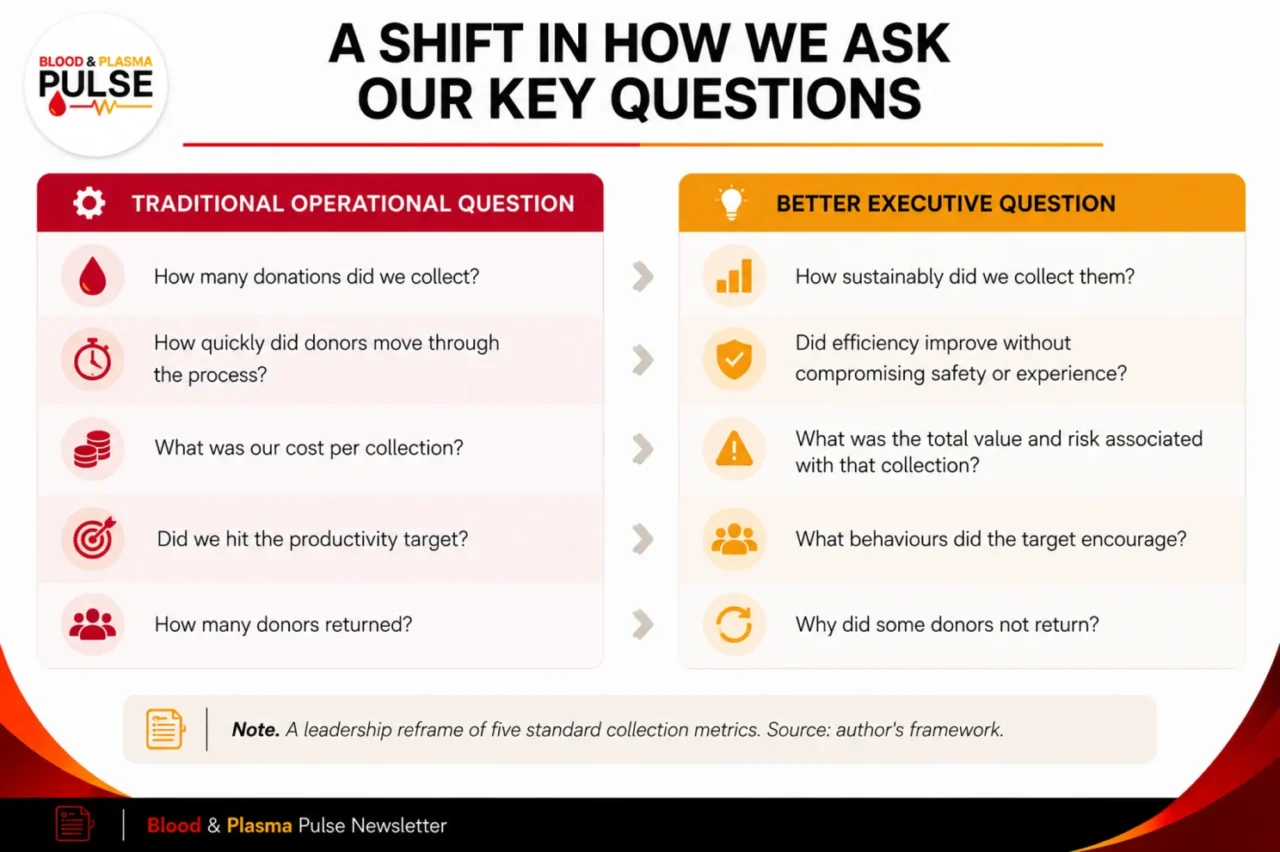
- Supply resilience. Donor base health is the supply resilience metric that no collection organization currently reports. Capacity, inventory, and contracted volume are all downstream of it.
- Donor safety. Safety and sustainability are the same programme viewed over different time windows. An organization that manages adverse reactions primarily as a compliance obligation is missing that the same dataset is its most predictive retention signal.
- Quality and compliance. Quality systems already capture most of what a donor sustainability view requires: deviations, adverse reactions, complaints, deferrals, protein and IgG trends. The data exists. It is filed under compliance and never enters the operating conversation. That is an organizational design problem, not a data problem, and it is fixable without a single new system.
- Workforce. Relational care is a staffing model, not a training module. It requires establishment levels with slack in them, tenure long enough to build competence, and supervisors who are not themselves fully utilized. Cost per collection improves reliably when you strip all three out, and the effect is invisible for roughly eighteen months.
- Technology and data. Scheduling systems, queue management and predictive deferral tooling can genuinely reduce friction. They can also be deployed purely to compress cycle time; in that case, they accelerate the underlying problem with better instrumentation. The personalized nomogram trial is the counter-example worth studying: technology aimed at measuring the donor more precisely, rather than at moving them faster (Hartmann et al., 2021).
- Governance. The specific accountability failure is that donor sustainability has no owner. Throughput belongs to operations, adverse reactions to quality, retention to marketing, and staff turnover to HR. Four functions, each holding one quadrant of a single system, structurally guarantee that nobody manages the whole.
- Financial sustainability. Donor acquisition cost is real, and it is not small. Every avoidable lapse is a re-acquisition. Any operating decision that trades a fraction of a donor’s lifetime value for a marginal gain in today’s throughput destroys value, and current reporting makes it look like an improvement.
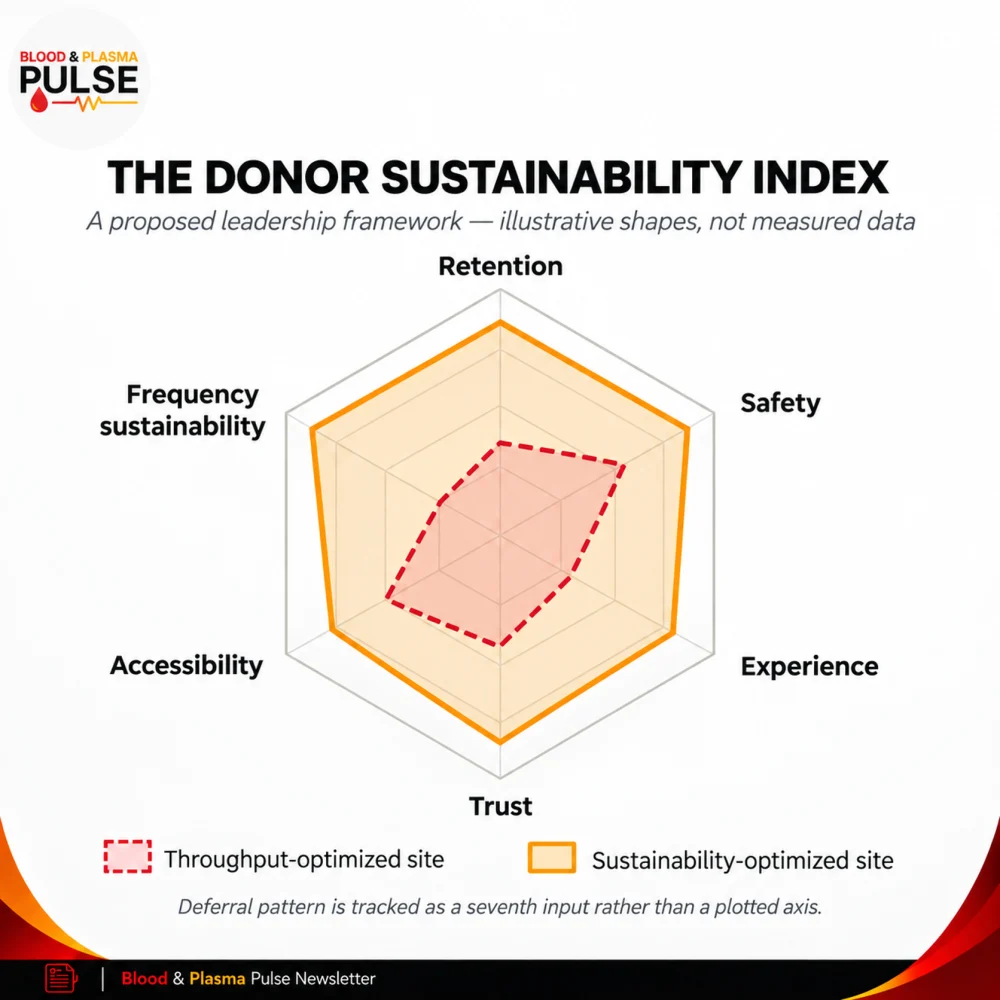
Note: the two profiles are illustrative constructions to show the shape of the trade-off. They are not derived from measured data, and this is not a validated or industry-adopted metric.
The Central Tension
The tension is not efficiency against experience. Stated that way, it is not a real contest, because efficiency reports monthly, in currency, to people with authority, while donor attrition reports never, in no unit, to nobody.
The genuine tension runs between two definitions of performance that share a vocabulary.
Short-horizon performance asks how much was collected, how fast, at what cost. It is legitimate, necessary, auditable, and the basis on which collection organizations retain their contracts and their funding.
Long-horizon performance asks whether the capacity to collect was preserved or consumed in the process. It is equally legitimate and almost entirely unmeasured.
Because the first is quantified and the second is not, the organization does not experience the trade-off as a decision. It experiences it as good news. That is what makes this a leadership problem rather than an operational one. Nobody is choosing wrongly. The choice is not being presented.
What Should Happen Next?
Plasma and blood operators
Pair every productivity KPI with a balancing KPI and review both at the same meeting, at the same cadence, at the same level of seniority. Treat an unpaired productivity metric as an incomplete control, the same way you would treat a process without a specification limit.
Report donor base health as a standing item to the executive team and the board: 12-month retention by cohort, first-to-second donation conversion, adverse reaction rate segmented by severity and by donor experience level, deferral recovery rate, and staff tenure by site.
Use IgG at recruitment predictively, not only for compliance (Warner et al., 2025). Model concentration risk in the donor base explicitly, and treat over-reliance on a small cohort of high-frequency donors as the supply chain risk it is (D’aes et al., 2024).
Policymakers and regulators
Consider whether donor sustainability indicators belong in routine reporting alongside adverse event data; the raw material already exists inside licensed establishments.
As SoHO implementation proceeds toward August 2027, the supply continuity provisions offer a natural vehicle for treating donor base health as a continuity input rather than a marketing concern (European Commission, n.d.).
The 1992 source plasma nomogram also warrants a fresh look on its own merits: trial evidence indicates that a personalized approach can increase collected volume while preserving the safety profile (Hartmann et al., 2021).
Healthcare and blood system leaders
Ask your collection partners what their 12-month donor retention rate is, and what it was three years ago. If the answer is not readily available, that is the finding.
Fractionators and manufacturers
Supply agreements written purely on litres and specifications transmit no signal about the health of the base producing them. There is room to build donor sustainability reporting into commercial terms, as supplier quality and continuity obligations already are.
Patient and donor organizations
Donor experience advocacy and patient access advocacy are the same campaign over a long enough horizon. That connection is rarely made publicly, and it should be.
Table 2. Every productivity KPI needs a balancing KPI
Leadership Takeaway
The strategic conclusion
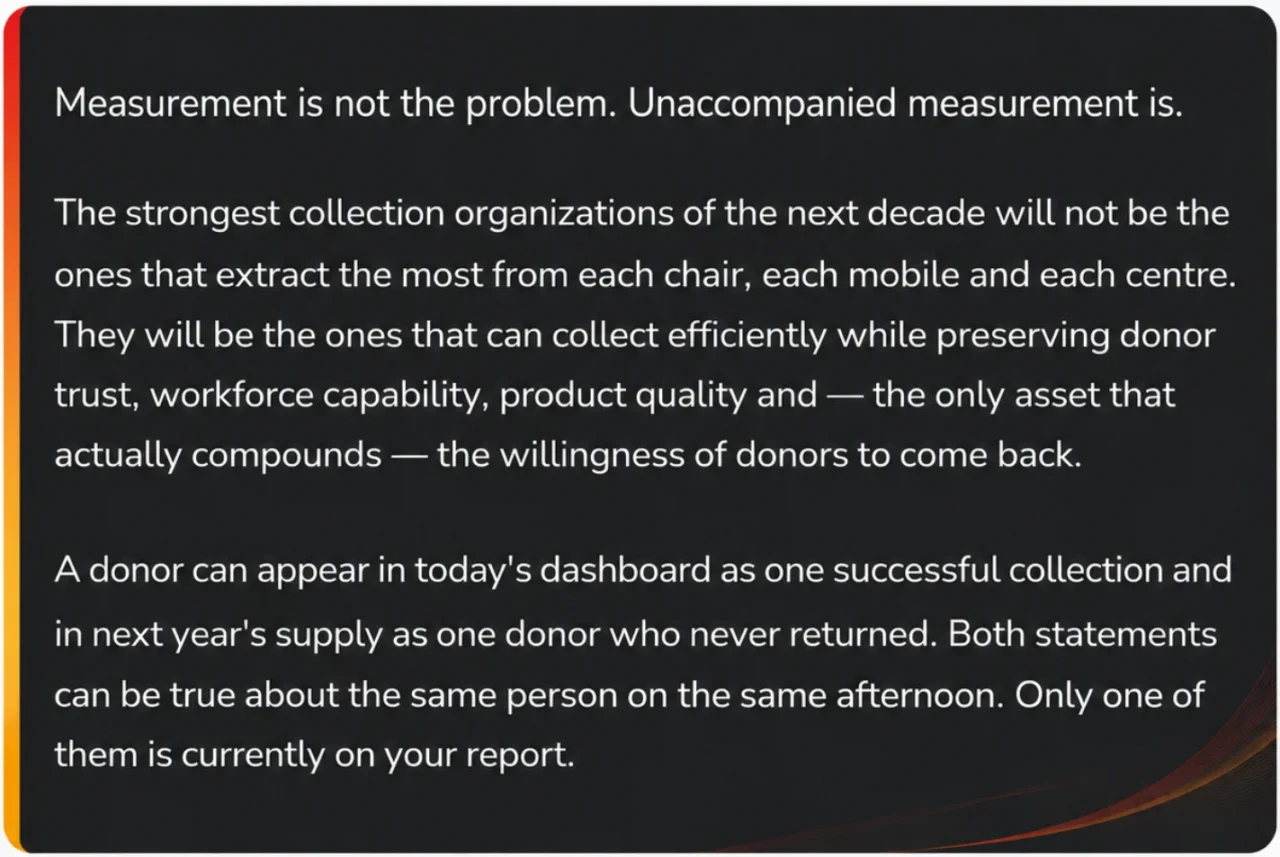
Measure the collection. Manage the system. Protect the donor relationship.
References
- ADRP: The Association for Blood Donor Professionals. (2025). Building resilience: Tackling phlebotomist turnover head-on.
- D’aes, T., van den Hurk, K., Schroyens, N., Mikkelsen, S., Severijns, P., De Buck, E., and colleagues. (2024). Balancing donor health and plasma collection: A systematic review of the impact of plasmapheresis frequency. Transfusion Medicine Reviews. Desai, T., and colleagues. (2026). The different barriers to donating plasma in plasma donors, whole blood donors, and non-donors in the United Kingdom. Transfusion.
- Etherington, C., Meyer, S. B., Vesnaver, E., and colleagues. (2026). Barriers and enablers to non-remunerated plasma donation: A meta-synthesis of the qualitative literature using the theoretical domains framework. Vox Sanguinis.
- European Commission. (n.d.). SoHO Regulation. Public Health.
- France, C. R., France, J. L., Roussos, M., and Ditto, B. (2004). Mild reactions to blood donation predict a decreased likelihood of donor return. Transfusion and Apheresis Science, 30(1), 17–22.
- France, C. R., Rader, A., and Carlson, B. (2005). Donors who react may not come back: Analysis of repeat donation as a function of phlebotomist ratings of vasovagal reactions. Transfusion and Apheresis Science, 33(2), 99–106.
- Hartmann, J., Ragusa, M. J., Popovsky, M. A., and Leitman, S. F. (2020). Source plasma collection in the United States: Toward a more personalized approach. American Journal of Hematology, 95(6), E139–E142.
- Hartmann, J., Ragusa, M. J., Burchardt, E. R., Manukyan, Z., Popovsky, M. A., and Leitman, S. F. (2021). Personalized collection of plasma from healthy donors: A randomized controlled trial of a novel technology-enabled nomogram. Transfusion, 61(6), 1789–1798.
- Haugen, M., Nissen-Meyer, L. S. H., Strand, T. A., and Magnussen, K. (2025). The effect of plasma donation frequency on total serum protein, immunoglobulin G and donor safety: A non-inferiority randomized controlled trial. Vox Sanguinis.
- The Health Foundation. (2015). Evidence scan: The impact of performance targets within the NHS and internationally.
- Hogan Lovells. (2024, July 18). New SoHO Regulation published in the EU Official Journal.
- Holloway, K. (2023). Emotional labor of nurses and phlebotomists in a new source plasma collection site during the COVID-19 pandemic. Global Qualitative Nursing Research, 10.
- Medical Economics. (2026, January 17). Strengthening the blood supply: Rebuilding morale and retention in a strained laboratory workforce.
- Seeley, M., Bari, A., and Holloway, K. (2025). A relational approach to understanding the factors influencing new plasma donor retention in Canada. Vox Sanguinis, 120(5), 455–463.
- Strathern, M. (1997). ‘Improving ratings’: Audit in the British University system. European Review, 5(3), 305–321.
- Tenbensel, T., Chalmers, L., Jones, P., Appleton-Dyer, S., Walton, L., and Ameratunga, S. (2020). Gaming New Zealand’s emergency department target: How and why did it vary over time and between organisations? International Journal of Health Policy and Management.
- Thijsen, A., and Masser, B. (2019). Vasovagal reactions in blood donors: Risks, prevention and management. Transfusion Medicine, 29(Suppl. 1), 13–22.
- The World Data. (2026, February 15). Blood plasma statistics in US 2026.
- U.S. Food and Drug Administration. (1992, November 4). Volume limits — Automated collection of source plasma [Memorandum].
- U.S. Food and Drug Administration. (2026). FDA roundtable: Strengthening the supply chain for blood manufacturing — 09/29/2026.
- Warner, J. V., Drinkwater, M. J., Chu, G. J., Kelly, S., and McComish, J. S. (2025). Use of immunoglobulin G homeostatic set point and recovery time in plasmapheresis donor safety monitoring: A retrospective observational cohort study. Vox Sanguinis, 120(4), 374–382.”
Other posts featuring Reza Shojaei on Hemostasis Today.
-
Sep 15, 2026, 17:32Thomas Dayspring: MHT for Vasomotor Symptoms May Also Offer Cardiovascular Benefits
-
Sep 15, 2026, 17:31Rebecca Risman: Deciphering the Mechanisms of Fibrinolysis in Contracted Clots
-
Sep 15, 2026, 17:31Clare Tower: 30 Times Higher Does Not Tell the Whole Story
-
Sep 15, 2026, 17:29Erica Wood: Looking Forward to the Webinar on Future Directions in Haemovigilance
-
Sep 15, 2026, 17:28Caitlin Raymond: Can an Antibody Screen Tell You If a Transfusion Will Actually Hurt Your Patient?
-
Sep 15, 2026, 17:28Rachel Margolis-Goodman: When Conventional Treatment Could Not, Research Found an Answer
-
Sep 15, 2026, 17:27Carly Newton: Closing the Gap in Sickle Cell Disease Readmissions
-
Sep 15, 2026, 17:26Jared Rice: Understanding Extreme Platelet Counts in Preterm Infants
-
Sep 15, 2026, 17:25Gregg W. Stone: OCT-Guided PCI Reduces Stent Thrombosis in Patients With Diabetes