


Caitlin Raymond: Can an Antibody Screen Tell You If a Transfusion Will Actually Hurt Your Patient?
Caitlin Raymond, Assistant Professor of Pathology and Transfusion Medicine at University of Wisconsin-Madison, shared a post on LinkedIn:
“Can an antibody screen tell you if a transfusion will actually hurt your patient?
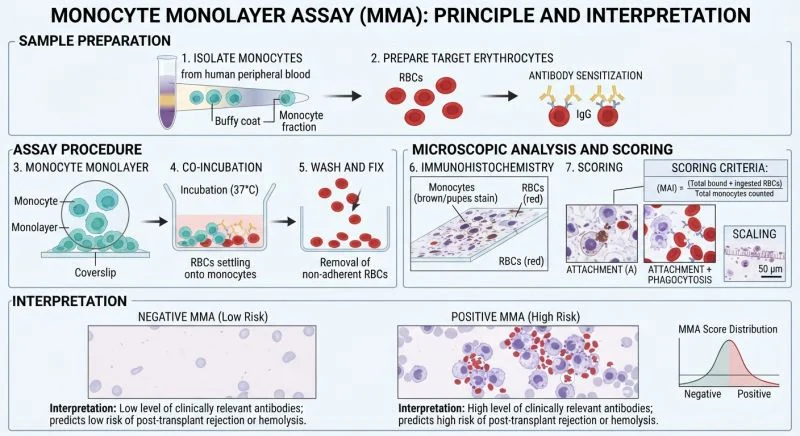
Not always. Sometimes the antibody is there, confirmed, undeniable, and the real question is whether it will provoke destruction once transfused red cells hit circulation. Serology can’t answer that. So we ask monocytes instead.
The monocyte monolayer assay puts antibody-coated red cells in front of a sheet of donor monocytes and watches what happens. Do the monocytes ignore them? Or do they start phagocytosing, engulfing red cells whole?
- Higher phagocytic or adherence index: more concern for clinically significant hemolysis
- Lower index: more reassurance the antibody may be biologically quiet
- Used when antigen-negative units are scarce, when antibody significance is uncertain, and in HDFN risk assessment
But a reassuring result isn’t a guarantee. Interlab variability is real, cutoffs vary by specificity, and a normal donor’s monocytes in a dish are still one step removed from what happens in a specific patient’s spleen and vasculature.
We built this test because we couldn’t ask the real question directly. Whether it gets us close enough is still a judgment call, every time.
What’s your read: should ambiguous MMA results push toward more caution, or less, when antigen-negative units are hard to find?”
Other posts featuring Caitlin Raymond on Hemostasis Today.
-
Sep 15, 2026, 17:29Erica Wood: Looking Forward to the Webinar on Future Directions in Haemovigilance
-
Sep 15, 2026, 17:28Rachel Margolis-Goodman: When Conventional Treatment Could Not, Research Found an Answer
-
Sep 15, 2026, 17:27Carly Newton: Closing the Gap in Sickle Cell Disease Readmissions
-
Sep 15, 2026, 17:26Jared Rice: Understanding Extreme Platelet Counts in Preterm Infants
-
Sep 15, 2026, 17:25Gregg W. Stone: OCT-Guided PCI Reduces Stent Thrombosis in Patients With Diabetes
-
Sep 15, 2026, 15:29Abdul Muqtadir Abbasi: Recognizing Thalassemia Trait Is Essential for Every Physician
-
Sep 15, 2026, 15:17Shehab Mohamed: A New Regional Consensus on HLH Diagnosis and Management
-
Sep 15, 2026, 15:17Sheharyar Raza: Managing Randomness in Artificial Intelligence for Transfusion Medicine
-
Sep 15, 2026, 15:00Sarah Wachtman: Modeling AAV-Based Gene Therapy for Hemophilia A Using Pediatric Liver Organoids