


Joseph R. Shaw: Study Questions Blanket “No-Bridging” Strategy for Mechanical Heart Valves
Joseph R. Shaw, Director of Research Plus Program at Ottawa Department of Medicine, EHJ-CVP Associate Editor at European Heart Journal, shared a post on LinkedIn about a recent article he and his colleagues co-authored, published in JAMA Network Open, adding:
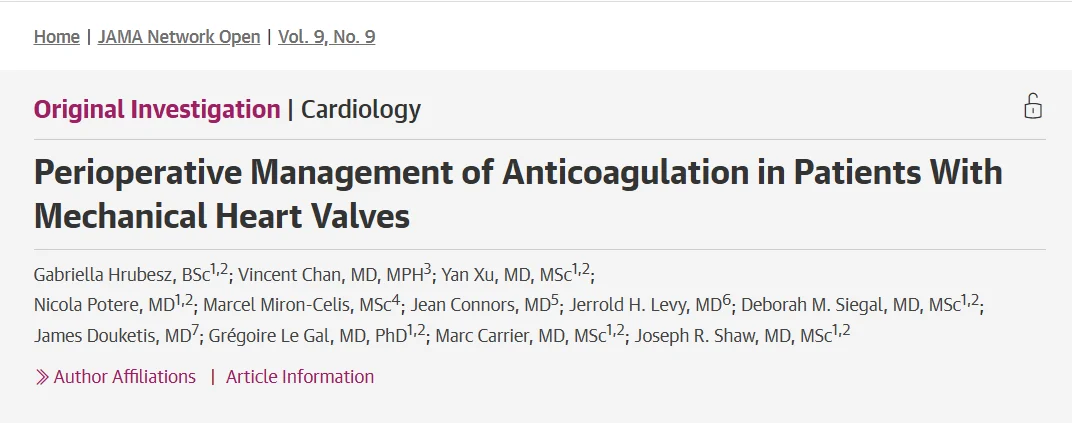
“I’m happy to share that our new study, ‘Perioperative Management of Anticoagulation in Patients With Mechanical Heart Valves,’ is now published in JAMA Network Open.
Perioperative anticoagulation in patients with mechanical heart valves (MHVs) involves high-stakes decisions with limited evidence.
Many receive their valves at a younger age, and a perioperative stroke can have lifelong consequences.
BRIDGE demonstrated increased bleeding without a demonstrated thromboembolic benefit in atrial fibrillation – but excluded MHVs.
PERIOP2 found no clear benefit from postoperative bridging, but excluded patients with multiple MHVs or MHVs and prior stroke/TIA.
All participants received preoperative bridging. Its selected population may not fully reflect the risks encountered in routine MHV care.
Our retrospective cohort at The Ottawa Hospital included 373 patients undergoing 613 planned VKA interruptions.
Bridging practices were consistent with a tailored, risk-adapted approach to perioperative anticoagulation.
Therapeutic-dose bridging was common preoperatively (84.2%) but more selective postoperatively (31.5%).
Postoperative therapeutic bridging was more frequent with mitral/dual than aortic MHVs (46.0% vs 23.6%) and with prior thromboembolism (45.9% vs 28.7%).
Estimated 30-day risks of arterial thromboembolism (ATE) and major bleeding were 1.5% and 2.1%.
No postoperative bridging was associated with higher ATE risk than any postoperative bridging, including prophylactic dosing: 4.9% vs 0.9% (sHR 5.30; 95% CI 1.45–19.40).
A landmark analysis estimate to account for possible immortal time bias remained directionally consistent, but attenuated and imprecise (sHR 3.26; 95% CI 0.62–17.21).
Major bleeding was more frequent after high- versus low/moderate-bleeding-risk procedures (3.8% vs 0.6%).
In the Figure 3 sensitivity analysis, therapeutic postoperative bridging, compared with prophylactic or no bridging, was not significantly associated with clinically relevant bleeding – major or clinically relevant nonmajor bleeding (sHR 1.75; 95% CI 0.81–3.77).
High procedural bleeding risk remained significantly associated (sHR 4.61; 95% CI 1.69–12.62).
These hypothesis-generating findings suggest that tailoring bridging to patient and procedural risks may help mitigate both thromboembolism and bleeding. They support caution about a blanket no-bridging approach.
Representative prospective studies are needed to define the optimal timing and intensity of bridging in this population.”
Title: Perioperative Management of Anticoagulation in Patients With Mechanical Heart Valves
Authors: Gabriella Hrubesz, Vincent Chan, Yan Xu, Nicola Potere, Marcel Miron-Celis, Jean Connors, Jerrold H. Levy, Deborah M. Siegal, James Douketis, Grégoire Le Gal, Marc Carrier, Joseph R. Shaw
Stay updated on all scientific advances with Hemostasis Today.
-
Sep 18, 2026, 01:35Matthew Hazell: From Platelet Refractoriness to Protecting Transplanted Organs
-
Sep 18, 2026, 01:23Apple Joy A. Valenzuela: Exploring How Neutrophil Develops from the Myeloblast to the Mature Segmented Neutrophil
-
Sep 18, 2026, 01:13Su Someh: Gaps and Variation in Global Plasma Donor Protection Policies
-
Sep 17, 2026, 20:38Konstantinos Bistas: Reduced Circulating Tregs in Pediatric Chronic Neutropenia
-
Sep 17, 2026, 15:33Gopal Patidar: Honoured to Contribute to the ASFA 2026 Guidelines for Therapeutic Apheresis
-
Sep 17, 2026, 20:36Cosima C. Hoch: Developing a 3D Organotypic Co-Culture Model for Pleomorphic Adenoma
-
Sep 17, 2026, 20:19Riten Kumar: Boston Children’s Hospital Ranked No. 1 in Seven Pediatric Specialties
-
Sep 17, 2026, 20:17Katrina Snow: Whole Blood or Component Therapy – Which Would You Choose?
-
Sep 17, 2026, 16:30Daria Camilli: Empowering Bleeding Disorder Advocacy Through Health Economics