

CRISPR and Hemophilia: The Next Frontier of In Vivo Gene Editing
Hemophilia treatment has traditionally focused on replacing the missing coagulation factor. Factor VIII or IX replacement can prevent bleeding, but treatment generally requires repeated administration and does not correct the underlying genetic defect.
Gene therapy has introduced a different approach by delivering genetic material that enables endogenous factor production. Genome editing takes this concept further: instead of simply adding a therapeutic gene, it aims to make a targeted and potentially durable change to the DNA of the patient’s own cells.
The goal is to turn cells into a continuous source of functional coagulation factor, potentially reducing or eliminating the need for repeated factor replacement.
How Does In Vivo CRISPR Gene Editing Work?
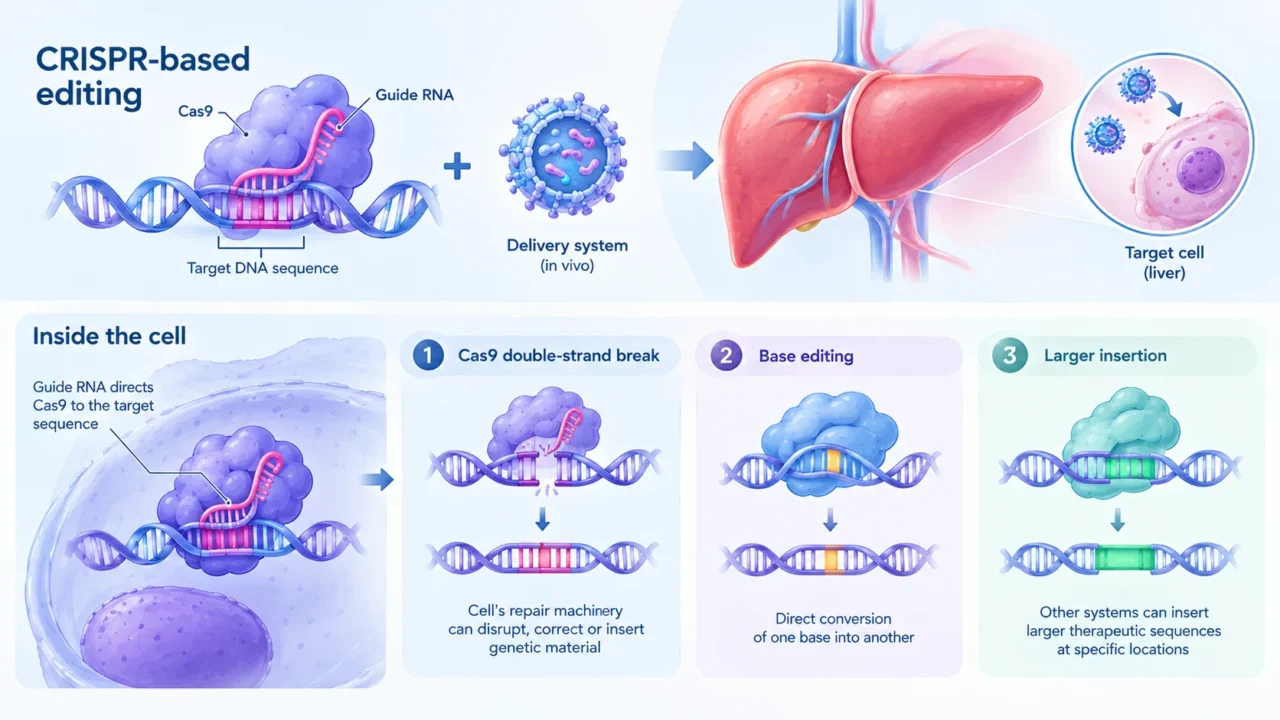
CRISPR-based editing uses a programmable system to recognize a specific DNA sequence inside a cell. The two key components are a guide RNA, which determines where the system should act, and an editing enzyme such as Cas9, which performs the DNA modification.
For in vivo treatment, these components have to be delivered directly into the patient’s target cells. In hemophilia, the liver is an important target because it can produce and release coagulation factors into the circulation.
Once inside the cell, the guide RNA directs Cas9 to the selected DNA sequence. Conventional Cas9 can create a targeted double-strand DNA break, after which the cell’s own repair machinery can be used to disrupt, correct or insert genetic material.
Not all CRISPR technologies require a double-strand break. Base editors, for example, can directly convert one DNA base into another, while other editing systems are being developed to insert larger therapeutic sequences at specific genomic locations.
What Is the Therapeutic Goal in Hemophilia?
The ultimate objective is not simply to edit DNA, but to restore clinically meaningful coagulation factor production.
In hemophilia B, editing strategies can target F9 or introduce a functional F9 sequence into a selected genomic location. The edited liver cell could then continuously produce factor IX, which enters the circulation and participates in the coagulation cascade.
For hemophilia A, the same principle applies to F8 and factor VIII. Restored FVIII participates in the intrinsic tenase complex, supporting factor X activation and downstream thrombin and fibrin generation.
Why Is Hemophilia B an Important Testing Ground?
Hemophilia B is caused by pathogenic variants in F9, which encodes factor IX. Compared with F8, the therapeutic F9 sequence is considerably smaller, making it more compatible with commonly used gene-delivery strategies.
This has contributed to the development of in vivo genome-editing approaches for hemophilia B. Clinical studies are now evaluating whether targeted F9 gene insertion can provide sustained endogenous FIX production in humans.
From Gene Addition to Gene Insertion
One approach is to insert a functional therapeutic sequence into a selected genomic site rather than attempting to repair every possible F9 mutation individually.
In this strategy, an AAV vector can provide the therapeutic DNA template, while another delivery system can provide the CRISPR editing components. The CRISPR system directs the nuclease to the selected genomic site, where cellular DNA-repair mechanisms can incorporate the therapeutic sequence. Preclinical studies have explored loci such as the albumin gene, which can support strong liver-specific expression.
The attraction of this approach is that a single editing strategy could potentially be applicable to patients carrying different disease-causing variants.
What Makes Hemophilia A More Challenging?
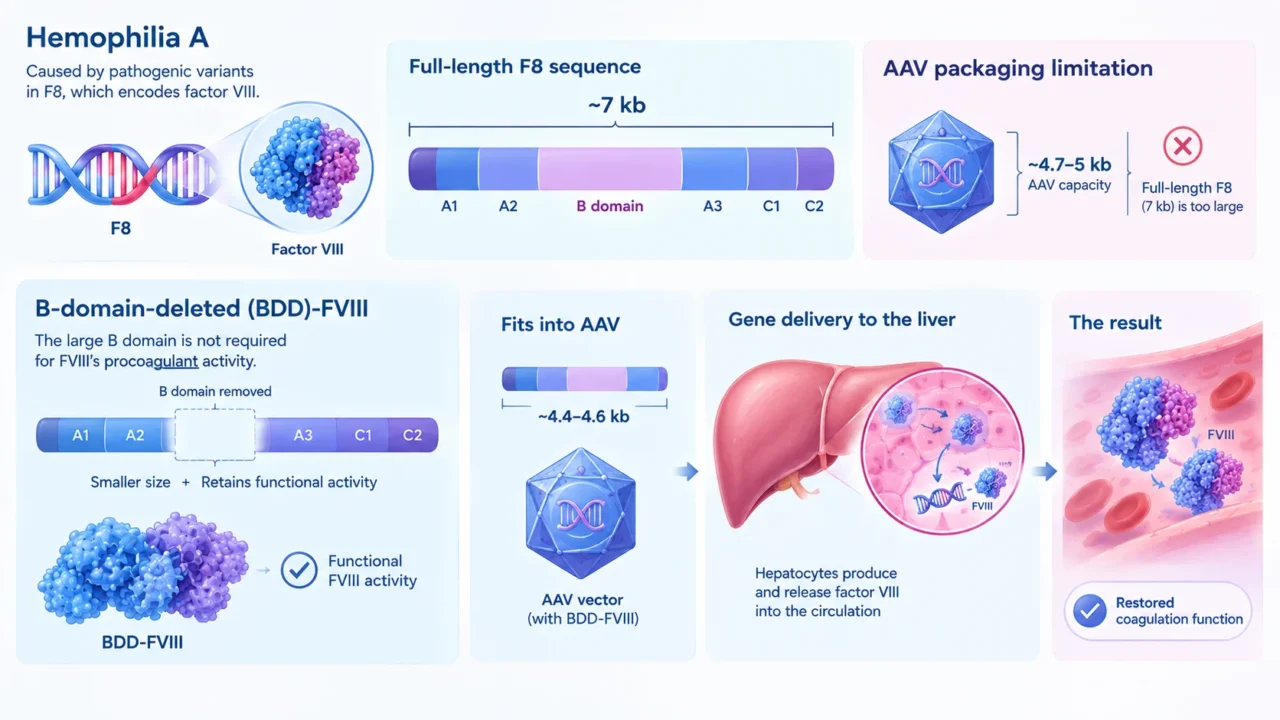
Hemophilia A is caused by pathogenic variants in F8, which encodes factor VIII. The full-length F8 coding sequence is approximately 7 kb, while conventional AAV vectors have a packaging capacity of roughly 4.7–5 kb, making the complete sequence too large for straightforward AAV delivery.
Researchers therefore developed B-domain-deleted factor VIII (BDD-FVIII) constructs. The large B domain is not required for FVIII’s procoagulant activity, so removing it substantially reduces the size of the therapeutic sequence while retaining functional FVIII activity.
This strategy is already important in conventional hemophilia A gene therapy, where BDD-FVIII constructs are used to overcome AAV packaging limitations.
How Could CRISPR Overcome the F8 Problem?
Instead of trying to repair every individual F8 mutation, researchers are investigating whether a functional FVIII sequence can be inserted into a selected genomic location.
In preclinical models, CRISPR/Cas9 has been used to insert BDD-FVIII sequences into defined genomic loci, including the albumin locus, resulting in sustained FVIII expression and improvement of the coagulation phenotype in hemophilia A models.
This is conceptually different from correcting the patient’s original F8 mutation. The aim is to create a new, functional source of FVIII rather than necessarily restoring the original gene sequence.
Why Is Delivery So Important?
Genome editing cannot work unless the editing machinery reaches the appropriate cells. An in vivo treatment therefore has to solve several problems simultaneously: deliver the editor, deliver the therapeutic DNA when required, reach the appropriate tissue, and achieve sufficient editing without excessive exposure elsewhere.
AAV vectors are efficient vehicles for liver-directed gene delivery, while lipid nanoparticles are being investigated for delivery of CRISPR components such as nuclease mRNA and guide RNA. Using different delivery systems for different components may help overcome the size limitations of a single vector.
What Has Reached the Clinic?
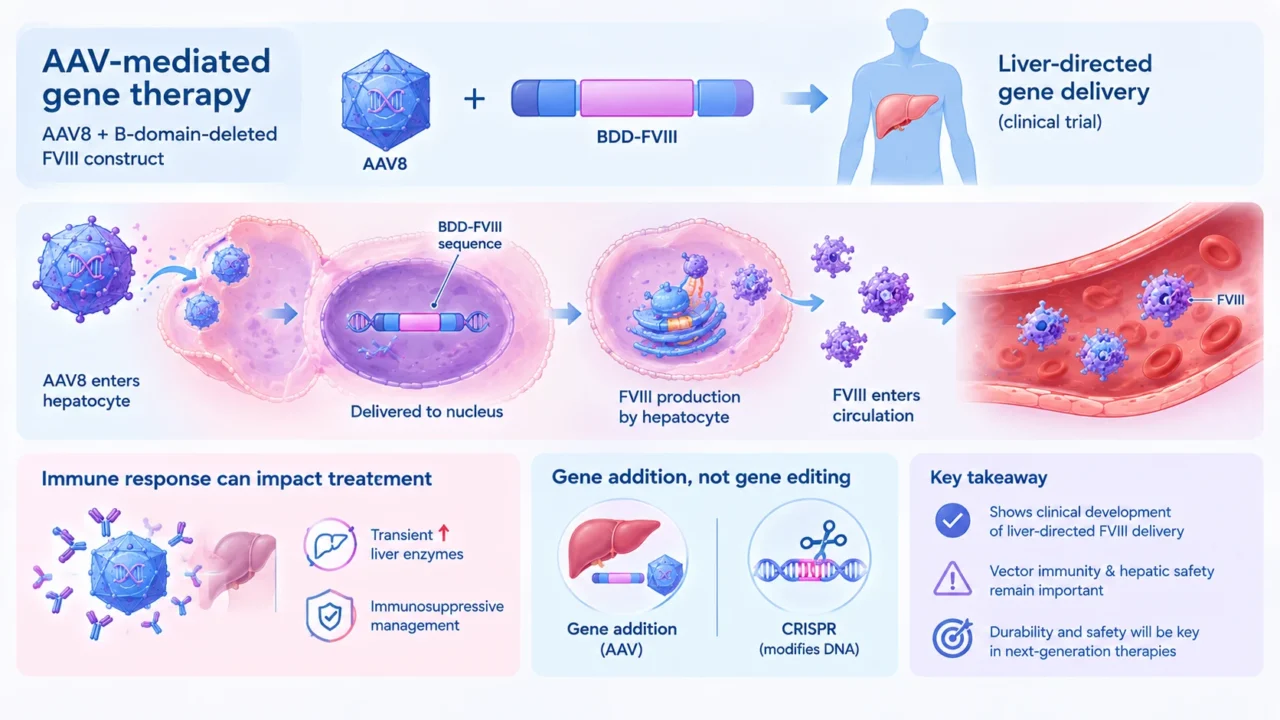
While CRISPR-based genome editing for hemophilia remains investigational, AAV-mediated gene therapy has already reached clinical trials. A 2026 Phase 1 pilot study evaluated an AAV8-based gene therapy carrying a B-domain-deleted factor VIII construct in patients with severe hemophilia A, demonstrating the clinical development of liver-directed FVIII gene delivery.
The study also highlights an important challenge for liver-directed gene therapy: immune responses against the AAV vector can affect treatment. Transient elevations in liver enzymes and the need for immunosuppressive management illustrate why vector immunity and hepatic safety remain important considerations as these therapies move through clinical development.
This is gene addition rather than CRISPR gene editing. The therapeutic FVIII sequence is delivered to hepatocytes to enable factor production, whereas CRISPR-based approaches aim to modify the patient’s genomic DNA itself. The distinction is important when considering both the potential durability and the safety questions of next-generation therapies.
A New Approach for Hemophilia A
One emerging strategy combines two delivery systems: an AAV vector provides a B-domain-deleted FVIII sequence, while a lipid nanoparticle delivers the CRISPR nuclease and guide RNA.
The editing system targets the albumin locus in hepatocytes, allowing the therapeutic FVIII sequence to become integrated into the genome and placed under the control of the albumin regulatory environment. Preclinical data from this approach have reported sustained FVIII activity in non-human primates, while clinical development remains investigational.
Base Editing Opens Another Route
CRISPR does not always have to be used to insert a complete replacement gene.
Base editing can modify individual DNA nucleotides without generating the conventional double-strand break produced by Cas9 nuclease. This creates the possibility of correcting specific pathogenic variants or introducing functional changes that increase coagulation factor activity.
For hemophilia, such approaches are being explored particularly for F9, where modifying a single nucleotide can potentially generate a high-activity FIX variant. These approaches remain under investigation and are not yet established clinical treatments.
The Safety Question
The possibility of permanently altering genomic DNA also introduces safety questions that are different from those associated with conventional factor replacement.
Researchers need to evaluate unintended off-target editing, unwanted genomic rearrangements, immune responses to the editing components or delivery systems, and the long-term behavior of edited cells. These questions become particularly important when treatment is intended to produce a permanent genetic change.
Gene Therapy and Gene Editing Are Not the Same
It is important to distinguish the two approaches.
In conventional gene therapy, a therapeutic genetic sequence is delivered to cells so they can produce the missing coagulation factor. In gene editing, the therapeutic objective involves modifying the cellular genome itself, for example by correcting a mutation or inserting a functional factor sequence at a defined genomic location.
Both approaches aim to reduce dependence on repeated factor replacement, but the biological mechanisms and long-term considerations are different.
From Replacing Factor to Editing Its Source
The development of CRISPR-based approaches represents a shift in how inherited bleeding disorders can be approached.
Instead of repeatedly replacing factor VIII or IX, researchers are exploring whether the patient’s own cells can be genetically modified to produce the missing factor continuously. The field is still experimental, but clinical development in hemophilia B and increasingly sophisticated preclinical strategies for hemophilia A are bringing this concept closer to clinical testing.
The central question is no longer only how to replace the missing clotting factor, but whether the underlying genetic source of factor production can be safely and durably modified.
What Comes Next?
Several questions will determine whether in vivo genome editing can become a clinical treatment for hemophilia: how durable the editing will be, how much factor production is required, how efficiently the editing machinery can be delivered, and whether long-term genomic safety can be demonstrated.
For hemophilia A, overcoming the size and expression challenges associated with F8 remains particularly important. For hemophilia B, clinical studies are already testing whether targeted genome editing can provide sustained FIX production.
CRISPR is therefore not yet a replacement for established hemophilia therapy. It is an emerging therapeutic platform that could eventually move treatment from repeated factor replacement toward targeted and potentially durable genetic correction.
FAQ
1. What is CRISPR gene editing?
CRISPR is a programmable genome-editing technology that can recognize specific DNA sequences and make targeted genetic modifications.
2. How could CRISPR be used to treat hemophilia?
CRISPR-based approaches aim to modify liver cells so they can produce functional factor VIII or factor IX, potentially reducing the need for repeated factor replacement.
3. What is the difference between gene therapy and gene editing?
Gene therapy generally delivers therapeutic genetic material to cells to enable factor production, while gene editing directly modifies the cell’s genome.
4. Why is the liver targeted in hemophilia gene editing?
Hepatocytes can produce and release coagulation factors into the bloodstream, making the liver an important target for in vivo genetic therapies.
5. Why is hemophilia B currently more advanced in CRISPR development?
The F9 gene and its therapeutic sequence are substantially smaller than F8, making delivery and genetic engineering more straightforward. Clinical development of in vivo genome-editing approaches has therefore progressed further in hemophilia B.
6. Why is hemophilia A technically more challenging?
The full-length F8 coding sequence is approximately 7 kb, exceeding the packaging capacity of conventional AAV vectors. Researchers have therefore developed smaller constructs, including B-domain-deleted FVIII, and are investigating alternative delivery and editing strategies.
7. Does CRISPR always cut both DNA strands?
No. Conventional Cas9 can create a double-strand DNA break, but newer approaches such as base editing can modify individual DNA bases without producing a conventional double-strand break.
8. Could CRISPR permanently cure hemophilia?
Potentially, but this has not yet been established. In vivo genome editing remains investigational, and the durability, efficacy and long-term safety of these approaches still need to be demonstrated.
9. What are the main safety concerns with in vivo gene editing?
Important concerns include unintended off-target editing, genomic rearrangements, immune responses, delivery-related toxicity and the long-term behavior of genetically modified cells.
10. Is CRISPR currently an approved treatment for hemophilia?
No. CRISPR-based in vivo genome editing for hemophilia remains investigational. Several approaches are being studied, while established treatments and approved gene therapies remain the current clinical options.
Written by Hermine Sayiyan, MD
Stay updated with Hemostasis Today.
-
Sep 18, 2026, 17:48Ronak H. Mistry: Updated ASH Guidelines Bring New Focus to Iron Deficiency
-
Sep 18, 2026, 17:32Hassan Kawtharany: New Ferritin Cutoffs for the Diagnosis of Iron Deficiency With or Without Anemia
-
Sep 18, 2026, 17:20Abhishek G P: GAVE as an Important Cause of Chronic Gastrointestinal Blood Loss
-
Sep 18, 2026, 17:08Irem Karaman Sebin: ASH 2026 Changes a Key Concept in Iron Deficiency
-
Sep 18, 2026, 16:51Adarsh Krishnan Sundara Rajan: Is VTE the Most Underdiagnosed Critical Threat in Modern Healthcare?
-
Sep 18, 2026, 16:13Christian Irsara: PF4 Immunothrombosis Following Natural Adenovirus Infection
-
Sep 18, 2026, 16:10Leo Nicolai։ The Spleen Emerges as a Key Regulator of Thromboinflammation
-
Sep 18, 2026, 16:05Targeting Factor XI to Reduce Thrombosis Without Compromising Hemostasis – ISTH
-
Sep 18, 2026, 15:54Swapnil Pawar: Why Aren’t We Using Cryopreserved Platelets Everywhere Yet?