

Pall T. Onundarson: DOACs – Monitoring, Tailoring Dose and Identifying Problems
Pall T. Onundarson, Professor Emeritus of Hematology at University of Iceland, shared a post on LinkedIn:
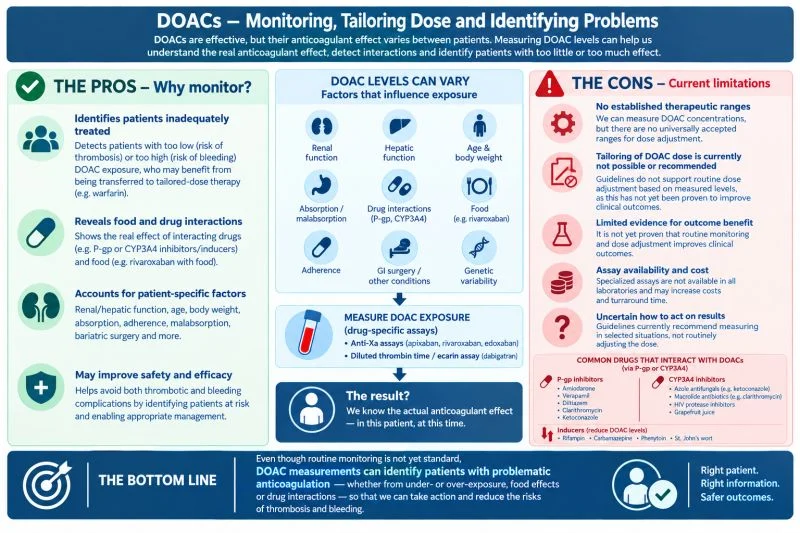
“DOACs can be measured and monitored. Yet, in clinical practice, they rarely are.
At Landspitali, we have had DOAC assays available 24/7 for the past 10 years, but clinicians request them almost exclusively in emergencies but not to monitor therapeutic effect. ‘No monitoring needed’ it is claimed.
I feel DOACs should be monitored occasionally for the benefit of patients. Their pharmacokinetics mean they do not require the frequent monitoring needed with VKAs.
But why not identify patients who consistently achieve appropriate drug levels?
And why not offer those whose levels are persistently too high or too low an alternative: a tailored-dose anticoagulant such as warfarin?
I am old enough to remember when the old generation of ‘clotters’ lined up and warned at professional meetings against the one-dose-fits-all strategy. Many are gone now, and in the enthusiasm that followed the DOAC trials, their concerns were largely forgotten. Now, those concerns are resurfacing.
In my view, DOAC levels should be measured periodically; perhaps once or twice a year, when new drugs are prescribed that could interact or if the patient´s condition changes, e.g. heart failure.
DOAC-patients are hopefully having their renal function checked anyway. When levels are unexpectedly high or low, we should ask why and recognize that some patients may benefit from switching to a VKA, where treatment can be individually tailored.”
Other posts featuring Pall T. Onundarson on Hemostasis Today.
-
Sep 20, 2026, 01:18Sebastian Mafeld: Has 2026 Changed How We Treat Pulmonary Embolism?
-
Sep 20, 2026, 01:15Thierry Fumeaux: From Efficacy to Effectiveness – The Value of Real-World Evidence
-
Sep 20, 2026, 01:14Said El Shamieh: VEGFA Genetic Variants and Bleeding Risk During Warfarin Therapy
-
Sep 20, 2026, 01:04Omar Danoun: Levetiracetam May Increase Thromboembolic Risk With DOACs
-
Sep 20, 2026, 01:02Mohamed Abo-Aly: Which Antiseizure Medication is Safest for Patients on DOACs?
-
Sep 20, 2026, 00:58Hamza Rafiq: How Does a Deep Vein Thrombosis Become a PE?
-
Sep 20, 2026, 00:50A Shared Platelet Factor 4–Targeted Immune Mechanism in Adenovirus Infection – NEJM
-
Sep 20, 2026, 00:46Julia R. Coleman: Platelet Biology and Sex Differences in the Plasma Milieu at AAST 2026
-
Sep 19, 2026, 18:03Manisha Madkaikar: Clinical, Hematological, and Molecular Features of Sickle β-Thalassemia