

Platelet Metabolic Reprogramming: How Cellular Energy Drives Thrombosis
Platelets are traditionally viewed as anucleate cellular fragments that respond to vascular injury through highly coordinated receptor and signaling pathways. Yet platelet activation is also an energetically demanding process. Adhesion, spreading, integrin activation, granule secretion, cytoskeletal remodeling, and thrombus stabilization all require rapid and tightly regulated ATP production.
What has become increasingly clear is that platelet metabolism is not simply a passive source of energy. Upon activation, platelets undergo metabolic reprogramming, increasing aerobic glycolysis while dynamically engaging mitochondrial oxidative phosphorylation, the pentose phosphate pathway, fatty-acid metabolism, and redox signaling. These pathways do more than maintain cellular energy: they generate metabolic intermediates and signaling molecules that can amplify platelet activation and influence the phenotype adopted within a developing thrombus.
This creates an intriguing connection between cellular metabolism and thrombosis. The metabolic state of a platelet can influence whether it primarily supports aggregation or progresses toward a highly procoagulant phenotype characterized by phosphatidylserine exposure and enhanced thrombin generation. Recent evidence suggests that mitochondrial bioenergetics may function as an important determinant of this functional heterogeneity, positioning platelet metabolism as a potential therapeutic vulnerability in pathological thrombosis.
The Platelet Energy Challenge
Resting platelets rely on both glycolysis and mitochondrial oxidative phosphorylation (OXPHOS) to satisfy their basal energy requirements. However, activation dramatically increases their energetic demand. Processes such as actin remodeling, integrin αIIbβ3 activation, granule secretion, and clot retraction require rapid ATP availability.
Activated platelets therefore increase glycolytic flux even when oxygen is available. This aerobic glycolysis provides rapidly accessible ATP and metabolic intermediates and can remain advantageous when oxygen and nutrients become restricted inside a densely packed thrombus.
Importantly, this does not mean that mitochondria become dispensable. Current evidence supports metabolic specialization: glycolytic ATP is particularly important for rapid responses such as shape change and aggregation, whereas mitochondrial OXPHOS contributes substantially to sustained secretion and thrombus amplification.
The PDK–PDH Switch Redirects Glucose Toward Glycolysis
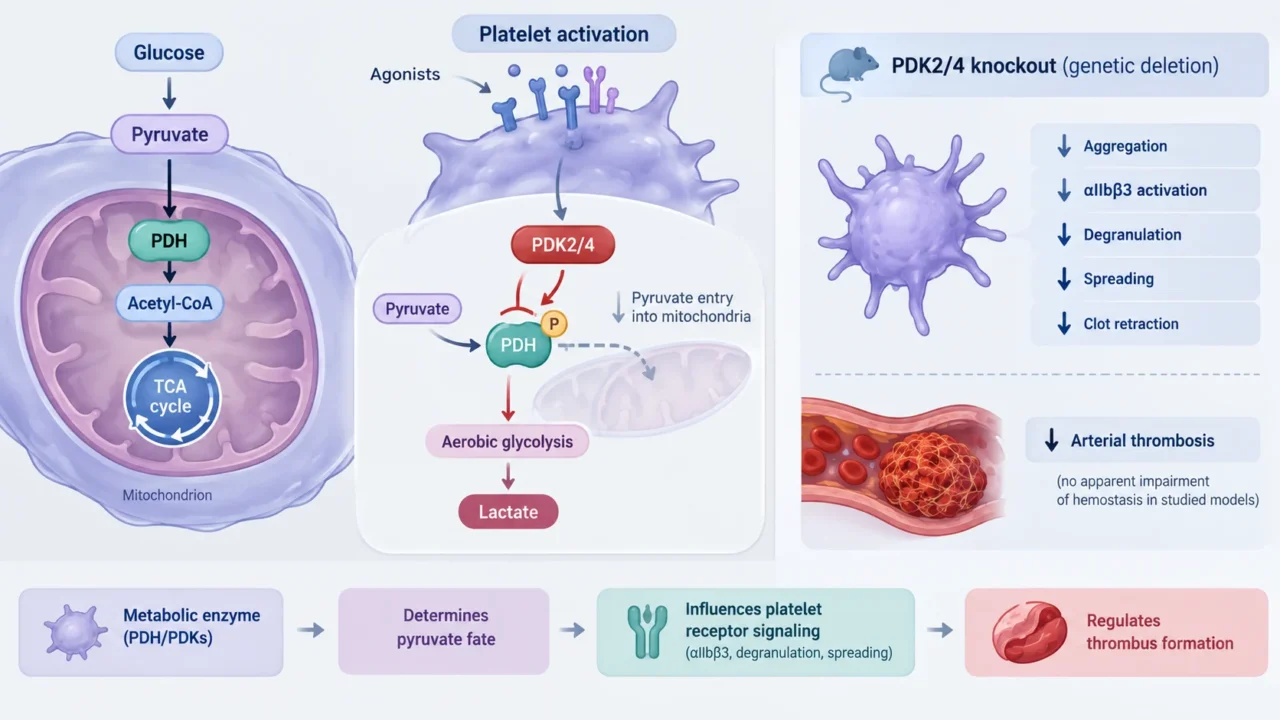
One of the key metabolic checkpoints is the pyruvate dehydrogenase complex (PDH), which normally converts pyruvate into acetyl-CoA and allows glucose-derived carbon to enter the tricarboxylic acid cycle.
Following platelet stimulation, pyruvate dehydrogenase kinases (PDKs) phosphorylate and inhibit PDH. This reduces pyruvate entry into mitochondrial oxidation and redirects metabolic flux toward aerobic glycolysis and lactate production. PDK2 and PDK4 appear particularly important in this process.
This pathway is not simply a consequence of platelet activation. Genetic deletion of PDK2/4 in mice reduced platelet aggregation, αIIbβ3 activation, degranulation, spreading, and clot retraction. Importantly, these mice also demonstrated reduced experimental arterial thrombosis without an apparent impairment of hemostasis in the studied models.
The finding provides an important mechanistic connection: a metabolic enzyme that determines where pyruvate goes can influence platelet receptor signaling and thrombus formation.
PKM2 Connects Glycolysis to the Pentose Phosphate Pathway
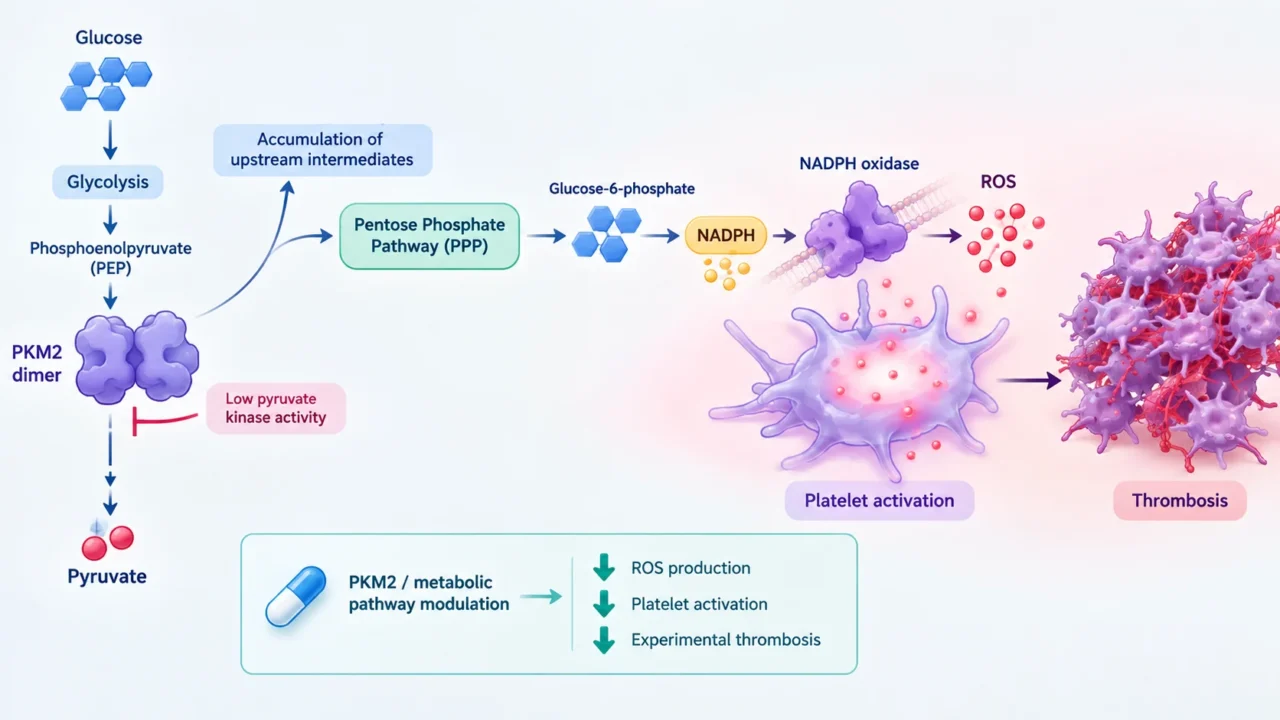
Pyruvate kinase M2 (PKM2) represents another important metabolic checkpoint. PKM2 catalyzes the final step of glycolysis, converting phosphoenolpyruvate to pyruvate.
Its dimeric form has relatively low pyruvate kinase activity. This configuration can allow upstream glycolytic intermediates to accumulate and enter alternative metabolic pathways, including the pentose phosphate pathway (PPP).
This creates a particularly interesting connection between glucose metabolism and oxidative signaling. Increased glucose-6-phosphate flux through the PPP generates NADPH, which provides reducing power for NADPH oxidase-dependent reactive oxygen species (ROS) production.
In platelets, ROS are not simply markers of metabolic damage. They can function as signaling molecules that amplify platelet activation. Experimental modulation of PKM2 and associated metabolic pathways has been shown to reduce ROS production, platelet activation, and experimental thrombosis.
ROS: When Metabolic By-Products Become Signaling Molecules
The relationship between metabolism and platelet activation becomes particularly interesting at the level of reactive oxygen species. Increased glycolytic flux can supply glucose-6-phosphate to the PPP, increasing NADPH availability.
NADPH can then support NADPH oxidase activity and ROS generation. These ROS can modify redox-sensitive signaling pathways and contribute to amplification of platelet activation. Thus, a change in glucose metabolism can be translated into a change in intracellular signaling.
This means that the metabolic switch toward glycolysis does not merely solve an ATP problem. It can simultaneously reshape the redox environment of the platelet and strengthen signaling downstream of platelet agonists.
Mitochondria: More Than ATP Factories
Mitochondria remain central to platelet biology despite the increased reliance on glycolysis after activation. They regulate oxidative phosphorylation, mitochondrial membrane potential, ROS generation, calcium handling, and metabolic adaptation.
Recent evidence proposes that mitochondrial bioenergetics may help determine platelet functional heterogeneity. Glycolytic ATP can support rapid aggregation, whereas mitochondrial OXPHOS becomes particularly important for sustained high-energy functions such as granule secretion and thrombus amplification.
This creates a metabolic dimension to platelet heterogeneity. Activated platelets do not necessarily become functionally identical: some predominantly contribute to aggregation, whereas others develop a procoagulant phenotype characterized by extensive phosphatidylserine exposure.
The Mitochondrial Calcium Switch
One of the strongest links between mitochondrial metabolism and thrombosis involves calcium. Strong platelet stimulation can produce sustained cytosolic Ca²⁺ elevation, followed by mitochondrial Ca²⁺ uptake through the mitochondrial calcium uniporter (MCU).
Excessive mitochondrial Ca²⁺ accumulation can promote mitochondrial permeability transition pore (mPTP) opening, mitochondrial dysfunction, and the transition toward a highly procoagulant phenotype.
Experimental deletion of MCU reduces procoagulant platelet formation while leaving several other aspects of platelet activation relatively preserved. This suggests that mitochondrial calcium handling is not simply part of generalized platelet activation but may participate in the specific transition toward the procoagulant state.
The concept has gained further support from recent reviews describing mitochondrial Ca²⁺ flux, membrane potential, oxidative stress, and mPTP regulation as interconnected determinants of procoagulant platelet formation and thrombosis.
From Metabolic Stress to Phosphatidylserine Exposure
Procoagulant platelets are not simply “more activated” platelets. They represent a distinct functional phenotype characterized by high-level phosphatidylserine (PS) externalization.
When PS appears on the outer platelet membrane, it creates a negatively charged surface that supports assembly of coagulation enzyme complexes. This provides a catalytic platform for thrombin generation and therefore links platelet biology directly to secondary coagulation.
Mitochondrial dysfunction can therefore have consequences far beyond ATP production. Through Ca²⁺ handling, mPTP activity, membrane potential changes, and associated signaling, mitochondrial metabolism can influence whether an activated platelet remains predominantly aggregatory or becomes strongly procoagulant.
AMPK–ACC Links Energy Sensing to Lipid Signaling
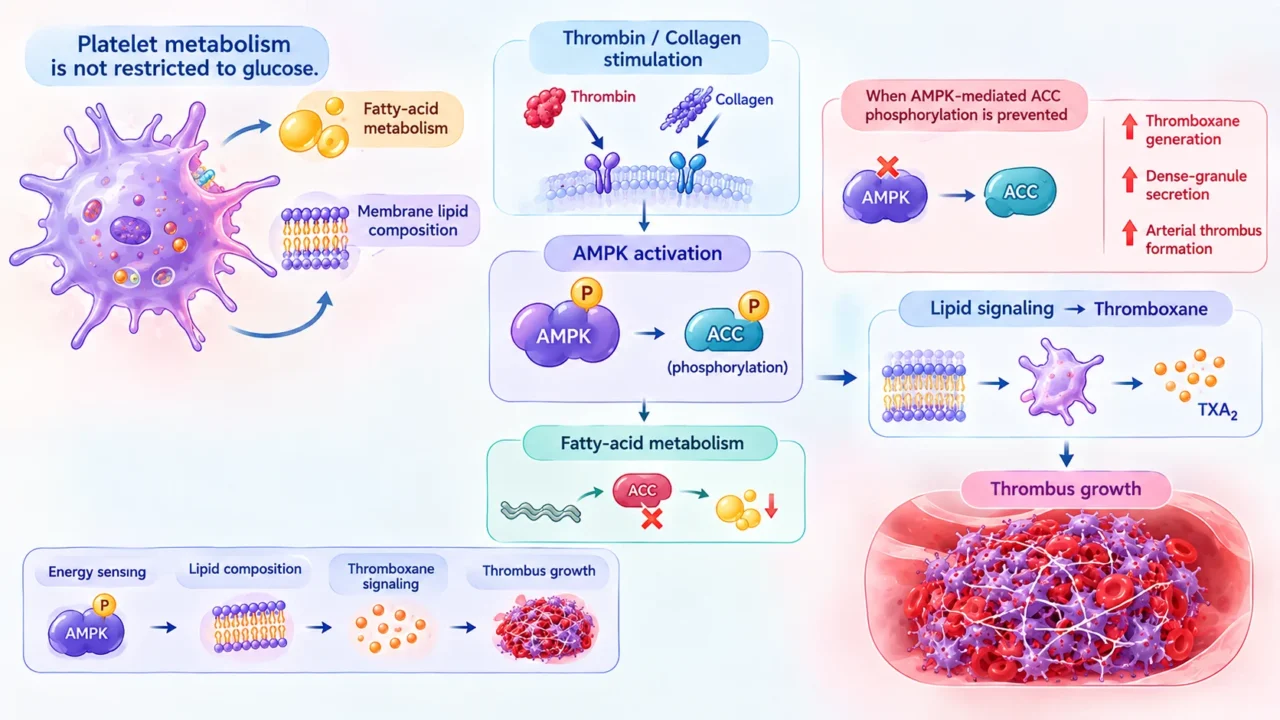
Platelet metabolism is not restricted to glucose. Fatty-acid metabolism and membrane lipid composition also influence platelet activation.
AMP-activated protein kinase (AMPK) is an important cellular energy sensor. Following thrombin or collagen stimulation, platelet AMPK phosphorylates acetyl-CoA carboxylase (ACC), an enzyme involved in fatty-acid metabolism.
Experimental prevention of AMPK-mediated ACC phosphorylation increased thromboxane generation, dense-granule secretion, and arterial thrombus formation. The findings demonstrate that cellular energy sensing can directly influence platelet lipid signaling and thrombosis.
This provides another example of how metabolic pathways intersect with classical platelet mediators: energy sensing can alter lipid composition, which can alter thromboxane signaling, which can alter thrombus growth.
The Thrombus Creates Its Own Metabolic Environment
As platelets accumulate, the thrombus becomes a densely packed cellular structure. Oxygen and nutrient diffusion can become increasingly restricted, creating a metabolically challenging microenvironment.
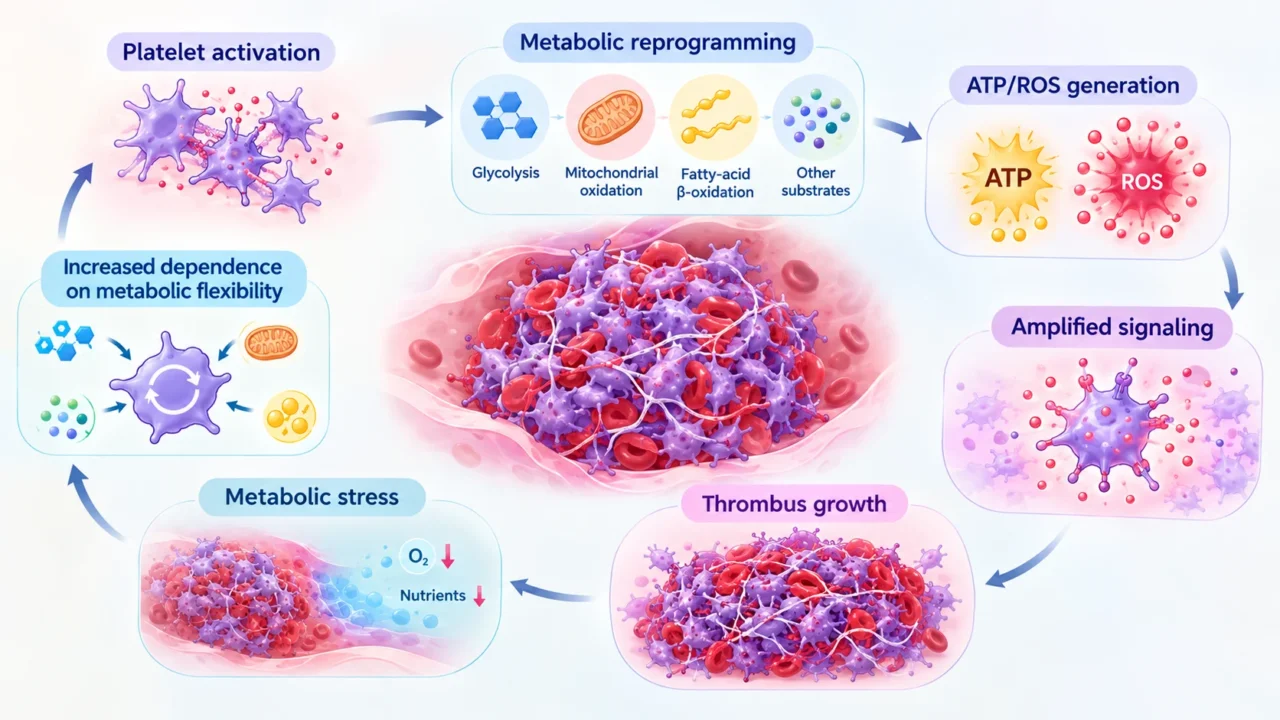
This is one reason platelet metabolic flexibility matters. Activated platelets can alter their dependence on glycolysis, mitochondrial oxidation, fatty-acid β-oxidation, and other substrates according to the surrounding metabolic conditions.
A potential feedback loop therefore emerges:
Platelet activation → metabolic reprogramming → ATP/ROS generation → amplified signaling → thrombus growth → metabolic stress → increased dependence on metabolic flexibility.
This model suggests that metabolism may help sustain platelet activity even as the thrombus itself progressively changes its biochemical environment.
Could Metabolic Pathways Become Antithrombotic Targets?
The metabolic pathways involved in platelet activation are attractive therapeutic targets because they sit downstream of multiple platelet agonists. Rather than blocking one receptor such as P2Y12 or one enzyme such as COX-1, metabolic intervention could theoretically interfere with several activation pathways simultaneously.
Preclinical studies have explored PDKs, PKM2, glucose-6-phosphate dehydrogenase, fatty-acid β-oxidation, mitochondrial pathways, and other metabolic checkpoints. Several experimental interventions have reduced platelet activation and thrombosis in animal models.
However, this approach faces an important translational challenge. Metabolic pathways are shared with other tissues, and platelet metabolism is highly adaptable. Inhibiting one pathway may therefore produce metabolic compensation or systemic toxicity. The goal would be to identify metabolic vulnerabilities that are particularly important in pathological platelet activation while preserving physiological hemostasis․
Why Platelet Metabolism Changes the Thrombosis Paradigm
The emerging model is that platelet activation cannot be explained exclusively by receptors and second-messenger pathways. Platelets also possess a dynamic metabolic state that determines how they generate energy, regulate redox signaling, handle calcium, remodel lipids, and respond to metabolic stress.
Glycolysis provides rapid ATP and metabolic intermediates; the PPP supports NADPH-dependent redox signaling; mitochondrial metabolism sustains high-demand functions; fatty-acid pathways influence lipid signaling; and mitochondrial Ca²⁺ handling can contribute to the procoagulant phenotype.
In this framework, metabolism is not simply the fuel for thrombosis. It is part of the signaling architecture that determines how thrombosis develops.
FAQ
1. Why do activated platelets increase aerobic glycolysis?
Activated platelets have rapidly increasing energy requirements for cytoskeletal remodeling, integrin activation, secretion, and aggregation. Aerobic glycolysis provides rapidly available ATP and remains advantageous when oxygen availability becomes restricted within a growing thrombus.
2. Does increased glycolysis make platelet mitochondria unnecessary?
No. Glycolysis and mitochondrial OXPHOS appear to support partially distinct platelet functions. Glycolysis is particularly important for rapid responses, whereas mitochondrial oxidative metabolism contributes to sustained secretion and thrombus amplification.
3. How do PDK2 and PDK4 connect metabolism to thrombosis?
PDK2/4 phosphorylate and inhibit PDH, reducing pyruvate entry into mitochondrial oxidation and redirecting glucose metabolism toward aerobic glycolysis. Genetic deletion of PDK2/4 reduced platelet activation and experimental arterial thrombosis in mice.
4. Why is PKM2 important in platelet activation?
PKM2 regulates the final step of glycolysis. Its dimeric form can alter glycolytic flux and promote accumulation of intermediates entering the PPP, thereby increasing NADPH availability and supporting ROS-dependent platelet signaling.
5. How does glucose metabolism generate platelet ROS?
Increased glycolytic flux can increase glucose-6-phosphate availability for the PPP. PPP activity generates NADPH, which can support NADPH oxidase-dependent ROS production. These ROS can function as signaling molecules that amplify platelet activation.
6. How does mitochondrial calcium promote the procoagulant phenotype?
Strong platelet activation produces sustained Ca²⁺ elevation. Mitochondrial Ca²⁺ uptake through MCU can contribute to mPTP opening and mitochondrial dysfunction, processes associated with high-level phosphatidylserine exposure and procoagulant platelet formation.
7. Why is phosphatidylserine important for thrombosis?
Externalized phosphatidylserine creates a negatively charged platelet surface that supports assembly of coagulation enzyme complexes and promotes thrombin generation. Procoagulant platelets therefore provide a direct bridge between platelet activation and secondary coagulation.
8. How does AMPK influence thrombus formation?
AMPK regulates ACC phosphorylation and platelet lipid metabolism. Experimental disruption of AMPK–ACC signaling increased thromboxane generation, dense-granule secretion, and thrombus formation, demonstrating a direct connection between energy sensing and platelet function.
9. Can mitochondrial metabolism determine platelet phenotype?
Increasing evidence suggests that mitochondrial bioenergetics contributes to platelet heterogeneity. Mitochondrial membrane potential, OXPHOS, calcium handling, and mPTP activity may influence the transition between predominantly aggregatory and procoagulant phenotypes.
10. Could platelet metabolism become a new antithrombotic target?
Potentially. PDKs, PKM2, PPP enzymes, fatty-acid metabolism, and mitochondrial pathways have produced antithrombotic effects in preclinical studies. However, metabolic compensation, tissue specificity, and preservation of normal hemostasis remain major translational challenges.
Written by Hermine Sayiyan, MD
Stay updated with Hemostasis Today.
-
Sep 25, 2026, 16:26Gemma Postil: AI Tools in Modern Health Research
-
Sep 25, 2026, 16:01Mostafa Hammam: When aPTT Correction Is Not the End
-
Sep 25, 2026, 15:50Adam Boruchov: Registration Is Open For The 2026 New England Hematologic Diseases Symposium
-
Sep 25, 2026, 15:23Bringing Hope and Treatment Access to Morocco’s Hemophilia Community – World Federation of Hemophilia
-
Sep 25, 2026, 15:22Alejandro González Veliz: Targeting Atherosclerosis Before the First Event
-
Sep 25, 2026, 15:00Sarah Richardson: Finding Strength Through Bleeding Disorders Advocacy
-
Sep 25, 2026, 14:54James Fildes: Modeling Device Related Thrombosis in Multi Organ Systems
-
Sep 25, 2026, 14:46Thomas Maxwell: From Hemophilia Shame to Strength – Walking for Bleeding Disorders
-
Sep 25, 2026, 14:35Sarita Rani Jaiswal: Sharing Basic Science Insights at EBMT HWP 2026