

Managing Thrombotic Risk in Pregnancy
Pregnancy brings profound physiological changes to the hemostatic system.
The balance between coagulation, anticoagulant pathways and fibrinolysis shifts throughout pregnancy and remains altered after delivery, contributing to an increased risk of venous thromboembolism (VTE).
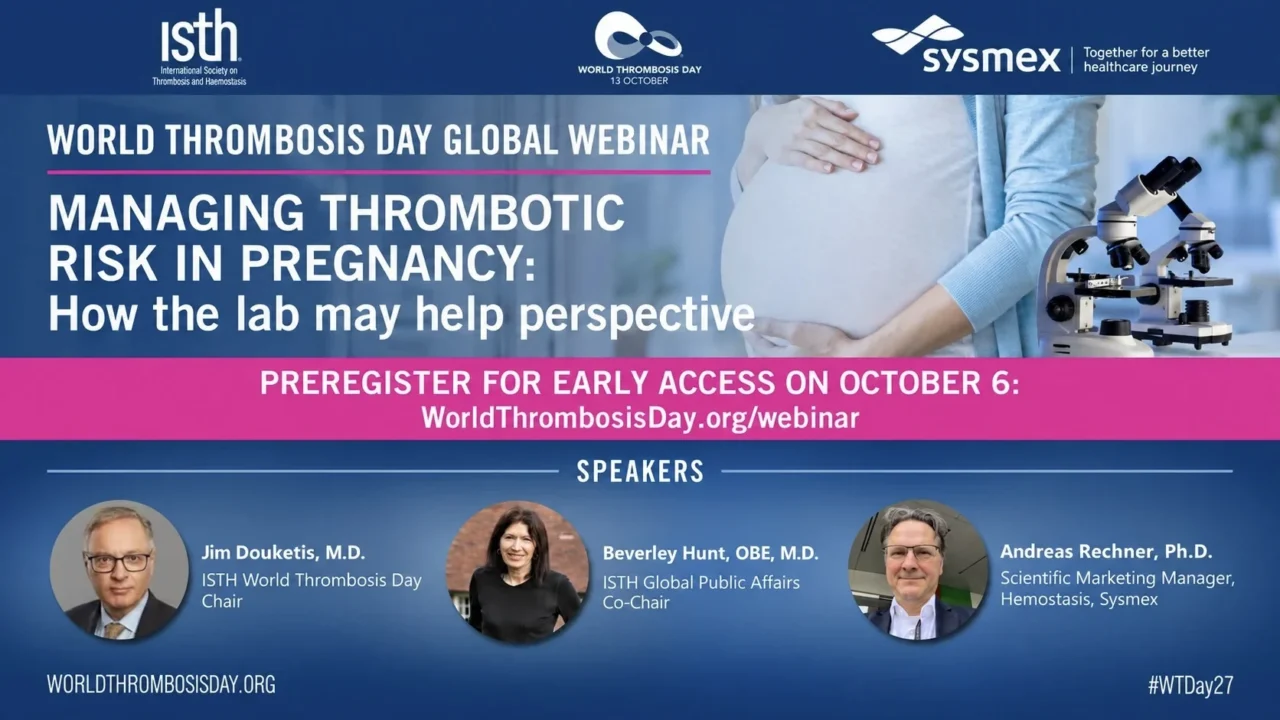
Ahead of World Thrombosis Day on October 13, the World Thrombosis Day campaign is highlighting thrombotic risk in pregnancy with a free educational webinar examining this important topic from three perspectives: diagnosis, treatment, and research.
The 45-minute webinar, supported by International Society on Thrombosis and Haemostasis (ISTH) and Sysmex, will explore how thrombotic risk is assessed and managed before conception, during pregnancy, and in the postpartum period.
It will also consider the role of laboratory information in clinical decision-making and how emerging research is contributing to the understanding of thrombosis in pregnancy.
Why Does Thrombotic Risk Change During Pregnancy?
Pregnancy is associated with a physiological shift toward a procoagulant state. Changes in coagulation factors, natural anticoagulant pathways, and fibrinolysis, together with venous stasis caused by the growing uterus, contribute to an increased risk of VTE.
These adaptations are important for maintaining hemostasis during childbirth but can also increase thrombotic risk. The risk remains particularly relevant during the postpartum period.
Diagnosing thrombosis during pregnancy can also present challenges because symptoms such as leg swelling and shortness of breath may overlap with normal physiological changes associated with pregnancy. Recognizing these challenges and applying appropriate diagnostic approaches is therefore an important part of clinical care.
Three Perspectives on Thrombotic Risk
The World Thrombosis Day webinar brings together three experts who will examine pregnancy-associated thrombotic risk from complementary perspectives.
Andres Rechner, Ph.D. – Diagnosis
Rechner will explore the role of laboratory diagnostics in assessing thrombotic risk before, during, and after pregnancy, including how laboratory information can support clinical assessment.
Jim Douketis, M.D. – Treatment
Douketis will address treatment and anticoagulation management, with a focus on how laboratory information can contribute to therapeutic decision-making in pregnancy. He also chairs the World Thrombosis Day campaign.
Prof. Beverley Hunt, O.B.E. – Research
Hunt, Professor of Thrombosis and Haemostasis at King’s College London and a founding member of the World Thrombosis Day steering committee, will discuss the evidence and emerging research shaping our understanding of thrombotic risk and its management during pregnancy.
What Will the Webinar Cover?
The session will explore:
- Changes in thrombotic risk before conception, during pregnancy, and postpartum
- The role of laboratory testing in assessing thrombotic risk
- How laboratory information can support treatment and anticoagulation decisions
- Current evidence relating to pregnancy-associated thrombosis
- Emerging research and future directions in the field
- The webinar will be relevant to thrombosis specialists, obstetricians and gynecologists, laboratory professionals, and researchers interested in the intersection of pregnancy, thrombosis, and laboratory medicine.
Webinar Details
The “Managing Thrombotic Risk in Pregnancy” webinar is a 45-minute online session, premiering on October 12, 2026, ahead of World Thrombosis Day on October 13.
The webinar is supported by Sysmex and the International Society on Thrombosis and Haemostasis (ISTH), featuring experts Andres Rechner, Ph.D., Jim Douketis, M.D., and Prof. Beverley Hunt, O.B.E., who will discuss thrombotic risk in pregnancy from the perspectives of diagnosis, treatment and research.
Register for the webinar: World Thrombosis Day Webinar
Pregnancy-associated thrombosis remains an important area at the intersection of clinical assessment, laboratory medicine, treatment and research.
This World Thrombosis Day webinar offers an opportunity to explore these perspectives together and consider how continued research and advances in laboratory medicine can contribute to the care of patients during pregnancy and the postpartum period.

Stay updated with Hemostasis Today.
-
Sep 21, 2026, 04:06Allison Lewin: How Gender Shapes the Way We Receive Medical Care
-
Sep 21, 2026, 03:49Jessica Lee: Walking Together for a Stronger Bleeding Disorders Community
-
Sep 21, 2026, 03:36Syed Asif Ali Shah: From Pakistan to Australia – A Clinical Haematology Milestone
-
Sep 21, 2026, 03:22Katie Baca-Motes: Estradiol Fluctuations May Help Explain Menstrual Migraine
-
Sep 21, 2026, 03:00Family History Can Reveal Hidden Risk of Aortic Dissection – The Marfan Foundation
-
Sep 21, 2026, 02:47Transitioning from Paediatric to Adult Haemophilia Care – Haemophilia Foundation Australia
-
Sep 21, 2026, 02:29Diana Castro Paupério: A New Era for Patient Blood Management
-
Sep 21, 2026, 00:29Iheanyichukwu Ike: Childhood Anaemia in Nigeria Through an Analysis of the 2018 NDHS
-
Sep 21, 2026, 00:27Nicole De Vita: The Global Burden of Iron Deficiency and Anemia in Women at SABM