


Mohammed Ayaz Ali։ HIT – When an Anticoagulant Causes Thrombosis
Mohammed Ayaz Ali, Clinical Pharmacist at Helping Hand Foundation (NGO), shared a post on LinkedIn:
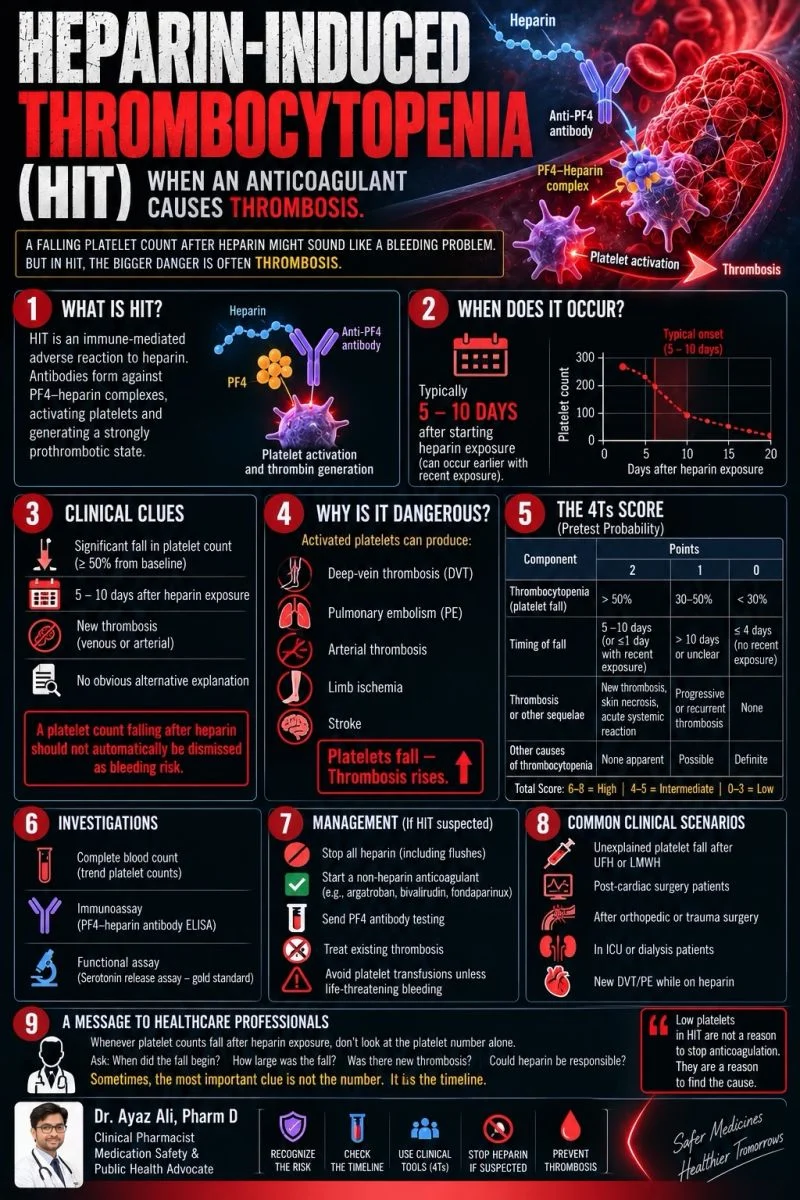
“Heparin-Induced Thrombocytopenia (HIT): When an Anticoagulant Causes Thrombosis
A falling platelet count after starting heparin might sound like a bleeding problem.
But in HIT, the bigger danger is often the opposite: Thrombosis.
A fascinating example of how a medication can trigger a paradoxical clinical emergency.
1.What is HIT?
HIT is an immune-mediated adverse reaction to heparin.
Antibodies form against PF4–heparin complexes, activating platelets and generating a strongly prothrombotic state.
2.The classic clue
Think about HIT when there is:
- Significant platelet fall
- Typically 5-10 days after heparin exposure
- New thrombosis
- No obvious alternative explanation
A platelet count falling after heparin should not automatically be dismissed as bleeding risk.
3.Why is it dangerous?
Activated platelets can produce:
- Deep-vein thrombosis
- Pulmonary embolism
- Arterial thrombosis
- Limb ischemia
- Stroke
The paradox is striking:
Platelets fall – thrombosis rises.
4.Where clinicians can miss it
The mistake can be assuming:
‘Low platelets means stop anticoagulation.’
In suspected HIT, the clinical approach is fundamentally different and requires urgent evaluation.
The 4Ts score can help estimate the pretest probability before laboratory confirmation.
5. A Message to healthcare professionals
Whenever platelet counts fall after heparin exposure, don’t look at the platelet number alone.
Ask:
- When did the fall begin?
- How large was the fall?
- Was there new thrombosis?
- Could heparin be responsible?
Sometimes, the most important clue is not the number.
It is the timeline.”
Stay updated with Hemostasis Today.
-
Oct 5, 2026, 15:31Irma Bagdoniene: Multidisciplinary Management of High-Risk Familial Hypercholesterolaemia and CAD
-
Oct 5, 2026, 15:00Serena Williams and Pulmonary Embolism: From Personal Crisis to Lessons in Venous Thromboembolism
-
Oct 5, 2026, 14:55Marco Moscarelli: 3D Reconstruction Enhances Volumetric Assessment of Post-TAVI Thrombosis
-
Oct 5, 2026, 13:24Abdul Muqtadir Abbasi: Diagnostic Pearls for Evaluating Isolated Thrombocytopenia in Residents
-
Oct 5, 2026, 13:16Katerina Pavenski: Rethinking What ‘Normal’ Means for Iron Deficiency
-
Oct 5, 2026, 13:09Rick Matthews: Balancing Established VTE Partnerships with Innovative Interventional Technologies
-
Oct 5, 2026, 13:01Nawsherwan Mohammad: Recognizing TTP Before the ADAMTS13 Result Arrives
-
Oct 5, 2026, 12:51Bruno Pougault: The Hidden Challenges Behind Anti Xa Testing
-
Oct 5, 2026, 12:41Syed Huzaifa Khan: Rethinking CTRP12 as a Biomarker for In Stent Restenosis