


Neeraj Songara: Can a Negative Antibody Screen Be Misleading?
Neeraj Songara, Resident Doctor at Dr S.N. Medical College Jodhpur, shared a post on LinkedIn:
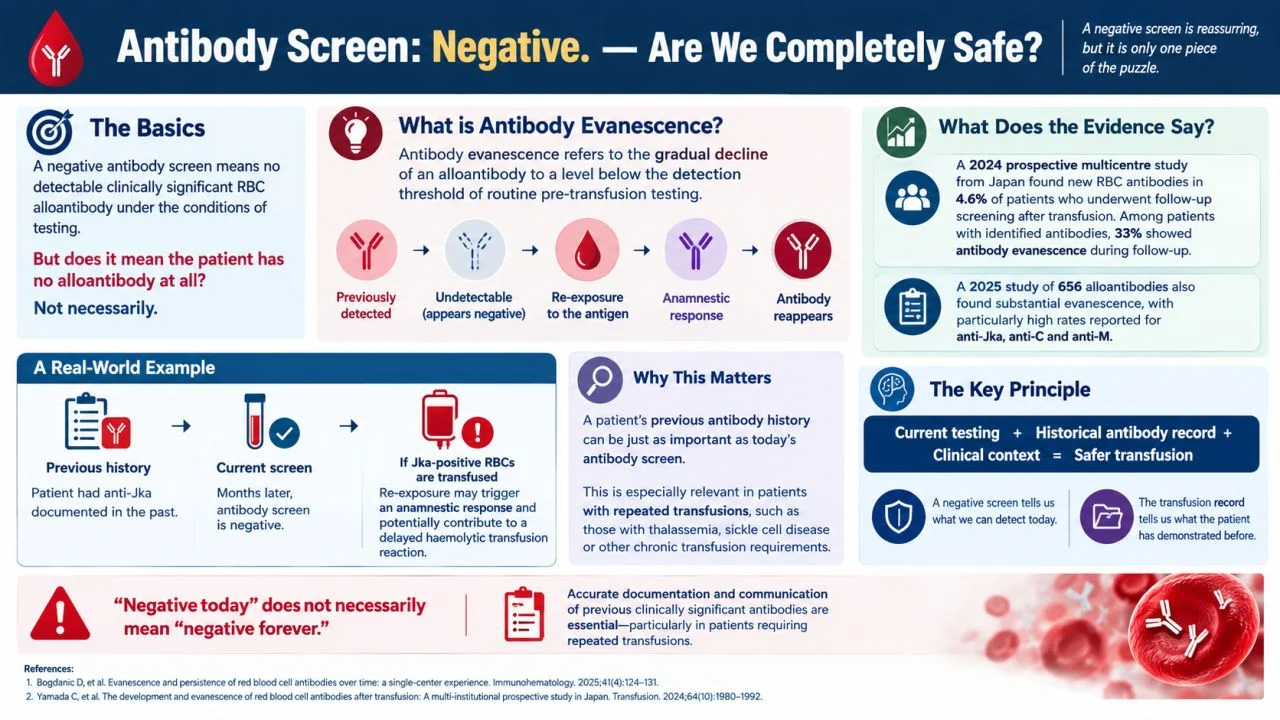
“‘Antibody Screen: Negative.’ — Are We Completely Safe?
A negative antibody screen is reassuring.
But does it mean the patient has no clinically significant RBC alloantibody?
Not necessarily.
One important concept in transfusion immunohematology is antibody evanescence – when an alloantibody gradually falls below the detection threshold of routine pre-transfusion testing.
The antibody may become:
Previously detected – undetectable – re-exposure to the antigen – anamnestic response – antibody reappears.
Why does this matter?
A 2024 prospective multicentre study from Japan found new RBC antibodies in 4.6% of patients who underwent follow-up screening after transfusion. Among patients with identified antibodies, 33% showed antibody evanescence during follow-up.
A 2025 study of 656 alloantibodies also found substantial evanescence, with particularly high rates reported for anti-Jka, anti-C and anti-M.
This is why a patient’s previous antibody history can be just as important as today’s antibody screen.
For example, a patient may have had anti-Jka documented previously, but months later the current screen may be negative.
If this history is missed and Jka-positive RBCs are transfused, re-exposure may trigger an anamnestic response and potentially contribute to a delayed haemolytic transfusion reaction.
The key principle:
- Current testing plus historical antibody record plus clinical context equals safer transfusion.
- A negative screen tells us what we can detect today.
- The transfusion record tells us what the patient has demonstrated before.
- ‘Negative today’ does not necessarily mean ‘negative forever.’
- Accurate documentation and communication of previous clinically significant antibodies are therefore essential -particularly in patients requiring repeated transfusions.”
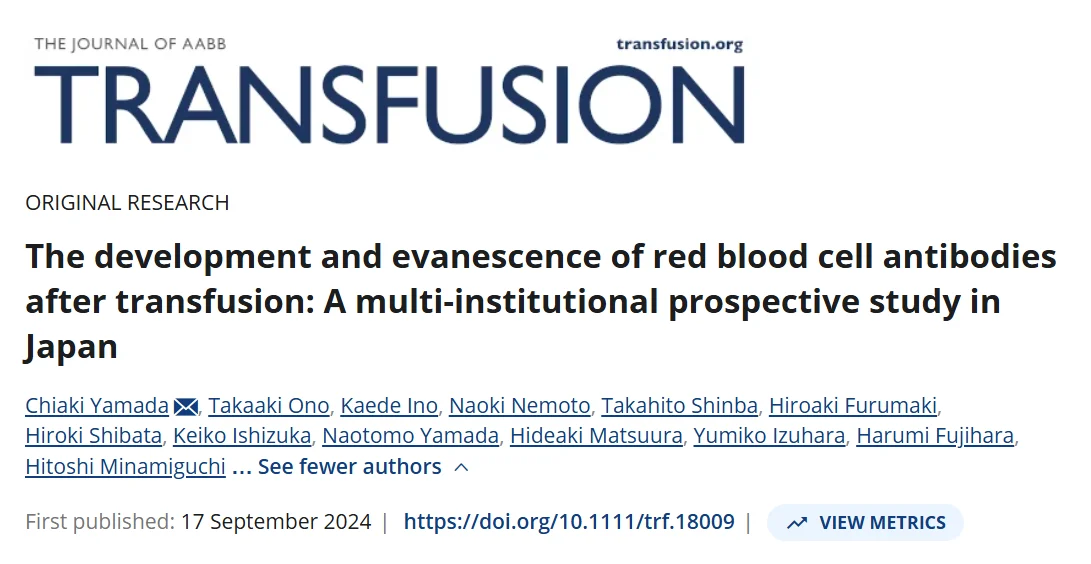
Title: The development and evanescence of red blood cell antibodies after transfusion: A multi-institutional prospective study in Japan
Authors: Chiaki Yamada, Takaaki Ono, Kaede Ino, Naoki Nemoto, Takahito Shinba, Hiroaki Furumaki, Hiroki Shibata, Keiko Ishizuka, Naotomo Yamada, Hideaki Matsuura, Yumiko Izuhara, Harumi Fujihara, Hitoshi Minamiguchi
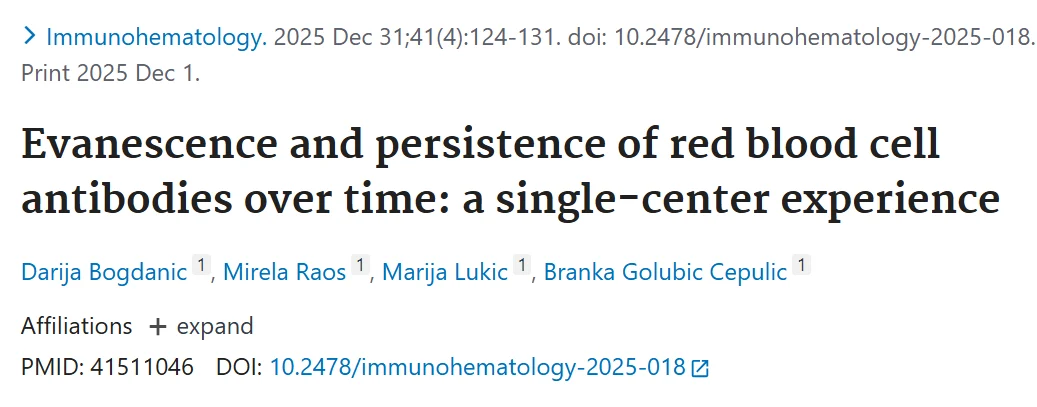
Title: Evanescence and persistence of red blood cell antibodies over time: a single-center experience
Authors: Darija Bogdanic, Mirela Raos, Marija Lukic, Branka Golubic Cepulic
Stay updated on Hemostasis Today.
-
Oct 7, 2026, 07:57Edward Lee Carter: When Should Apixaban Become the Default for Acute VTE?
-
Oct 7, 2026, 07:40Annette Bowyer: Exploring New Developments in Thrombin Generation
-
Oct 7, 2026, 07:06Omid Seidizadeh: When Acquired von Willebrand Syndrome Takes Different Paths
-
Oct 7, 2026, 04:09James P. Crowley: Could the Microbiome Protect Us From Severe EBV Infection?
-
Oct 7, 2026, 03:58Sohanur Rohanman Sohan: Explainable AI for Anemia Prediction Using Machine Learning
-
Oct 7, 2026, 03:00Sandeep Kumar: A Second Chance for a Child with Fanconi Anemia
-
Oct 7, 2026, 02:41Kemal Karaagac: Optimising DOAC Resumption After Major Bleeding in Atrial Fibrillation
-
Oct 7, 2026, 02:21Joseph Aslan: mPTP Inhibition Targets Platelet Procoagulant Activity and Thrombosis
-
Oct 7, 2026, 02:07Manuel Monreal: ECG Improves Risk Stratification in Acute Pulmonary Embolism