


Ney Carter Borges: How ApoB and Lp(a) Shape Coronary Plaque Risk
Ney Carter Borges, Member Cardiologist of Global Physician Association at Cleveland Clinic Florida, shared a post on LinkedIn about a recent article he and his colleagues co-authored, published in European Journal of Preventive Cardiology, adding:
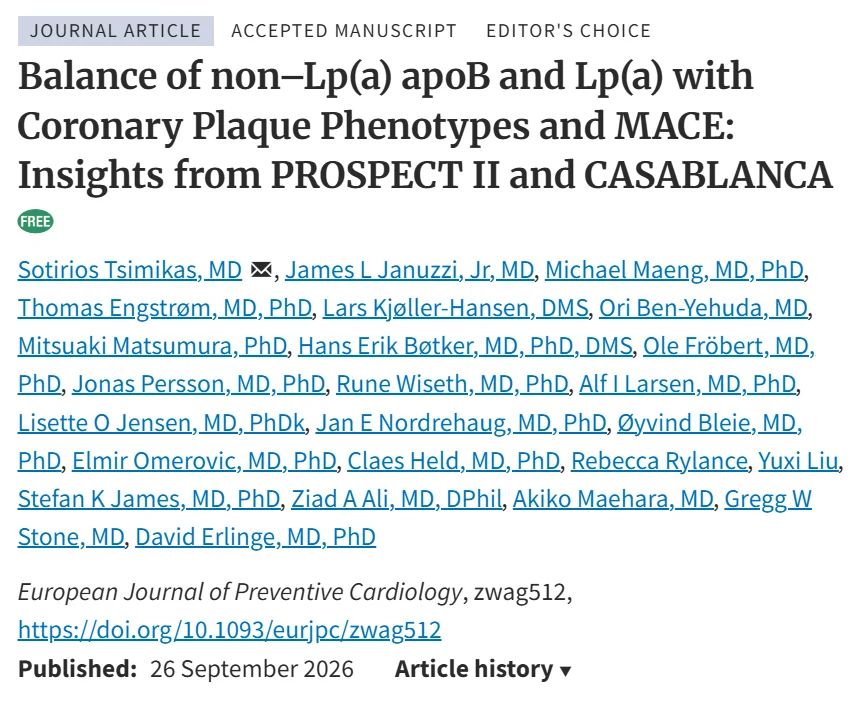
“Balance of non–Lp(a) apoB and Lp(a) with Coronary Plaque Phenotypes and MACE.
European Journal of Preventive Cardiology.
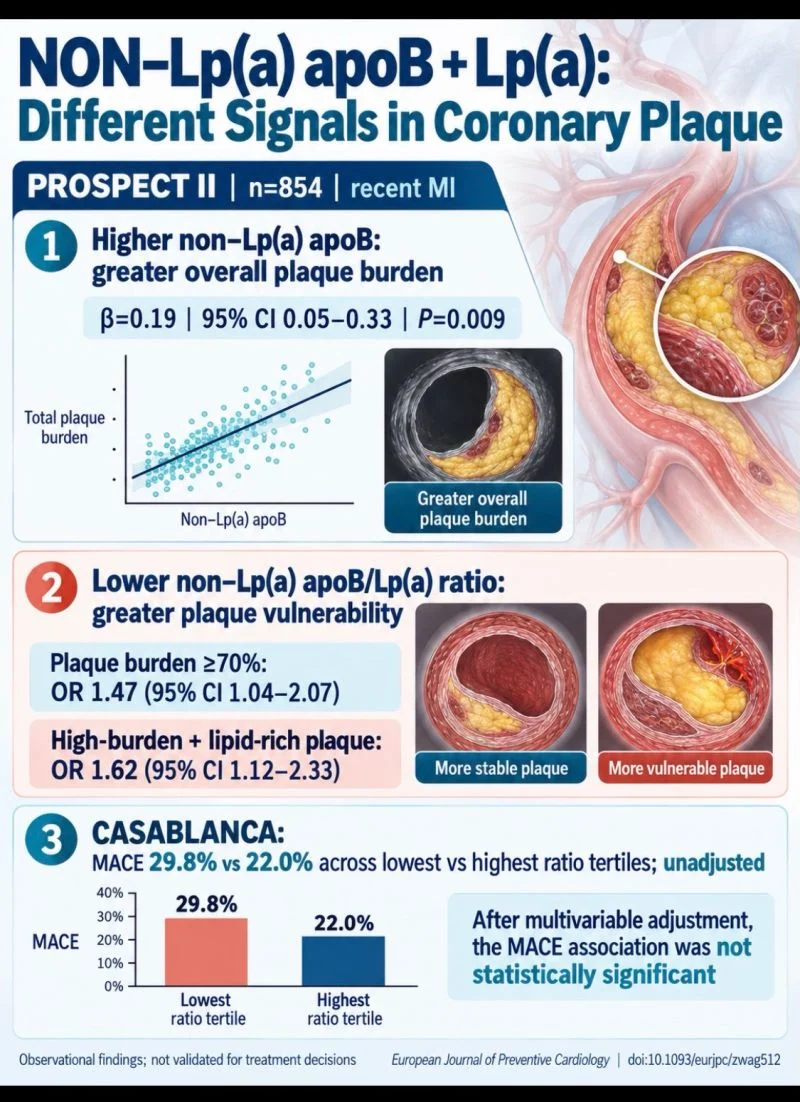
In this observational analysis of 854 patients with recent myocardial infarction from PROSPECT II, investigators separated apoB into Lp(a)-associated and non-Lp(a) particles and related their balance to coronary plaque features measured by NIRS-IVUS.
Higher non-Lp(a) apoB was independently associated with greater overall plaque burden (β equals 0.19; 95% CI, 0.05–0.33; P equals 0.009), but not with lipid-core burden.
Conversely, a lower non-Lp(a) apoB/Lp(a) ratio, indicating relative Lp(a) predominance, was associated with more high-risk plaque: compared with the highest tertile, the lowest tertile had higher odds of plaque burden more than or equals to 70% (OR 1.47; 95% CI, 1.04–2.07) and the composite of high plaque burden plus lipid-rich plaque (OR 1.62; 95% CI, 1.12–2.33).
The composite prevalence was 37.4% versus 28.2% across the lowest and highest tertiles.
In the external CASABLANCA cohort, lower ratios marked higher Lp(a) and oxidized phospholipid levels and higher unadjusted MACE rates (29.8% vs 22.0%); associations were not statistically significant after multivariable adjustment.
The findings support distinct roles for conventional apoB particles in plaque quantity and Lp(a) in vulnerability. The ratio remains exploratory, and neither causality nor clinical treatment utility has been established.
NIRS-IVUS did not directly assess fibrous-cap thickness, and prospective studies are needed before this metric can inform risk stratification or treatment decisions.”
Title: Balance of non-Lp(a) apoB and Lp(a) with Coronary Plaque Phenotypes and MACE: Insights from PROSPECT II and CASABLANCA
Authors: Sotirios Tsimikas, James L Januzzi, Jr, Michael Maeng, Thomas Engstrøm, Lars Kjøller-Hansen, Ori Ben-Yehuda, Mitsuaki Matsumura, Hans Erik Bøtker, Ole Fröbert, Jonas Persson, Rune Wiseth, Alf I Larsen, Lisette O Jensen, Jan E Nordrehaug, Øyvind Bleie, Elmir Omerovic, Claes Held, Rebecca Rylance, Yuxi Liu, Stefan K James, Ziad A Ali, Akiko Maehara, Gregg W Stone, David Erlinge
Find more posts featuring Ney Carter Borges on Hemostasis Today.
-
Oct 7, 2026, 14:41Vikash Jaiswal: Does Timing Matter for Calcium in Pre-Eclampsia Prevention?
-
Oct 7, 2026, 14:34Pre-Registration Ends for Our Webinar on Pregnancy and Thrombotic Risk – World Thrombosis Day
-
Oct 7, 2026, 14:19Maha Othman: Celebrating the Opening of The Current at St. Lawrence College
-
Oct 7, 2026, 14:12Zahra Ghasemi: The Role of Recovered and Source Plasma in Plasma Fractionation
-
Oct 7, 2026, 14:01Ronnie Hutcheon: The Risks of Incorrect Apixaban Dosing
-
Oct 7, 2026, 13:49A Plasma Proteomic Signature of Antiphospholipid Syndrome – JTH
-
Oct 7, 2026, 13:38Mary Panagrosso: Biology-Guided PRP for Musculoskeletal Disorders
-
Oct 7, 2026, 13:31Sihem Kebaili: Two Recent RPTH Publications Highlighting Rare Coagulation and Immune Thrombocytopenia Cases
-
Oct 7, 2026, 13:23Nisheeth Patel: The Clinical Balance Between Clot Prevention and Bleeding