


Aravind Palraj: The Prolonged aPTT Puzzle in SLE
Aravind Palraj, Senior Resident of Clinical Immunology and Rheumatology at Madras Medical College, shared a post on X:
“High yield pearl 6:
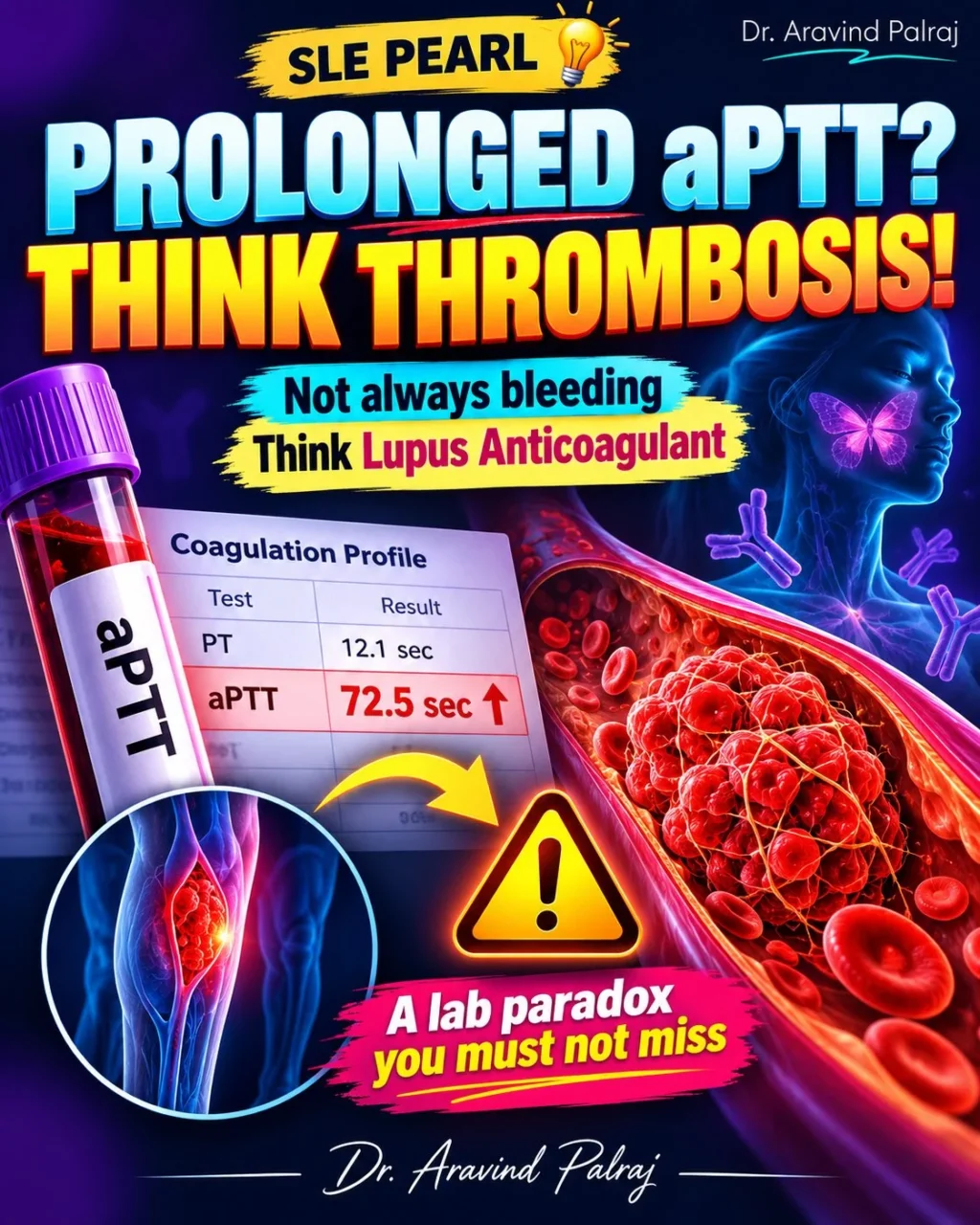
An SLE patient has an aPTT of 78 seconds.
But she has no bleeding manifestations.
Does a prolonged aPTT always mean increased bleeding risk?
No. Sometimes it signals exactly the opposite!
Think Lupus Anticoagulant (LA).
One of the most fascinating paradoxes in clinical immunology.
5 Clinical pearls every rheumatologist must know.
1. Prolonged aPTT does NOT always mean bleeding Lupus anticoagulant interferes with phospholipid-dependent coagulation reactions in vitro. But in vivo, persistent LA positivity is associated with increased thrombotic risk.
2. Why does LA cause thrombosis? Antiphospholipid antibodies, especially those directed against β2-glycoprotein I, can promote:
- Endothelial activation
- Monocyte tissue-factor expression
- Platelet activation
- Complement activation
- Impaired physiological anticoagulant mechanisms
3. A normal aPTT does NOT exclude lupus anticoagulant Routine aPTT reagents vary in their sensitivity to LA. A patient may have a normal routine aPTT but a positive dilute Russell’s viper venom time (dRVVT).
4. Mixing studies provide an important clue In a classic LA-associated prolonged aPTT:
- Mixing with normal plasma may fail to correct the prolongation.
- Excess phospholipid shortens the clotting time in confirmatory testing.
However, a correcting mixing study does not completely exclude a weak LA.
5. Anticoagulants can mislead you Heparin, warfarin and DOACs may interfere with LA testing, producing false-positive or false-negative results. Always interpret results in the context of current anticoagulant treatment.
Question
An SLE patient has:
- aPTT: 78 seconds
- PT/INR: Normal
- No bleeding
- Positive lupus anticoagulant
Should you give fresh frozen plasma simply to correct the aPTT?
Answer: No.
Isolated LA-associated prolongation does not itself indicate a bleeding tendency or require plasma correction.
Assess the clinical context and exclude other causes of prolonged aPTT.
TRAP
Can lupus anticoagulant ever be associated with severe bleeding? Yes!
Think lupus anticoagulant–hypoprothrombinaemia syndrome (LAHPS).
This rare condition causes acquired factor II deficiency and can produce serious haemorrhage, sometimes with prolongation of both PT and aPTT.
The take-home message
A prolonged aPTT is a laboratory observation, not a diagnosis of bleeding risk.
In SLE, lupus anticoagulant may indicate thrombotic risk despite its misleading name. Never confuse an anticoagulant effect in the laboratory with an anticoagulant effect in the patient.”
Stay updated with Hemostasis Today.
-
Oct 23, 2026, 15:33Smitirupa Mishra: A Systematic Approach to Bone Marrow Examination
-
Oct 23, 2026, 15:29José Antonio García Erce: Preoperative Anemia Emerges as a Modifiable Surgical Risk in New POWER Study
-
Oct 23, 2026, 15:13Reza Shojaei: Manufactured Red Blood Cells vs Blood Donation
-
Oct 23, 2026, 14:29Jean Jacques Kiladjian: International Scientific Exchange at IHCAMS in Tianjin
-
Oct 23, 2026, 13:56Chokri Ben Lamine: The Evolving Treatment Landscape of Persistent and Chronic ITP
-
Oct 23, 2026, 13:51Julia Barr: Back to Donating – One Pint, One Good Deed
-
Oct 23, 2026, 13:45Marta Velia Antonini: EuroELSO Webinar to Highlight New Evidence on ECMO Anticoagulation
-
Oct 23, 2026, 13:16Mary Cushman: Antiphospholipid Antibodies and Their Association with Ischemic Stroke
-
Oct 23, 2026, 13:07Cristina Figueroa Villalba: AABB 2026 Highlights in Transfusion Medicine and Cell Therapy