


Reza Shojaei: Manufactured Red Blood Cells vs Blood Donation
Reza Shojaei, Chief Operating Officer at Canadian Plasma Resources, shared a post on LinkedIn:
“Can we manufacture red blood cells instead of relying exclusively on collecting them?
It is a fascinating idea.
But at this stage, it still looks much more like a scientific ambition than a practical alternative to blood donation.
One of the developments that caught my attention at AABB was progress in manufactured red blood cells, or mRBCs.
According to AABB, Safi Biotherapeutics is developing a process that starts with hematopoietic progenitor cells and expands and differentiates them into red blood cells over approximately 21 days.
That is scientifically impressive.
It may also eventually have important applications for patients who are difficult to match, including some people with sickle cell disease or complex antibody profiles.
Manufactured cells with defined antigen characteristics could potentially provide more consistently matched products for selected patients.
But we should keep the scale of this development in perspective.
Today, this is not a substitute for blood donation.
It is not yet a mature, scalable or widely available manufacturing solution.
Major questions remain around cost, manufacturing capacity, regulatory approval, clinical performance, and whether production can ever reach the scale required to support routine blood systems. Safi hopes to begin a U.S. clinical trial in 2027.
Meanwhile, the real and immediate challenge is much more basic:
The world still needs people to donate blood.
And that need is especially urgent in low and middle income countries (LMICs).
WHO has repeatedly highlighted the enormous global disparity in blood availability.
High income countries collect a disproportionately large share of the world’s blood despite representing a much smaller share of the global population, while many lower income countries continue to struggle with insufficient collection, infrastructure, testing capacity, trained personnel and reliable access to safe blood.
In many health systems, the challenge is not how to manufacture blood in a bioreactor.
It is how to make sure a mother with severe bleeding, a child with malaria related anaemia, a trauma patient, or someone requiring surgery can receive a safe unit of blood when they need it.
That reality matters.
Manufactured RBCs may one day become an important complement to conventional donation, particularly for specialized or hard to match patients.
But for now, they remain closer to a promising dream than a solution to the world’s blood supply problem.
And while we watch that science develop, the most important message should not get lost:
- Real blood donors are needed today.
- They are needed everywhere.
- And they are needed most in places where blood access is already fragile.
Perhaps the future will eventually include both blood donation AND blood manufacturing.
But today, there is no replacement for the donor.
Read more 2″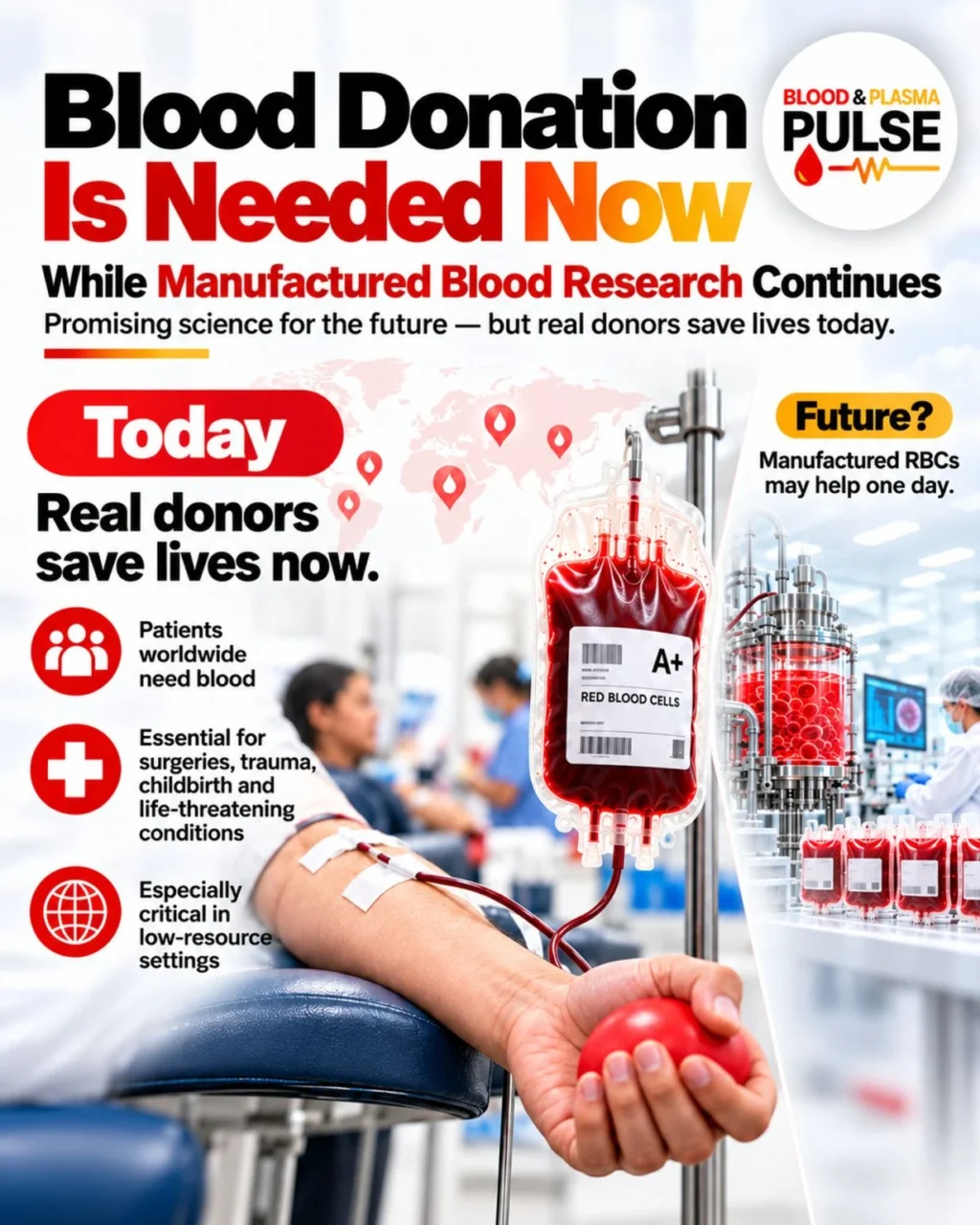
Stay updated with Hemostasis Today.
-
Oct 23, 2026, 14:29Jean Jacques Kiladjian: International Scientific Exchange at IHCAMS in Tianjin
-
Oct 23, 2026, 14:11Aravind Palraj: The Prolonged aPTT Puzzle in SLE
-
Oct 23, 2026, 13:56Chokri Ben Lamine: The Evolving Treatment Landscape of Persistent and Chronic ITP
-
Oct 23, 2026, 13:51Julia Barr: Back to Donating – One Pint, One Good Deed
-
Oct 23, 2026, 13:45Marta Velia Antonini: EuroELSO Webinar to Highlight New Evidence on ECMO Anticoagulation
-
Oct 23, 2026, 13:16Mary Cushman: Antiphospholipid Antibodies and Their Association with Ischemic Stroke
-
Oct 23, 2026, 13:07Cristina Figueroa Villalba: AABB 2026 Highlights in Transfusion Medicine and Cell Therapy
-
Oct 23, 2026, 13:02Jesus Ardila Novoa: New Therapies for ITP
-
Oct 23, 2026, 12:49Wolfgang Miesbach: Factor XI Inhibition and the Future of Precision Anticoagulation