


Abdulla A. Damluji: LATE-MT Reveals Benefits and Risks of Late Thrombectomy
Abdulla A. Damluji, Director of the Cardiovascular Center on Aging at Cleveland Clinic, shared a post on LinkedIn about a recent article by Pengfei Yang et al, published in NEJM, adding:
“For a decade, the treatment of acute ischemic stroke from large vessel occlusion has been organized around time.
Thrombectomy within 6 hours became standard after the 2015 trials, and the DAWN and DEFUSE 3 trials extended the window to 24 hours in patients selected by perfusion imaging.
The question that followed was predictable. If salvageable tissue, rather than the clock, defines who benefits, does the benefit persist beyond 24 hours? Observational series suggested that it might.
The LATE-MT trial, published this week in the New England Journal of Medicine, provides the first randomized answer.
Trial design
LATE-MT was an investigator initiated, open label, randomized trial with blinded outcome assessment conducted at 35 comprehensive stroke centers in China between November 2022 and December 2025.
Adults with occlusion of the anterior circulation on computed tomographic or magnetic resonance angiography were eligible if they presented 24 to 72 hours after symptom onset or the time they were last known to be well, had a National Institutes of Health Stroke Scale score of at least 6, and had salvageable tissue on automated perfusion imaging. Salvageable tissue was defined as an ischemic core below 50 milliliters, a mismatch ratio of at least 1.8, and a penumbra of at least 15 milliliters.
Patients were randomized 1 to 1 to endovascular therapy plus standard medical care or to standard medical care alone, with stratification by time from onset. The primary outcome was the distribution of modified Rankin scale scores at 90 days, analyzed by ordinal logistic regression.
Who was enrolled
Of 1088 patients screened, 336 formed the intention to treat population, with 168 in each group. The mean age was 64 years, 30.7% were female, and nearly all were of Han Chinese ancestry.
The median baseline stroke scale score was 10, the median ischemic core was 4.0 milliliters, and the median time from onset to randomization was 38.5 hours.
The groups were balanced except that prior intravenous thrombolysis and internal carotid artery occlusion were more common in the intervention group.
Thrombectomy was performed in 96.4% of patients assigned to intervention, with a median of 1 hour from randomization to arterial puncture, and successful reperfusion was achieved in 94.6% of those with angiographic data.
Efficacy
The primary outcome favored endovascular therapy. The common odds ratio for a better functional outcome at 90 days was 1.74, with a 95% confidence interval of 1.19 to 2.55 and a P value of 0.005.
Adjusted and per protocol analyses were consistent. Death or dependency at 90 days occurred in 51.5% of the intervention group and 64.7% of the control group, an odds ratio of 0.58.
Among survivors, dependency was 48.4% compared with 64.0%. Quality of life measured by the EuroQol questionnaire, the Barthel Index, and the utility weighted modified Rankin scale all favored intervention.
Recanalization at 48 hours was achieved in 82.4% of the intervention group compared with 18.0% of controls.
Two efficacy findings deserve attention because they did not follow the expected pattern. Neurologic scores at 7 days did not differ between groups, and infarct volume at 7 days was numerically larger with intervention, at 51.3 milliliters compared with 42.9 milliliters, although the confidence interval crossed zero.
The investigators attribute the absence of early neurologic improvement to the high prevalence of intracranial atherosclerotic disease, in which residual stenosis may blunt the immediate hemodynamic benefit of recanalization, and to the frequent use of general anesthesia and sedation that may have confounded early assessments.
The infarct volume result is harder to reconcile with a functional benefit and will require further imaging analysis, which the authors state is planned.
Safety
The cost of benefit was measurable. Any intracranial hemorrhage within 7 days occurred in 28.3% of the intervention group compared with 5.5% of controls, an odds ratio of 6.82. Symptomatic hemorrhage occurred in 4.8% of treated patients and in no control patient.
Death within 90 days occurred in 6.0% of the intervention group compared with 1.8% of controls, an odds ratio of 3.48 with a confidence interval of 0.94 to 12.89.
Five of the 10 deaths after thrombectomy were due to intracranial hemorrhage. Serious adverse events occurred in 22.0% compared with 13.1%, and procedural complications included dissection or perforation in 4.8% and embolization to a new territory in 2.4%. Hospitalization was 2.4 days longer with intervention.
The intervention group also received substantially more intravenous tirofiban, osmotic therapy, intensive care, intubation, and glucocorticoids, and these postrandomization differences in management are likely to have influenced both efficacy and safety.
Subgroups
In prespecified subgroup analyses, the treatment effect appeared larger in patients with internal carotid artery occlusion, with a common odds ratio of 3.88, than in those with middle cerebral artery occlusion, where the odds ratio was 1.25 and the interval included 1.
The effect was also larger in patients whose stroke etiology was not large artery atherosclerosis, with an odds ratio of 6.80, than in those with large artery atherosclerosis, where it was 1.48.
These findings are hypothesis generating, but they suggest that the signal may be concentrated in embolic occlusions of proximal vessels and attenuated in the atherosclerotic disease that was common in this population.
Interpretation
LATE-MT establishes that thrombectomy can improve functional outcome in imaging selected patients as late as 72 hours after stroke onset, and the magnitude of benefit is comparable to that seen in the 6 to 24 hour trials.
It also establishes that the procedure in this window carries a sixfold increase in hemorrhage and a threefold increase in death, with a confidence interval that does not exclude the possibility that the mortality difference arose by chance.
The trial population was younger, less often female, and more often affected by intracranial atherosclerosis than Western cohorts, and the trial was conducted at experienced Chinese centers with a high rate of adjunctive antithrombotic therapy.
Whether the risk benefit balance transfers to older patients with atrial fibrillation treated in North American and European systems is an open question that ongoing trials will need to address.
Market implications
The commercial consequence of LATE-MT is an expansion of the addressable population for thrombectomy devices and the perfusion imaging software that selects patients.
Late presenters, patients transferred from distant hospitals, and patients with wake up strokes beyond 24 hours have historically been treated medically.
If guideline committees incorporate this evidence, even with caveats, the number of eligible procedures at comprehensive stroke centers will rise, and demand for automated perfusion platforms will rise with it.
The trial also reinforces the value of imaging selection over time based protocols, which favors vendors whose software is validated for late window thresholds.
At the same time, the hemorrhage and mortality signal will temper adoption outside high volume centers and will create pressure for devices and adjunctive strategies that reduce reperfusion injury.
Payers and hospital systems will need to weigh longer hospital stays and higher intensive care utilization against reduced long term disability, and health economic analyses from the trial are planned.
Key Points Helpful for Clinical Practice
- Imaging selected patients with anterior circulation large vessel occlusion presenting 24 to 72 hours after onset had better 90 day functional outcomes with thrombectomy than with medical care alone, with a common odds ratio of 1.74.
- Eligibility required an ischemic core below 50 milliliters, a mismatch ratio of at least 1.8, and a penumbra of at least 15 milliliters on automated perfusion imaging. These thresholds, not the clock, define the candidate.
- Symptomatic intracranial hemorrhage occurred in 4.8% of treated patients and 90 day mortality was 6.0% compared with 1.8% with medical care. Patients and families should be counseled that the procedure in this window trades disability for a measurable increase in hemorrhage and death.
- Benefit appeared concentrated in internal carotid artery occlusion and in non atherosclerotic etiology. Patients with intracranial atherosclerotic disease and middle cerebral artery occlusion derived less clear benefit.
- Early neurologic improvement was not seen at 7 days, and infarct volume did not differ. Expectations for rapid recovery after late window thrombectomy should be set accordingly.
- The population was younger and had less atrial fibrillation than typical Western cohorts, and adjunctive tirofiban and thrombolysis were used frequently. Direct extrapolation to older patients on anticoagulation is not supported by these data.
- Late window thrombectomy should remain the province of experienced comprehensive stroke centers until confirmatory trials in other populations report.
Key Market Implications
- The eligible population for mechanical thrombectomy expands to include late presenters and delayed transfers, increasing procedural volume at comprehensive stroke centers.
- Demand for automated perfusion imaging software will grow, with advantage to platforms validated for late window selection criteria.
- Device manufacturers gain a new indication to pursue in labeling and guidelines, but the safety signal will slow uptake at lower volume centers.
- Longer hospitalization and higher intensive care utilization create cost pressure that will shape payer coverage decisions pending health economic analyses.
- The hemorrhage and reperfusion injury signal creates a clinical need, and therefore a commercial opportunity, for neuroprotective and adjunctive strategies in late reperfusion.
- Generalizability concerns mean that confirmatory trials in North American and European populations are likely to be required before broad guideline adoption, extending the timeline for full market impact.”
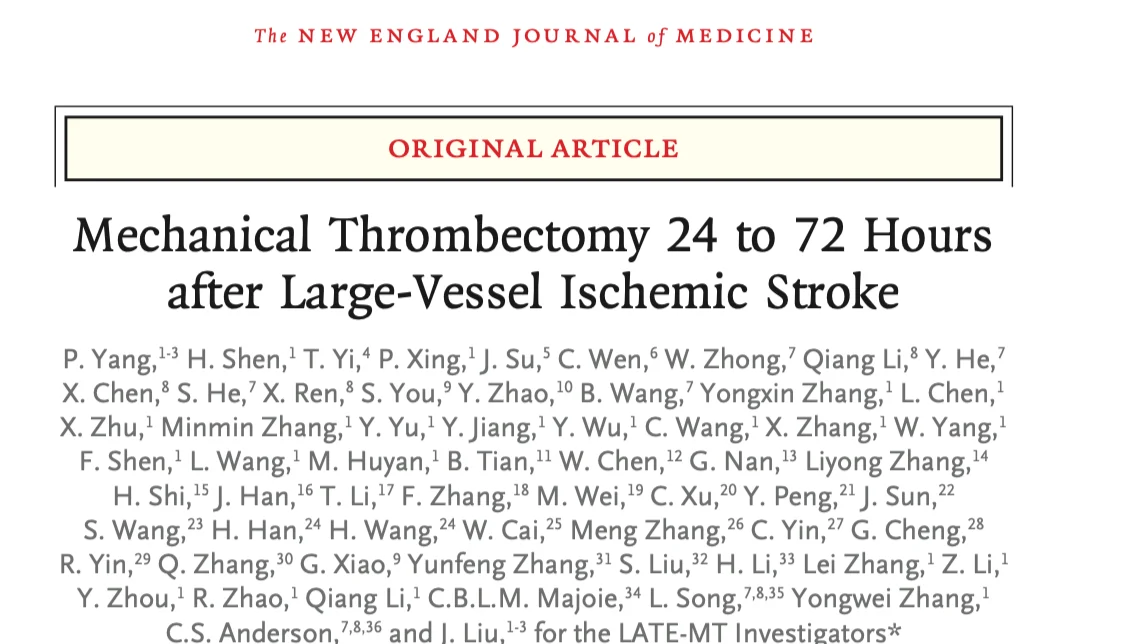
Title: Mechanical Thrombectomy 24 to 72 Hours after Large-Vessel Ischemic Stroke
Authors: Pengfei Yang, Hongjian Shen, Tingyu Yi, Pengfei Xing, Junfeng Su, Changming Wen, Weiyi Zhong, Qiang Li, Yunting He, Xiaoying Chen, Song He, Xinwen Ren, Shoujiang You, Yang Zhao, Borui Wang, Yongxin Zhang, Lei Chen, Xuan Zhu, Minmin Zhang, Ying Yu, Yi Jiang, Yina Wu, Chuanchuan Wang, Xiaoxi Zhang, Wenjin Yang, Fang Shen, Lijun Wang, Meihua Huyan, Bing Tian, Wenhuo Chen, Guangxian Nan, Liyong Zhang, Huaizhang Shi, Jianfeng Han, Tong Li, Fan Zhang, Ming Wei, Chenghua Xu, Ya Peng, Jun Sun, Shouchun Wang, Hongxing Han, Hao Wang, Wenqiang Cai, Meng Zhang, Congguo Yin, Guangsen Cheng, Rong Yin, Quanbin Zhang, Guodong Xiao, Yunfeng Zhang, Sheng Liu, Hui Li, Lei Zhang, Zifu Li, Yu Zhou, Rui Zhao, Qiang Li, Charles B.L.M. Majoie, Lili Song, Yongwei Zhang, Craig S. Anderson, Jianmin Liu
Other posts featuring Abdulla A. Damluji on Hemostasis Today.
-
Oct 26, 2026, 05:28Anirban Sen Gupta: Celebrating 20 Years of Research and Innovation
-
Oct 26, 2026, 05:13Shamee Shastry: ScholarGPS Recognises a Highly Ranked Blood Transfusion Scholar
-
Oct 26, 2026, 03:43Shazmah Shaikh: How Laser Atherectomy Helps Clear Blocked Arteries
-
Oct 26, 2026, 03:28Priya Prasad: Protecting Donors and Recipients Through Blood Safety
-
Oct 25, 2026, 19:55Giacomo Buso: LIPLEG Provides the Strongest Evidence to Date on Lipedema Treatment
-
Oct 25, 2026, 19:54Nicholas Lee: ASH Program Connects Trainees and Faculty With Mentors for Career Development
-
Oct 25, 2026, 19:53World Thrombosis Day Raises Blood Clot Awareness at Italian Airports
-
Oct 25, 2026, 19:49Tahsim Anwar: A Six-Year Analysis of Adverse Events in Therapeutic Apheresis
-
Oct 25, 2026, 19:37William Wallace: More than 1 in 3 People with Parkinson’s Were Low in B6