


Abdul Mannan/LinkedIn
Oct 30, 2026, 14:00
Abdul Mannan: A Negative PCR Does Not Exclude β-Thalassaemia
Abdul Mannan, Consultant Haematologist, Director Haemophilia Centre, Haematology Lab Lead at Betsi Cadwaladr University Health Board, shared a post on LinkedIn:
“The patient has β-thalassaemia major. The PCR says Negative.
Would you rule out the diagnosis?
I wouldn’t.
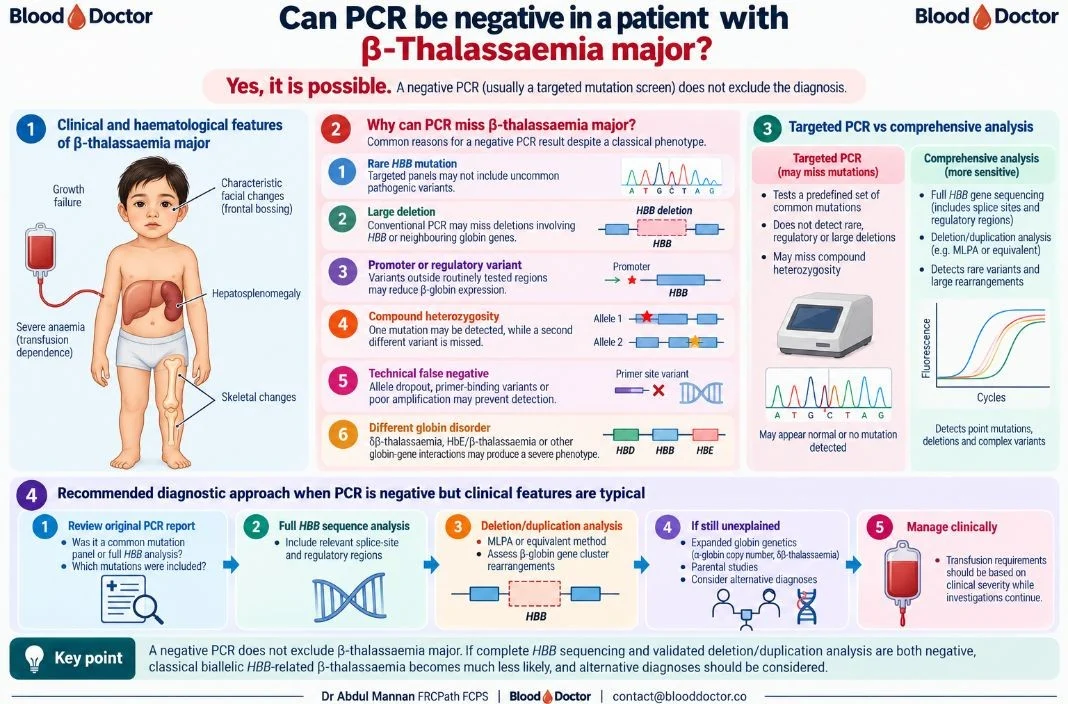
- Imagine a child with severe microcytic anaemia, hepatosplenomegaly, growth failure, markedly raised HbF and transfusion dependence.
- Clinically, everything points towards β-thalassaemia major.
- But the molecular report states: ‘No β-thalassaemia mutation detected.’
Here is where the diagnostic trap lies.
- A negative targeted PCR screen does not mean a normal HBB gene.
- The test may simply not have looked for the causative variant.
What could have been missed?
- A rare HBB variant absent from the mutation panel.
- A large deletion involving the β-globin gene cluster.
- A promoter, splice-site or regulatory variant.
- Compound heterozygosity with an undetected second variant.
- Allele dropout or another technical limitation.
- And sometimes, the answer is a different globin disorder producing a similar phenotype.
So what should we do?
- First, examine the original molecular report. Was this a targeted mutation panel or full HBB sequence analysis?
- Review the pre-transfusion haemoglobin fractions.
- Proceed to HBB sequencing and deletion/duplication analysis, including MLPA where appropriate.
- If those investigations are unrevealing, reconsider the diagnosis and extend molecular testing.
The teaching point:
- A molecular test can be technically correct yet diagnostically incomplete.
- Before allowing a negative result to exclude a diagnosis, ask one question:
‘What exactly was this test designed to detect?’
That question can change the entire diagnostic pathway.
Have you encountered a patient whose clinical phenotype and molecular findings did not agree?”
Find more posts featuring Abdul Mannan on Hemostasis Today.
-
Oct 30, 2026, 14:27Isabella Presch: From Innovation to Accessibility in Cell and Gene Therapy
-
Oct 30, 2026, 13:53Matteo Foschi: Can Thrombolysis Safely Treat Stroke After Cardiac Procedures?
-
Oct 30, 2026, 13:42Wolfgang Miesbach: Gene Therapy-Associated Leukaemia With Clonal Persistence Over 16 Years
-
Oct 30, 2026, 12:47Louise St. Germain Bannon: Turning Thrombosis Awareness into Stroke Prevention
-
Oct 30, 2026, 12:36Aryabhatta Sadhu: Sickle Cell Crisis Recognising When Treatment Must Change
-
Oct 30, 2026, 12:22Fabrice Cognasse: The Future of Blood Banks From Transfusion Support to Precision Medicine
-
Oct 30, 2026, 12:09Carmelo Gurnari: Clonal Dynamics in the Bone Marrow During Sepsis and Emergency Haematopoiesis
-
Oct 30, 2026, 11:49Advancing Global Care for Hemophilia and Bleeding Disorders – World Federation of Hemophilia
-
Oct 30, 2026, 05:18Flora Peyvandi: Molecular and Lab Markers Linked to Bleeding Severity in Factor VII Deficiency