


Abdul Mannan: Why Apixaban May Be the Safer Choice for Acute VTE
Abdul Mannan, Consultant Hematologist at Betsi Cadwaladr University Health Board, shared a post on LinkedIn:
“For years, we’ve been prescribing both apixaban and rivaroxaban for acute VTE as if they were identical twins.
They’re not.
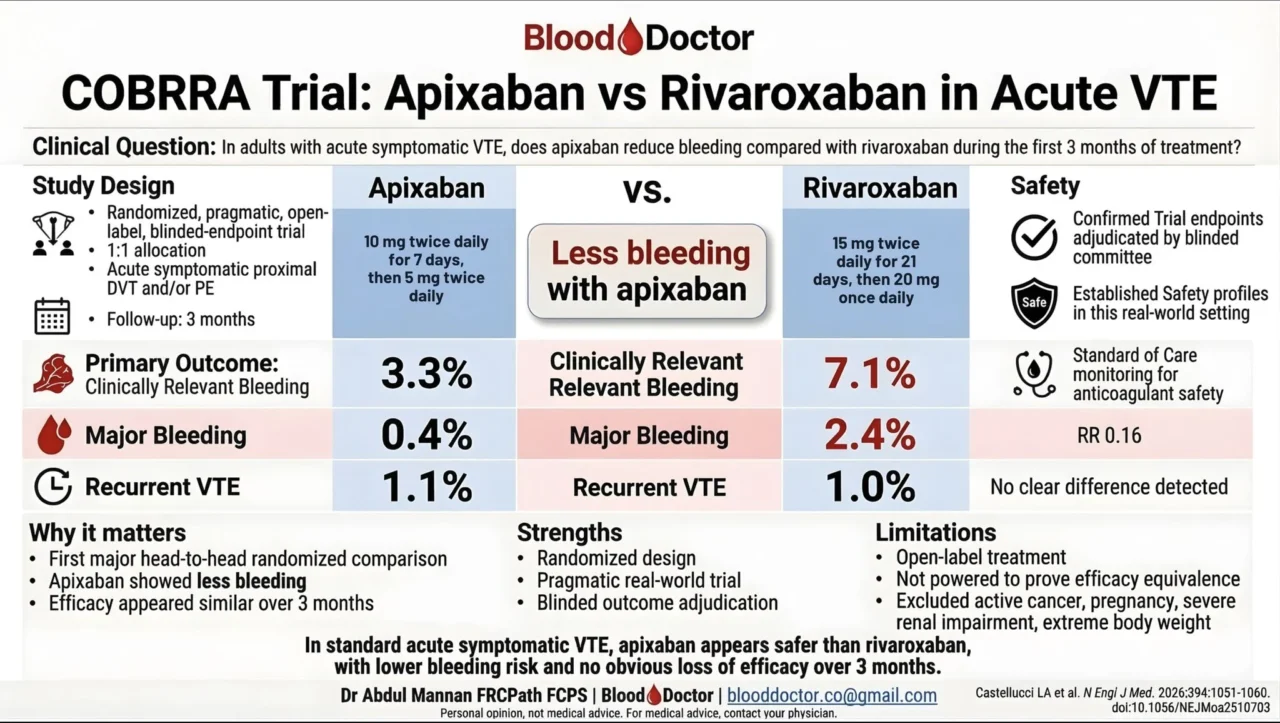
The COBRRA trial just published in NEJM (Castellucci LA et al., 2026) is the first randomised head-to-head comparison of these two DOACs in acute symptomatic VTE.
And the results are clear.
Here’s what the data shows:
- Clinically Relevant Bleeding: 3.3 percent with apixaban versus 7.1 percent with rivaroxaban
- Major Bleeding: 0.4 percent versus 2.4 percent (RR 0.16 – that is not a small difference)
- Recurrent VTE: 1.1 percent versus 1.0 percent (no meaningful difference)
Same protection. Less bleeding. That’s a win for patients.
This was a pragmatic, open-label, blinded-endpoint trial with 1:1 allocation across acute proximal DVT and PE.
Real-world design. Blinded outcome adjudication. Three months follow-up.
The limitation worth noting: it excluded active cancer, pregnancy, severe renal impairment, and extreme body weight.
So this applies to your standard acute VTE patient, not every patient.
But for that standard patient?
The choice just got easier.
Apixaban appears to be the safer DOAC for acute VTE treatment when bleeding risk matters. And bleeding risk always matters.
Does this change your practice?
Are you already defaulting to apixaban, or does your institution still treat them as equivalent?
Drop your thoughts below.”
Other posts featuring Abdul Mannan on Hemostasis Today.
-
Sep 23, 2026, 16:04Monia Ezzalfani: Advancing Patient-Centered Care in Hemophilia A and B
-
Sep 23, 2026, 15:49Bilge Başak: How Activated PRP Modulates Osteoarthritic Chondrocyte Function
-
Sep 23, 2026, 14:50Mbonjo Bitsie Dora: Strengthening Sickle Cell Care Through Education, Awareness and Innovation
-
Sep 23, 2026, 13:58The New B12 Diagnostic Algorithm: From Serum Cobalamin to Functional Deficiency
-
Sep 23, 2026, 13:56Noha Soror: Preparing for Hematology and Medical Oncology Board Certification
-
Sep 23, 2026, 13:46Ugochi Ogu: What Can Platelet Proteomics Reveal about Pain and Neurocognitive Vulnerability in Sickle Cell Disease?
-
Sep 23, 2026, 13:42Melissa Hollo: Connecting Obesity and Anemia for Earlier Maternal Risk Intervention
-
Sep 23, 2026, 13:16Beverley Hunt: Advances in Haemostatic Management of Postpartum Haemorrhage
-
Sep 23, 2026, 13:13Ioanna Mela: Recruiting a Research Associate on DNA nanotechnology