


Abdul Mannan: Postpartum Bleeding Is Not Always Obstetric Bleeding
Abdul Mannan, Consultant Haematologist at Betsi Cadwaladr University Health Board, shared a post on LinkedIn:
”Postpartum bleeding is not always obstetric bleeding.
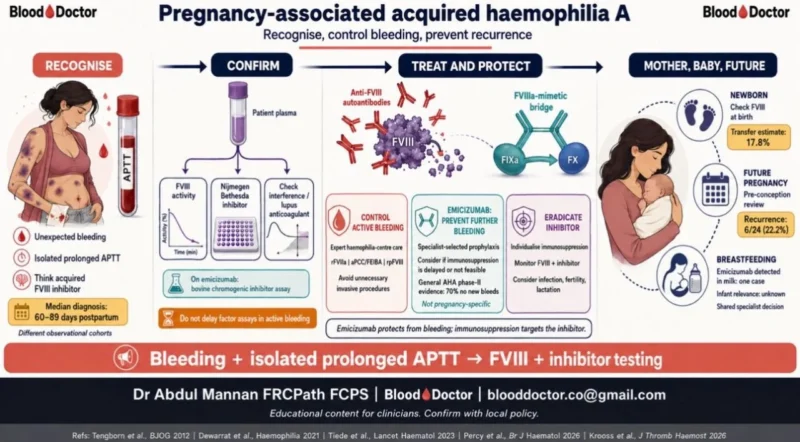
An isolated prolonged APTT is a diagnostic alarm, not a laboratory nuisance.
Pregnancy-associated acquired haemophilia A is rare, but it often presents weeks after delivery, when the patient has left maternity care.
For trainees and front-line teams, the first move is simple:
- Ask why the APTT is prolonged
- Send FVIII activity and a Nijmegen Bethesda inhibitor assay early
- In active bleeding, involve the haemophilia centre and specialist coagulation laboratory
- Control active bleeding and eradicate the inhibitor as linked, but separate, goals
Emicizumab now belongs in this conversation.
It is a specialist-selected option to prevent further bleeding in acquired haemophilia A, especially when immunosuppression is delayed or not feasible.
But it does not eradicate the inhibitor. And if it is used, laboratory monitoring must change: use a bovine chromogenic inhibitor assay.
For pregnancy and breastfeeding, be honest about the evidence gap.
The 2023 GTH-AHA-EMI study was not pregnancy-specific.
A 2026 postpartum case found emicizumab in breast milk, but we still do not know the clinical effect of infant exposure.
The practical message: do not miss the APTT, do not delay specialist input, and do not let a new therapy blur the difference between haemostatic protection and inhibitor eradication.
How does your maternity, emergency or coagulation service flag delayed postpartum bleeding with an isolated prolonged APTT?
Evidence: Percy et al., British Journal of Haematology 2026; Tiede et al., Lancet Haematology 2023; Dewarrat et al., Haemophilia 2021; Krooss et al., Journal of Thrombosis and Haemostasis 2026.”
Stay updated with Hemostasis Today.
-
Sep 15, 2026, 17:33Reza Shojaei: Blood and Plasma Donors Are Not a Production Metric
-
Sep 15, 2026, 17:32Thomas Dayspring: MHT for Vasomotor Symptoms May Also Offer Cardiovascular Benefits
-
Sep 15, 2026, 17:31Rebecca Risman: Deciphering the Mechanisms of Fibrinolysis in Contracted Clots
-
Sep 15, 2026, 17:31Clare Tower: 30 Times Higher Does Not Tell the Whole Story
-
Sep 15, 2026, 17:29Erica Wood: Looking Forward to the Webinar on Future Directions in Haemovigilance
-
Sep 15, 2026, 17:28Caitlin Raymond: Can an Antibody Screen Tell You If a Transfusion Will Actually Hurt Your Patient?
-
Sep 15, 2026, 17:28Rachel Margolis-Goodman: When Conventional Treatment Could Not, Research Found an Answer
-
Sep 15, 2026, 17:27Carly Newton: Closing the Gap in Sickle Cell Disease Readmissions
-
Sep 15, 2026, 17:26Jared Rice: Understanding Extreme Platelet Counts in Preterm Infants