


Akshat Jain: Does Mitapivat Translate to Clinical Benefit in SCD?
Akshat Jain, Hematology Pediatric Workforce Task Force at American Society of Hematology, shared a post on LinkedIn:
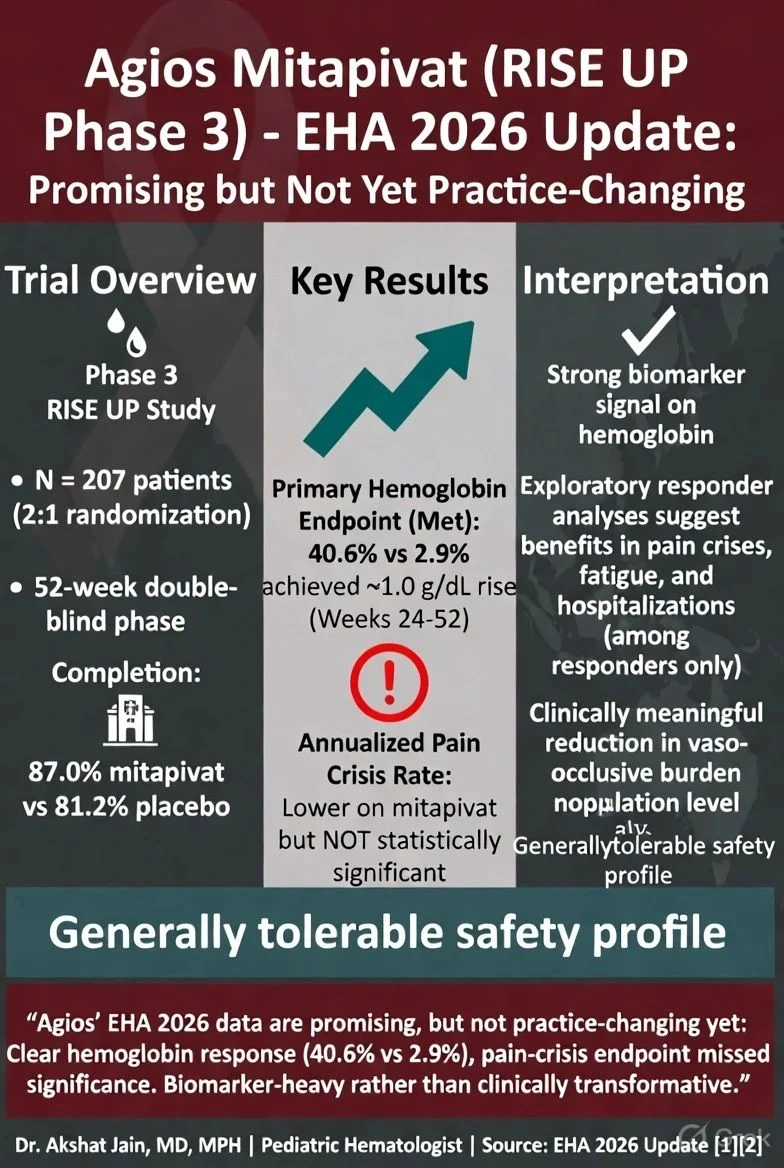
“2026 data are promising, but not practice-changing yet:
I had high hopes for this drug,but am disappointed because the most clinically important endpoints did not meet statistical significance.
Knowing that a small rise in hemoglobin doesnt always translate into life changing VOC reduction in the Real World especially while adjudicating risk and benefit (adverse effects of PKAs), this readout confirms why pain crisis end point did not meet statistically signifance and more importantly reduction in fatigue despite rise in hemoglbin in <50% subjects.
In the Phase 3 RISE UP study, mitapivat met the primary hemoglobin-response endpoint, with 40.6% of treated patients achieving a hemoglobin rise of at least 1.0 g/dL from Weeks 24 to 52 versus 2.9% on placebo, but the annualized pain-crisis endpoint did not reach statistical significance- That matters in Sickle Cell Disease, because hemoglobin improvement is biologically interesting, but patients and clinicians ultimately care most about whether the drug meaningfully reduces vaso-occlusive burden, fatigue, and hospitalizations in a durable way.
We are compelled to exercise caution in the interest of accuracy and not overstate the true treatment effect in SCD given the painful journey from recent drug fails,that warrioirs have to endure, but I remain hopeful that another formulation addresing PK pathway will come along ,showing statistical significant reduction in pain crisis.
We await the manuscript to see abut my takeaway from European Hematology Association (EHA) 2026 is: Pyruvate kinase looks promising, appears generally tolerable, and may help a subset of patients, but the current dataset still does not justify calling it a practice-changing sickle cell therapy without seeing the full peer-reviewed analysis and long-term real-world benefit.”
Stay updated with Hemostasis Today.
-
Nov 15, 2026, 10:32Ibrahim Gwarzo: Identifying Care Gaps and Emergency Pain Delays in Sickle Cell Disease at APHA 2026
-
Nov 15, 2026, 10:17Ify Osunkwo: How the Sickle Cell Community Can Influence FDA Drug Development Priorities
-
Nov 15, 2026, 10:11Ahmed Abdelsalam: Why Matching ABO and RhD Groups Does Not Guarantee Crossmatch Compatibility
-
Nov 15, 2026, 10:06Asma Khalil: New British Society for Haematology Guidance on Paediatric and Neonatal Transfusion
-
Nov 15, 2026, 09:41Girishkumar Modi: Navigating the 2026 Jehovah’s Witness Transfusion Policy Shift in Clinical Practice
-
Nov 15, 2026, 04:31Aakriti Gupta: Anticoagulation for Leaflet Thickening After TAVR
-
Nov 14, 2026, 23:57Jamie S. Y. Ho: Exploring the Mechanisms of Arterial Thrombosis and the Evolution of Antithrombotic Therapy
-
Nov 14, 2026, 23:53Jacopo Imberti: The Past, Present and Future of Arterial Thrombosis Research
-
Nov 14, 2026, 23:48Shrouk Ramadan: Joining the Editorial Review Board of Clinical and Applied Thrombosis and Hemostasis