

Arun V. J.: Did You Know A Glass Of Water is The Best Way To Retain A Blood Donor?
Arun V. J., The Leader of Transfusion Medicine at Malabar Medical College, shared a post on LinkedIn:
“Did You Know A Glass Of Water Is The Best Way To Retain A Blood Donor?
A glass of water before donation prevents more problems than a doctor on standby.
Most blood donation camps get the basics wrong. Not because of bad intentions. Because nobody taught the organisers what “good” looks like.
I’ve helped organise enough camps to see the same mistakes repeat. Donors waiting in long lines with no water. Registration forms filled in the open where everyone can see. First-time donors left alone with their anxiety. No follow-up after the camp ends.
The camp collects 30 units and everyone calls it a success. But fifteen people walked away before donating. Eight of them won’t come back. Three had reactions that a glass of water could have prevented.
The fix is not budget. It’s sequence.
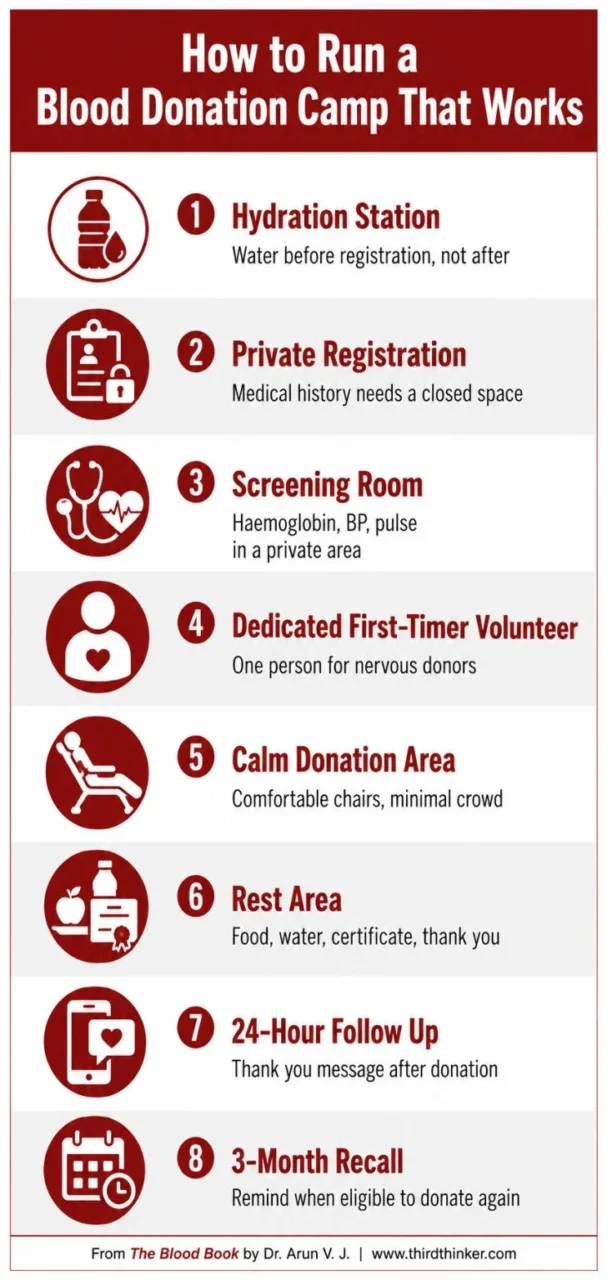
Hydration comes before registration. Every donor drinks water before anything else. A hydrated donor is significantly less likely to feel dizzy during or after donation.
Registration needs a private space. The form asks about medications, sexual history, recent illnesses. Nobody answers honestly at an open table where fifty people are watching.
Screening happens behind a partition. Haemoglobin, blood pressure, pulse, temperature. The result is shared clearly. ‘Your haemoglobin is 13.2, you’re eligible.’ Not just ‘you’re fine.’ Specific numbers calm nervous donors.
First-time donors get one dedicated volunteer. Someone who walks with them through every step, stays nearby during donation, and checks on them during rest. Twenty minutes of one volunteer’s attention. What it gives you is a donor who feels cared for and comes back.
The rest area is not an afterthought. Food, water, a certificate, a genuine thank you. The last ten minutes of the camp decide whether the donor remembers the experience as pleasant or stressful.
Follow up within 24 hours. ‘Thank you for donating. Please rest and stay hydrated. Your donation will support patients at [hospital name].’
Follow up again at three months. ‘You’re now eligible to donate again. Our next camp is on [date]. Would you like to come?’
Most camps never send this message. That’s exactly where repeat donors are made.
A camp is not a one-day event. It’s a system. The organisations that build it as a system never struggle with donor numbers.
I covered the complete camp framework in Chapter 14 of The Blood Book.
And this is exactly the kind of thinking I write about in my fortnightly newsletter, The Doctor Who Builds. How doctors can go beyond the clinic and build systems, programmes, and communities that outlast them.”
Find more posts featuring Arun V. J. on Hemostasis Today.
-
Nov 25, 2026, 08:57Ndembe Djeni Erwan: Sickle Cell Disease Awareness and Stigma Among Medical Students in Cameroon
-
Nov 25, 2026, 08:27Rana Zareef: Early Right Ventricular Remodeling in Pediatric Sickle Cell Disease
-
Nov 25, 2026, 08:08Jae Hyun Byun: Single-Cell Insights Into Carotid Atherosclerosis and Stroke Risk
-
Nov 25, 2026, 07:02Nicola Ammirabile: New Evidence in Structural Heart Interventions at PCR London Valves 2026
-
Nov 25, 2026, 05:58Paris Margaritis: Are LSECs the Panacea for FVIII Gene Therapy?
-
Nov 25, 2026, 05:53Rahul Kaushik: Challenging the “One-and-Done” Rule in AAV Gene Therapy
-
Nov 25, 2026, 05:45Michela Milani: WFH New Technology and Gene Therapy Workshop 2026
-
Nov 25, 2026, 05:37Ross Baker: How a WA Health Innovation is Changing Women’s Blood Health
-
Nov 25, 2026, 02:17Ahmad G. Alzahrani: Why Iron Is Low Despite High Ferritin in Inflammatory Anemia?