


Aryabhatta Sadhu: Which Part of Haemostasis Has Failed First?
Aryabhatta Sadhu, Attending Consultant and Head of Transfusion Medicine at Fortis Hospital Shalimar Bagh, New Delhi, shared a post on LinkedIn:
“A bleeding patient with ‘acceptable’ platelets can still be haemostatically unsafe.
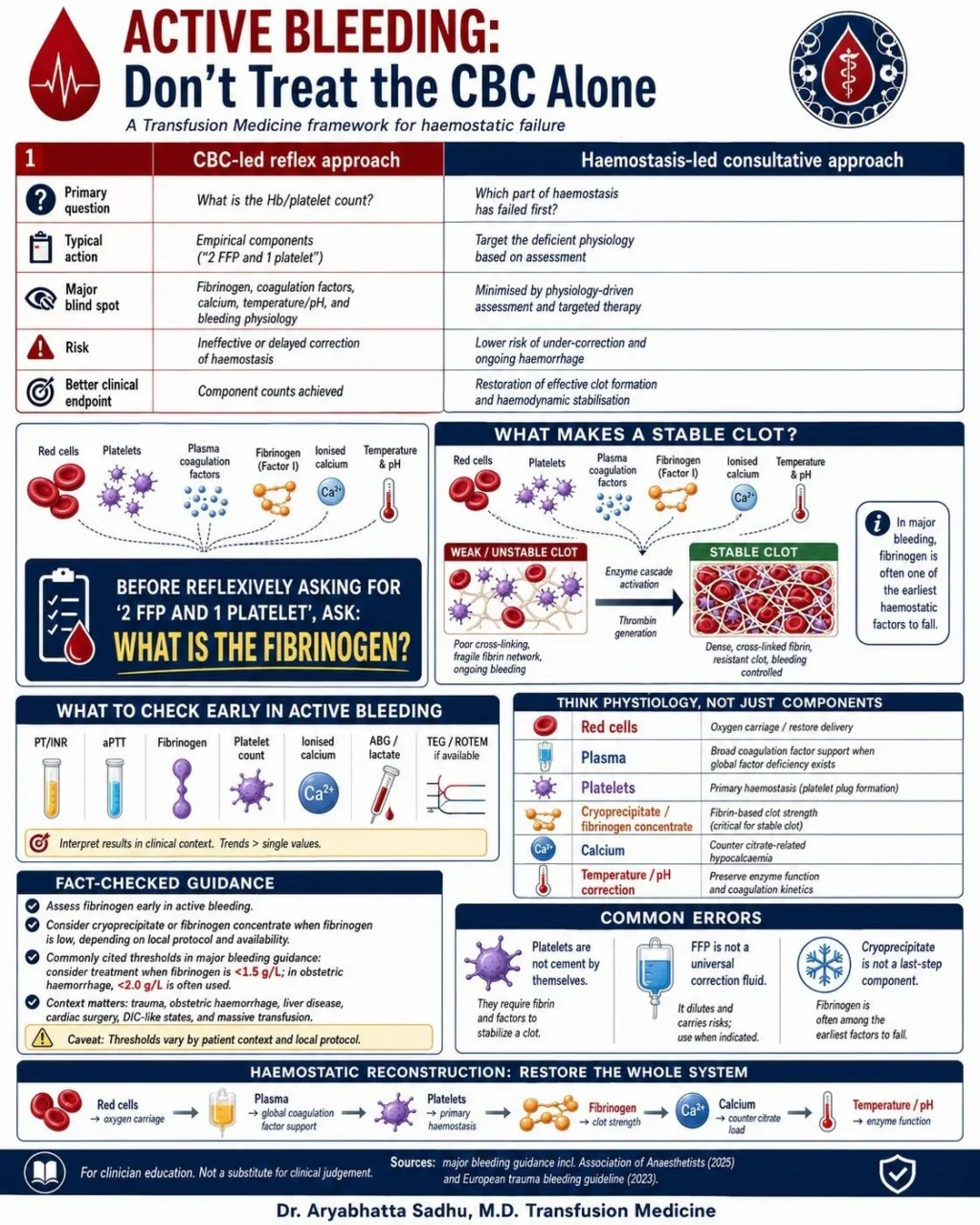
One common error in active bleeding is looking at haemoglobin and platelet count first, while fibrinogen is checked late – or corrected even later.
That is backwards physiology.
In major bleeding, fibrinogen is often one of the earliest haemostatic factors to fall.0
A patient may have a platelet count of 70,000–90,000/µL and still continue bleeding because the clot being formed has poor fibrin strength.
The clinical decision point is simple:
Before reflexively asking for ‘2 FFP and 1 platelet,’ ask:
What is the fibrinogen?
If the patient is actively bleeding and fibrinogen is low, correction with cryoprecipitate or fibrinogen concentrate should be considered early, depending on local availability and protocol.
This is even more critical in obstetric haemorrhage, trauma, liver disease, cardiac surgery, DIC-like states, and massive transfusion scenarios.
Platelets are not cement by themselves.
FFP is not a universal correction fluid.
Cryoprecipitate is not a ‘last step’ component.
A bleeding patient needs haemostatic reconstruction: red cells for oxygen carriage, plasma factors when coagulation is globally impaired, platelets when primary haemostasis is inadequate, fibrinogen when clot strength is failing, calcium when citrate load rises, and temperature/pH correction because enzymes do not work in a hostile physiology.
Practical takeaway:
In active bleeding, do not treat the CBC alone.
Ask for:
- PT/INR
- aPTT
- fibrinogen
- platelet count
- ionised calcium
- ABG/lactate
- TEG/ROTEM if available
The question is not ‘Which blood component is pending?’
The question is:
Which part of haemostasis has failed first?
That is where Transfusion Medicine must move beyond blood issue and function as bedside haemotherapy consultation.”
Other posts featuring Aryabhatta Sadhu with Hemsotasis Today.
-
Sep 22, 2026, 19:02Blocking Histone-Induced Platelet-Erythrocyte Interactions With Polyanions – Platelets Journal
-
Sep 22, 2026, 18:49Abdul Rahman Hamad: Early Action for Better Outcomes in Deep Vein Thrombosis
-
Sep 22, 2026, 18:37Carmine Siniscalchi: Age-Adjusted D-Dimer Cutoffs in DVT Diagnosis
-
Sep 22, 2026, 18:37Stefano Romeo: The Cardiovascular Patient Journey is Still Full of Gaps
-
Sep 22, 2026, 18:11Bharath Kumar V.։ Advancing Safer Anticoagulation for Cancer-Associated Thrombosis
-
Sep 22, 2026, 18:10Fatima Zahra: ASH Released New Guidelines on the Diagnosis of Iron Deficiency
-
Sep 22, 2026, 17:49Nirav Dhanesha: Targeting FXI for Safer Anticoagulation
-
Sep 22, 2026, 17:17Eric Lambert: Intravascular Imaging and the Future of Precision PCI
-
Sep 22, 2026, 16:45Claudiu Stoicescu: Are We Starting Cardiovascular Risk Assessment Too Late?