

Basyouni Omran: Clinical Guidance on Antiplatelet Use in Acute Ischemic Stroke
Basyouni Omran, ICU Registrar at Andalusia Health KSA, shared a post on LinkedIn about a recent article by Shyam Prabhakaran et al, published in Stroke, adding:
“Acute Ischemic Stroke: Antiplatelet Therapy – When and What?
Antiplatelet therapy is essential for secondary stroke prevention.
The choice and timing depend on stroke severity, thrombolysis status, and bleeding risk.
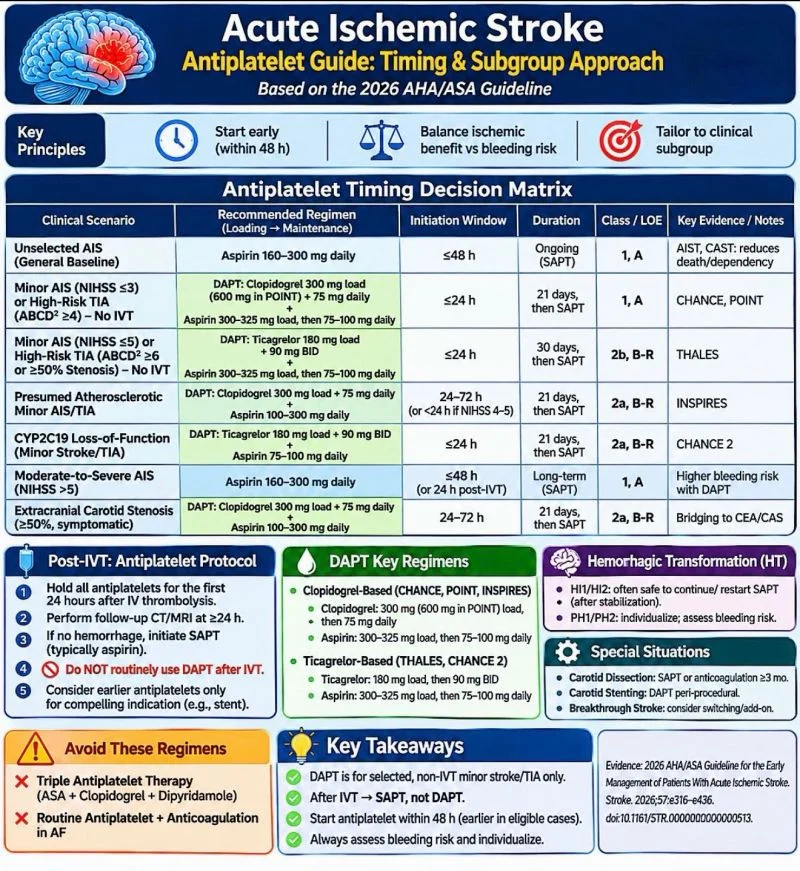
1. General Approach
- Start within 48 hours when appropriate.
- Assess ischemic versus bleeding risk.
- Individualize treatment.
2. Antiplatelet Strategies
Minor AIS (NIHSS less than or equal to 3) / High-risk TIA
- Aspirin plus Clopidogrel.
- Loading: Clopidogrel 300 mg plus Aspirin 300–325 mg.
- Maintenance: Clopidogrel 75 mg plus Aspirin 75–100 mg daily.
- Duration: 21 days, then SAPT.
Minor AIS (NIHSS less than or equal to 5) / High-risk TIA
- Aspirin plus Ticagrelor.
- Loading: Ticagrelor 180 mg plus Aspirin 300–325 mg.
- Maintenance: Ticagrelor 90 mg BID plus Aspirin 75–100 mg.
- Duration: 30 days, then SAPT.
Moderate–Severe AIS (NIHSS more than 5)
- Aspirin 160–300 mg.
- Long-term SAPT.
- Avoid routine DAPT.
3. After IV Thrombolysis
- Withhold antiplatelets for 24 hours.
- Repeat CT/MRI after greater than or equal to 24 hours.
- If no hemorrhage, initiate SAPT.
- Avoid routine DAPT after IVT.
4. Special Situations
- Hemorrhagic transformation: Individualize treatment.
- Carotid stenting: DAPT peri-procedurally.
- Carotid dissection: SAPT or anticoagulation.
- Breakthrough stroke: Reassess mechanism and therapy.
Avoid
- Routine triple antiplatelet therapy.
- Routine antiplatelet plus anticoagulation in AF without another indication.
Key Takeaways
- Early treatment when eligible.
- DAPT only for selected minor stroke/TIA patients.
- After IVT, wait 24 hours and exclude hemorrhage.
- Short-term DAPT followed by SAPT.
- Always assess bleeding risk.”
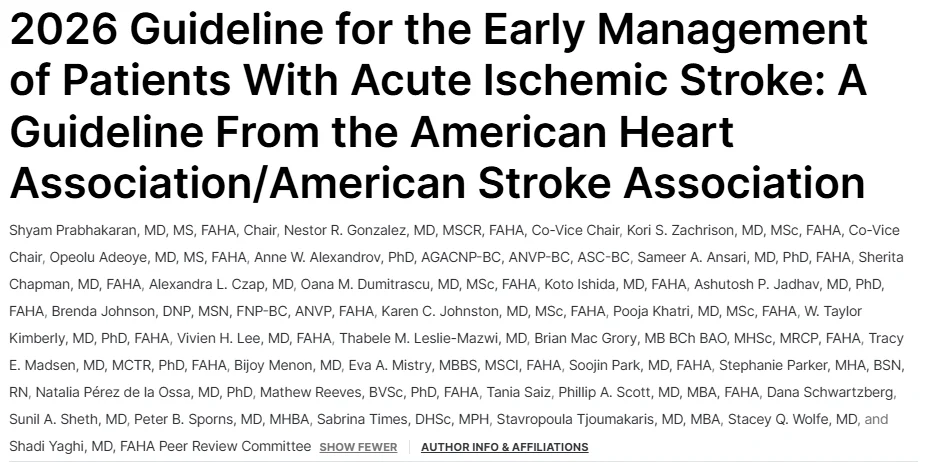
Title: 2026 Guideline for the Early Management of Patients With Acute Ischemic Stroke: A Guideline From the American Heart Association/American Stroke Association
Authors: Shyam Prabhakaran, Nestor R. Gonzalez, Kori S. Zachrison, Opeolu Adeoye, Anne W. Alexandrov, Sameer A. Ansari, Sherita Chapman, Alexandra L. Czap, Oana M. Dumitrascu, Koto Ishida, Ashutosh P. Jadhav, Brenda Johnson, Karen C. Johnston, Pooja Khatri, W. Taylor Kimberly, Vivien H. Lee, Thabele M. Leslie-Mazwi, Brian Mac Grory, Tracy E. Madsen, Bijoy Menon, Eva A. Mistry, Soojin Park, Stephanie Parker, Natalia Pérez de la Ossa, Mathew Reeves, Tania Saiz, Phillip A. Scott, Dana Schwartzberg, Sunil A. Sheth, Peter B. Sporns, Sabrina Times, Stavropoula Tjoumakaris, Stacey Q. Wolfe, Shadi Yaghi
Stay updated with Hemostasis Today.
-
Nov 24, 2026, 14:55Cecilia Kretz: Evaluating Aspirin-Free Antithrombotic Strategies in HeartMate 3 Patients
-
Nov 24, 2026, 14:54The Future of Global Hemophilia Care and the Impact of the World Health Assembly Resolution
-
Nov 24, 2026, 14:39Andrija Velevski: Why Oxygen Availability Does Not Guarantee Tissue Oxygenation
-
Nov 24, 2026, 14:07Mohamed Sherif Salem: AHA 2026 Recommendations for Antiplatelet Management in Acute Ischemic Stroke
-
Nov 24, 2026, 13:03Nikolaj Nytofte: Uncovering a Hidden Genetic Cause of Recurrent Venous Thromboembolism
-
Nov 24, 2026, 11:42Claudia Colombo: Early Clinical Outcomes Following Ultrasound-Assisted Thrombolysis in Pulmonary Embolism
-
Nov 24, 2026, 11:08Abuzar Rezaee: Improving Pulmonary Embolism Detection Through Better Data Annotation
-
Nov 24, 2026, 07:01Jesse Solar: Raising Awareness About Blood Clots and Pulmonary Embolism
-
Nov 24, 2026, 06:55Lisa-Marie Müller: Acute Pulmonary Embolism Outcomes in Germany