


Burhan Ullah/LinkedIn
Jun 8, 2026, 14:05
Burhan Ullah: The Expanding Role of Hematology Analyzers in Disease Detection and Monitoring
Burhan Ullah, Medical Laboratory Technologist of Chughtai Lab, shared a post on LinkedIn:
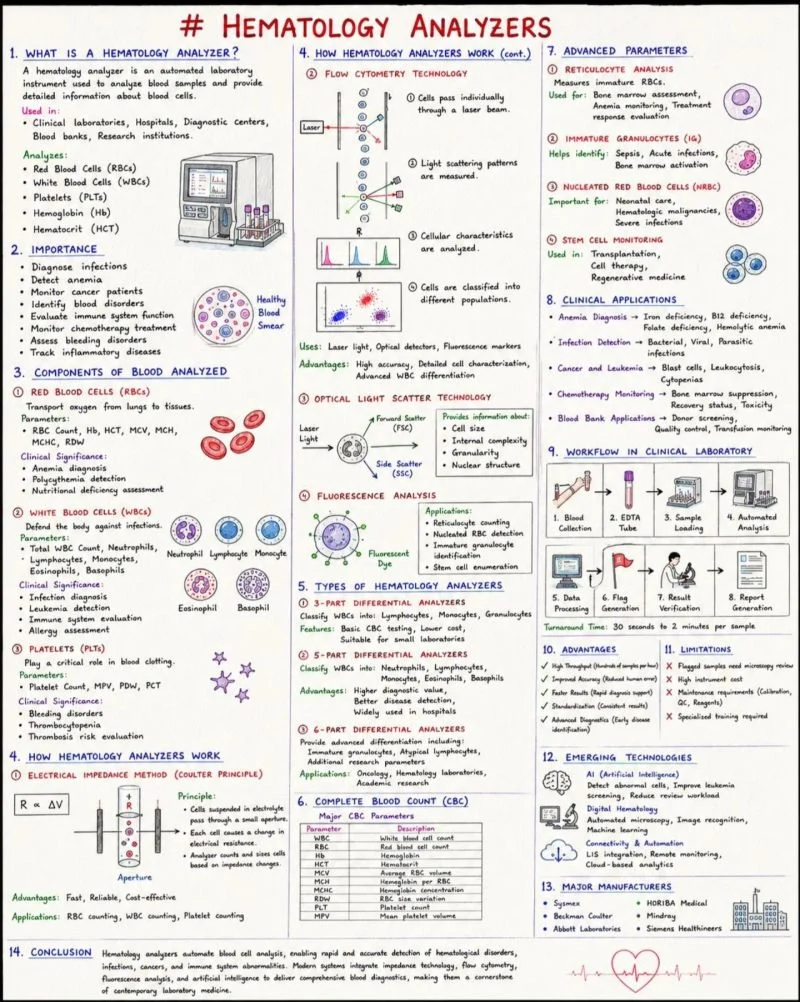
“Hematology Analyzers: The Heart of Modern Labs.
What is it?
- Automated instrument that analyzes blood cells fast and accurately.
- Used in: Clinical labs, hospitals, blood banks, research centers.
- Measures: RBCs, WBCs, Platelets, Hb, HCT
Why It’s Critical?
- Diagnose infections, anemia, blood disorders
- Monitor cancer patients and chemotherapy
- Assess immune function and bleeding risk
- Detect leukemia and inflammatory diseases
Key Blood Components Analyzed
- RBCs – O₂ transport | Params: RBC, Hb, HCT, MCV, MCH, MCHC, RDW | Detects: Anemia, polycythemia
- WBCs – Fight infection | Params: Neut, Lymph, Mono, Eos, Baso | Detects: Infection, leukemia, allergies
- Platelets – Blood clotting | Params: Count, MPV, PDW, PCT | Detects: Bleeding disorders, thrombosis
How It Works?
- Coulter Principle – Cells pass aperture, change resistance – Counts/sizes RBC and PLT. Fast and reliable.
- Flow Cytometry – Laser plus light scatter – Cell size and complexity – 5-part WBC diff. High accuracy.
- Fluorescence – Reticulocytes, NRBC, immature granulocytes, stem cells
Analyzer Types
- 3-part diff: Lymph, Mono, Granulocytes | Basic, low cost
- 5-part diff: Neut, Lymph, Mono, Eos, Baso | Hospital standard, better diagnosis
- 6-part diff: plus Immature granulocytes, atypical cells | Oncology and research
Key CBC Parameters
WBC, RBC, Hb, HCT, MCV, MCH, MCHC, RDW, PLT, MPV
Advanced Diagnostics
- Reticulocytes – Bone marrow function, anemia monitoring
- IG (Immature Granulocytes) – Sepsis, acute infections
- NRBC – Neonatal care, malignancies
- Stem Cells – Transplant, cell therapy
Clinical Applications
- Anemia: Iron/B12/Folate deficiency
- Infections: Bacterial, viral, parasitic
- Cancer: Blast cells, leukocytosis
- Chemo monitoring: Marrow suppression, toxicity
- Blood bank: Donor screening, transfusion safety
Lab Workflow
Blood draw – EDTA tube – Load – Auto analysis – Flags – Verify – Report
TAT: 30 sec – 2 min per sample
Pros versus Cons
- Pros: High throughput, accuracy, speed, standardization, early detection
- Cons: Flags need microscopy, high cost, maintenance, training required
Future of Hematology
- AI: Detect abnormal cells, leukemia screening
- Digital Hema: Auto microscopy, image recognition
- Automation: LIS integration, cloud analytics, remote monitoring
Top Manufacturers
- Sysmex
- Beckman Coulter
- Abbott
- Siemens Healthineers
- Mindray
- HORIBA
Bottom Line
Modern analyzers combine impedance, flow cytometry, fluorescence and AI for rapid, accurate blood diagnostics.
They’re the cornerstone of lab medicine.”
Stay updated with Hemostasis Today.
-
Oct 23, 2026, 17:45Lucy Brook: Had the Privilege of Attending the Blood 2026 Conference with New Zealand Blood Service
-
Oct 23, 2026, 16:05Platelet Secretion Defects and Their Role in the Diagnosis of Bleeding Disorders
-
Oct 23, 2026, 16:00Hemophilia Alliance team in New Orleans at the ATHN Data Summit
-
Oct 23, 2026, 15:49Brian Sapp: Why Exact Calf Vein Naming Is Critical for DVT Diagnosis?
-
Oct 23, 2026, 15:33Smitirupa Mishra: A Systematic Approach to Bone Marrow Examination
-
Oct 23, 2026, 15:29José Antonio García Erce: Preoperative Anemia Emerges as a Modifiable Surgical Risk in New POWER Study
-
Oct 23, 2026, 15:13Reza Shojaei: Manufactured Red Blood Cells vs Blood Donation
-
Oct 23, 2026, 14:29Jean Jacques Kiladjian: International Scientific Exchange at IHCAMS in Tianjin
-
Oct 23, 2026, 14:11Aravind Palraj: The Prolonged aPTT Puzzle in SLE