

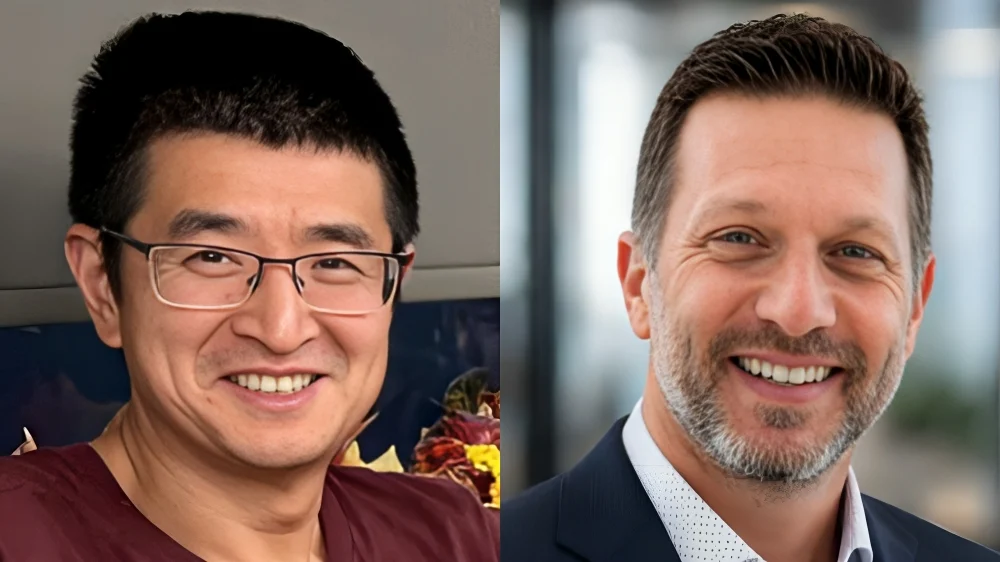
Chengyong Yang: Can Plasma Reveal Cell Specific Signals
Chengyong Yang, Founder at Ascend Biosciences, shared Sarantis Chlamydas‘ post on LinkedIn, adding:
“The interesting part here isn’t the clock – it’s that plasma can resolve cell-type signal at all.
Plasma is a bulk mixture.
Getting cell-specific information out of it only becomes possible once you’re measuring enough proteins that tissue-of-origin signatures start to separate.
That’s a threshold effect, and it’s why this kind of work wasn’t feasible with 50-plex panels a few years ago.
We run Olink panels day to day, and this is a good illustration of why breadth matters even when you think you know which proteins you care about.
The finding here isn’t in any single marker – it’s in the pattern across hundreds of them.
The open question, as with every aging clock: does it move when you intervene?
Cross-sectional association with chronological age is the easy part.
A clock that shifts in response to treatment is a different and much more valuable thing.”
Sarantis Chlamydas, Head of Human Health and MultiOmics Strategy at Thermo Fisher Scientific, shared a post on LinkedIn:
“What if we could measure how fast our cells are aging?
A new Nature Medicine study using Olink proteomics takes a major step in that direction developing protein-based clocks that capture aging at the cellular level.
The future of biological age may be cell-specific.”
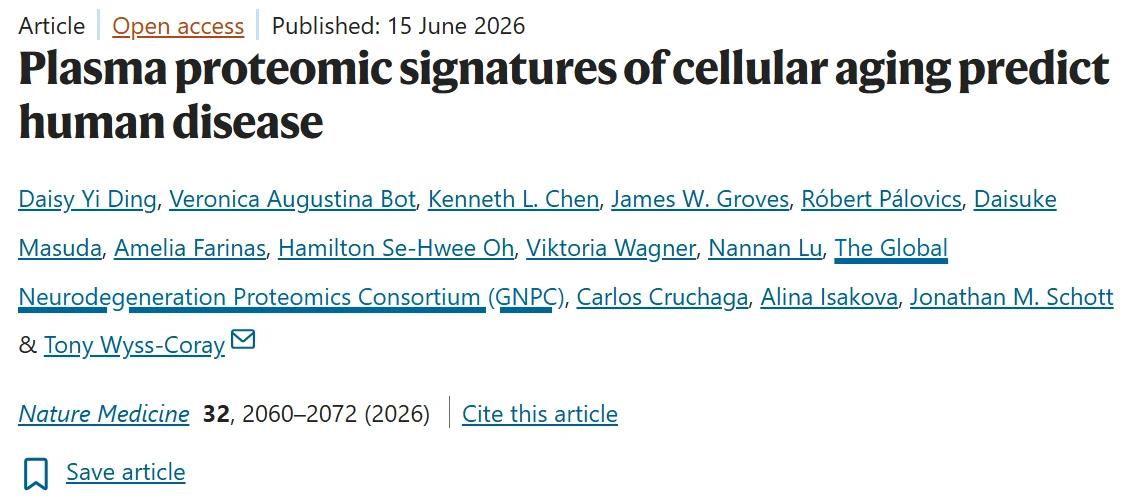
Title: Plasma proteomic signatures of cellular aging predict human disease
Authors: Daisy Yi Ding, Veronica Augustina Bot, Kenneth L. Chen, James W. Groves, Róbert Pálovics, Daisuke Masuda, Amelia Farinas, Hamilton Se-Hwee Oh, Viktoria Wagner, Nannan Lu, Carlos Cruchaga, Alina Isakova, Jonathan M. Schott, Tony Wyss-Coray
Stay uodated with Hemostasis Today.
-
Sep 28, 2026, 16:43Scott Sutton: Community and Connection in Immune Thrombocytopenia
-
Sep 28, 2026, 16:24Pankti Solanki: ISBT Recognized JAMA as the 49th Human Blood Group System
-
Sep 28, 2026, 15:52Kassa Tameru: Antithrombotic Management in GI Bleeding and Elective Endoscopy
-
Sep 28, 2026, 15:51Chengappa Kavadichanda: How Do aPLs Change Over Time in Early Lupus?
-
Sep 28, 2026, 15:18Linda Shore-Lesserson: Celebrating 25 Years of PBM at the SABM Meeting
-
Sep 28, 2026, 14:45Access Real-Time Bleeding Disorder Guidelines with the New WFH Resource Hub – WFH
-
Sep 28, 2026, 14:44Subham Banerjee: When Routine Blood Grouping Hid a Rare Diagnosis
-
Sep 28, 2026, 14:41Francois Roubille: Can Low-Dose Colchicine Prevent Atrial Fibrillation After CABG?
-
Sep 28, 2026, 14:39William Aird: Gulliver’s Atlas – Mapping the Evolution of the Vertebrate Red Cell